

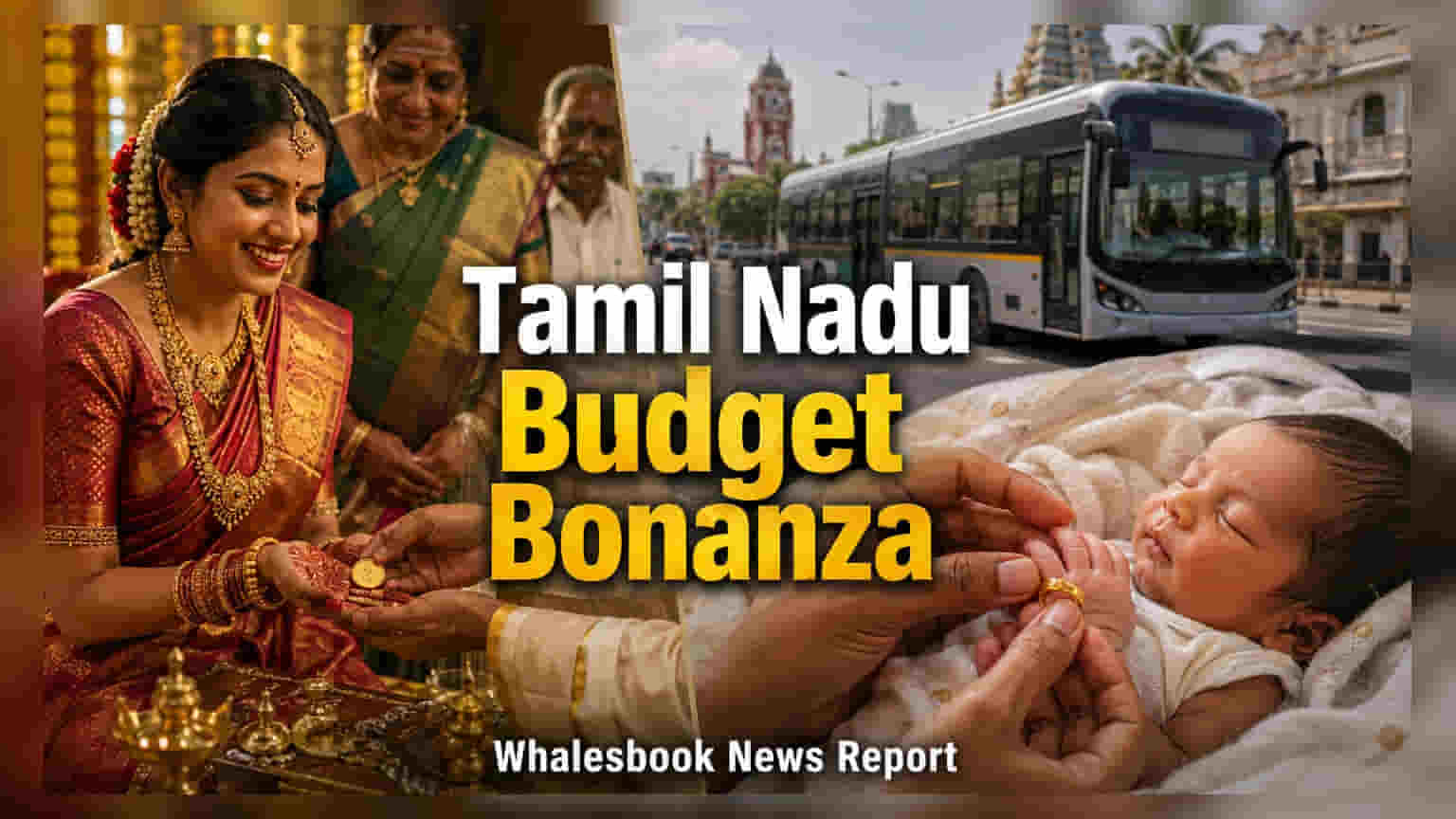
The Tamil Nadu government has presented its 2026-27 budget, focusing on major social welfare schemes and transport infrastructure. The plan includes gold gifts for brides and newborns, alongside a push for 1,000 new electric buses in Chennai. Investors are focusing on the state's fiscal health and the potential for new infrastructure contracts.
The Tamil Nadu government, led by Chief Minister C. Joseph Vijay, presented its 2026-27 state budget on Wednesday, outlining a significant focus on social welfare and public transport infrastructure. Finance Minister N. Marie Wilson announced the spending plan, which includes substantial allocations for family support schemes and a major upgrade to the public bus fleet in Chennai.
Among the highlights, the budget sets aside ₹812 crore for the 'Annan Seer' scheme, which provides an eight-gram gold coin and a silk saree to eligible brides. Additionally, the government has earmarked ₹560 crore to provide a one-gram gold ring to newborns delivered in government hospitals, an initiative aimed at encouraging public health facility utilization. Other allocations include subsidies for livestock to help vulnerable groups, including widows and persons with disabilities, as part of the state's broader rural livelihood efforts.
From an infrastructure perspective, the government plans to add 1,000 new air-conditioned electric buses to the Chennai Metropolitan Transport Corporation's fleet. These buses will be procured under the Gross Cost Contract (GCC) model. Under this model, the government pays a service fee to private operators to run the buses, rather than bearing the entire upfront cost of purchasing and maintaining the vehicles. This approach is increasingly used by state transport corporations across India to modernize fleets while managing capital expenditure pressures.
While the budget signals a push for infrastructure and social development, it also highlights the challenge of balancing high-volume welfare spending with the state’s overall debt and fiscal deficit. Financial analysts often monitor such state budgets for potential pressure on government finances, which can limit the space for long-term capital investments.
Investors tracking the infrastructure and automotive sectors will likely watch for the tender process and final contracts regarding the 1,000 electric buses. The success of this project will depend on the government’s ability to execute these contracts on time, as previous bus procurement programs in various states have sometimes faced delays due to funding or operational hurdles. The next important step for market participants will be the release of formal tender documents and the timeline for fleet deployment.