 Whalesbook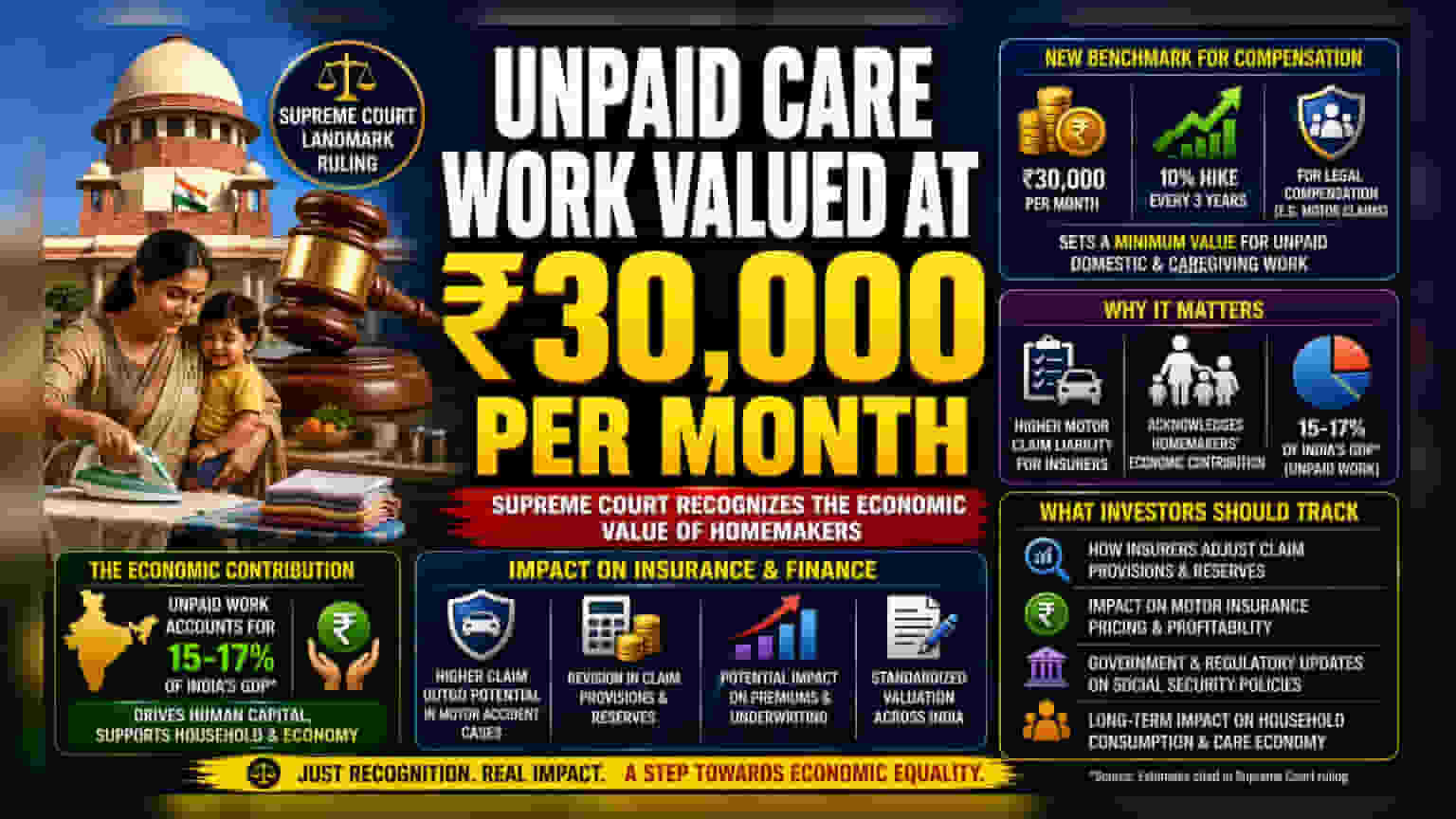


The Supreme Court has mandated a minimum Rs 30,000 monthly valuation for unpaid homemaker labor, primarily for calculating motor accident compensation. This landmark ruling formally acknowledges the economic weight of domestic work, estimated at 15-17% of India's GDP. Investors should monitor the potential impact on insurance sector claim payouts, evolving social policies, and the broader shift toward integrating household economic contributions into formal financial frameworks.
What Happened
The Supreme Court of India has issued a landmark ruling establishing a minimum monetary value of Rs 30,000 per month for unpaid domestic and caregiving work. This valuation is primarily intended for compensation calculations in legal matters, such as motor accident claims where a homemaker is the victim. The court further directed that this figure should be subject to a 10% increase every three years to account for inflation and economic shifts. This judgment formally recognizes the often-uncounted economic contribution of homemakers, who perform essential tasks that support the broader workforce and household stability.
Why This Matters for Insurance and Finance
For the insurance and financial sectors, this ruling introduces a significant shift in liability calculations. Motor insurance claims, a massive segment of the general insurance industry in India, rely on the "income" of the victim to determine compensation. Historically, valuing the work of homemakers—who do not have a formal salary—has been complex and often resulted in lower compensation awards. By establishing a clear, standardized monthly value, the court has set a new floor for these payouts. General insurance companies may need to account for higher potential liabilities in their motor accident claim reserves as courts apply this new benchmark.
The Economic Context
The court’s decision highlights a major economic reality: household and caregiving labor, predominantly performed by women, is a massive but hidden part of the national economy. Estimates cited in the ruling suggest that this unpaid work accounts for approximately 15-17% of India’s Gross Domestic Product (GDP). Despite its scale, this contribution has traditionally been absent from conventional economic accounting and public policy discussions. By assigning a monetary value, the judiciary is pushing for this work to be acknowledged as a driver of human capital and economic productivity, rather than just personal or familial activity.
Potential Impact on Costs
While this ruling provides crucial social recognition, it carries financial implications for various stakeholders. For the insurance sector, increased compensation amounts in accident cases directly impact the cost of claims. If the industry faces a sustained increase in claim payouts, it could influence underwriting decisions or pricing strategies in the motor insurance segment. Furthermore, the court’s push for broader policy support—such as childcare services and social security—suggests a potential long-term trend toward government spending in these areas, which could influence fiscal policy and public service allocations.
What Investors Should Track
Investors and market participants may watch how insurance companies adjust their provisioning for motor accident claims in response to this new precedent. The key monitorable is whether the insurance industry seeks to balance these potential cost increases through premium adjustments or improved operational efficiency. Additionally, investors should monitor government and regulatory commentary regarding the integration of this valuation into wider social security or economic inclusion policies. The long-term impact on household consumption and the potential formalization of caregiving services remain important themes to track as the legal and policy landscape evolves.