

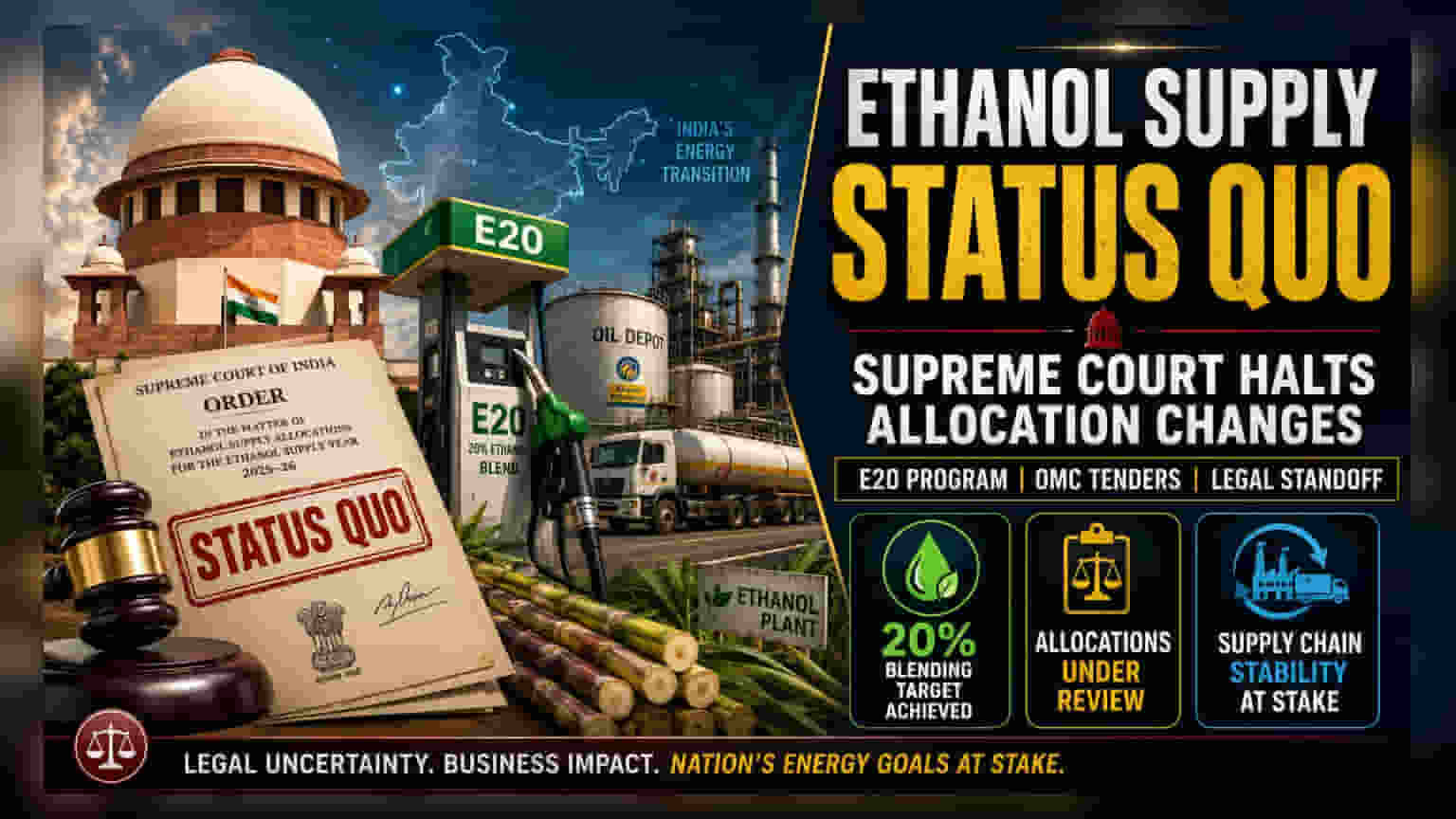
The Supreme Court has directed all parties to maintain status quo regarding ethanol supply allocations for the 2025-26 supply year. This follows an appeal by Bharat Petroleum Corporation (BPCL) against a Karnataka High Court order. The government has confirmed that the 20% ethanol blending program is a stable national policy, with the legal dispute centering on allocation procedures for specific suppliers.
What Happened
The Supreme Court has ordered a status quo on ethanol supply allocations for the 2025-26 Ethanol Supply Year (ESY). This decision follows a petition filed by state-run oil marketing company Bharat Petroleum Corporation Limited (BPCL). BPCL challenged a Karnataka High Court directive that had instructed oil marketing companies (OMCs)—including BPCL, Hindustan Petroleum (HPCL), and Indian Oil (IOC)—to reconsider a distillery's request for increased ethanol allocation before finalizing the tender process.
The Supreme Court bench, comprising Justices M.M. Sundresh and Sheel Nagu, issued the status quo order while hearing the plea. The court is now evaluating the consolidation of similar cases pending across various High Courts to prevent conflicting legal rulings and ensure continuity in the national ethanol procurement framework.
Why This Matters for the Ethanol Program
India’s Ethanol Blended Petrol (EBP) program is a national initiative aimed at enhancing energy security and reducing crude oil import dependency. The government successfully achieved the 20% ethanol blending target in December 2025. For the 2025-26 supply year, ethanol supply contracts were finalized in October 2025. These contracts involve allocations to hundreds of suppliers, forming a complex supply chain that supports the national blending roadmap.
Oil Marketing Companies argued that reopening or altering these finalized allocations for individual suppliers at this stage would destabilize the entire supply chain and could trigger a wave of similar litigations from other manufacturers. The current legal challenge highlights the complexities involved in managing large-scale, country-wide procurement contracts and the need for procedural consistency.
Clarifying Government Submissions
It is important to note that the government has explicitly clarified reports suggesting that the 20% ethanol blending program was described as an "ongoing experiment" during the court proceedings. The Office of the Attorney General for India stated that such reports are completely false and do not reflect the actual submissions made before the Supreme Court. The government maintains that the EBP program is a scientifically validated national initiative, and the Attorney General’s comments focused on the need to resolve ongoing litigation to prevent disruption to the national supply of ethanol.
Impact on Business and Supply
For integrated sugar companies and dedicated ethanol manufacturers, the predictability of these contracts is a vital revenue component. The ethanol procurement process, which transitioned toward more structured long-term offtake agreements, provides the assurance needed for distilleries to invest in capacity. Legal disputes that threaten to re-open finalized tenders create uncertainty for both OMCs managing the logistics and suppliers relying on these guaranteed volumes. Investors often monitor these policy frameworks because any major disruption to the procurement mechanism can impact the revenue visibility for ethanol-producing sugar firms.
What Investors Should Track Next
The next key development will be the Supreme Court’s decision on the transfer petitions, which would consolidate these legal matters. Investors may track the upcoming hearings to understand whether the current allocation framework remains stable for the remainder of the 2025-26 supply year. The continuity of the national ethanol blending program and the resolution of procurement disputes remain important monitorables for the sugar and bioenergy sectors.