

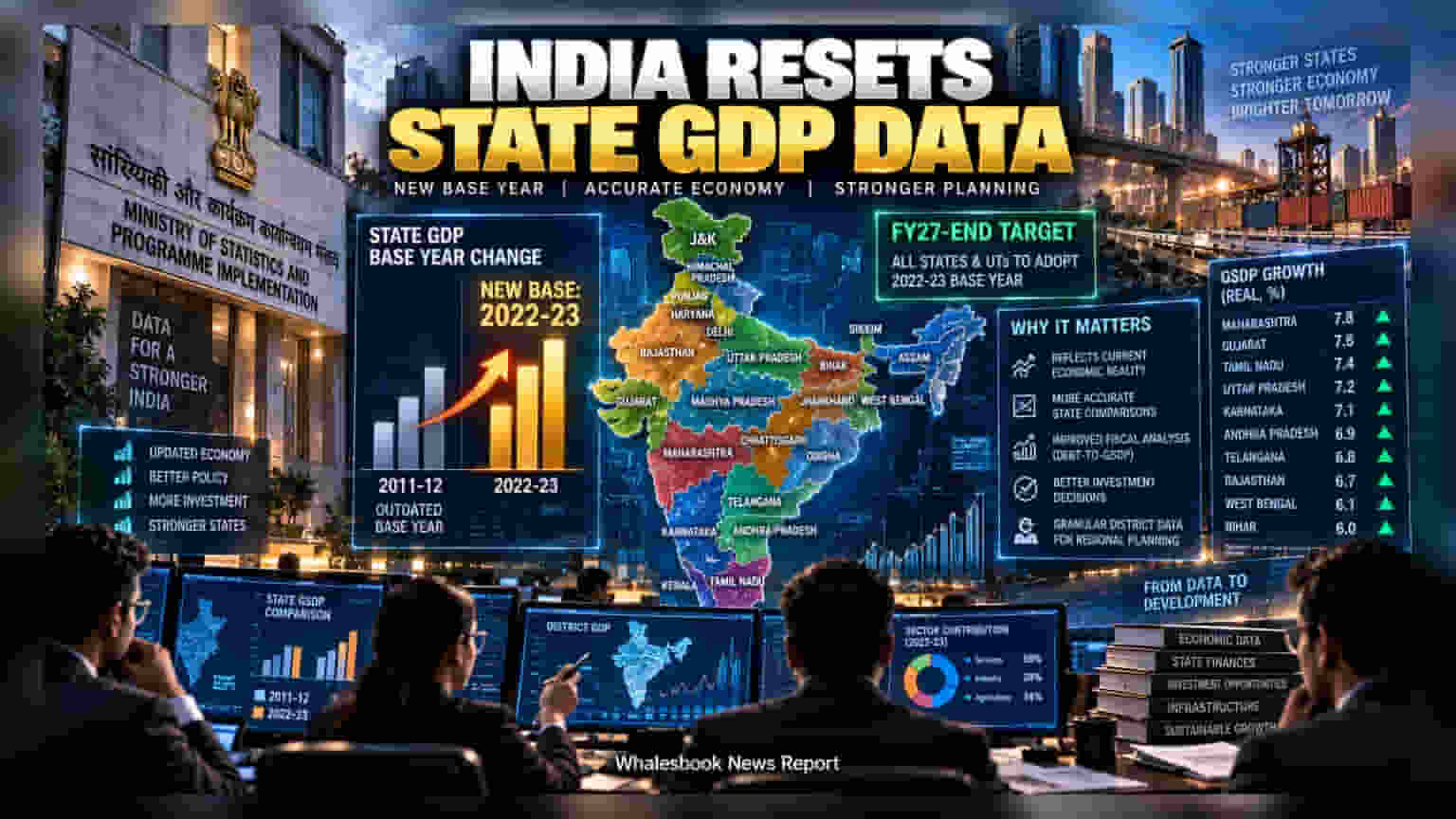
Indian states will adopt the 2022-23 base year for GSDP calculations by the end of FY27, aligning with the national series. This update improves economic comparability across states, but investors should watch for potential distortions in reported growth rates and fiscal ratios during the transition phase.
Indian states are moving toward a new benchmark for measuring their economic output. The Ministry of Statistics and Programme Implementation (MoSPI) has set a target for all states and Union Territories to shift their Gross State Domestic Product (GSDP) estimates to the 2022-23 base year by the end of FY27. This move is designed to sync state-level economic data with the Centre’s revised national accounts, which were officially updated in early 2026.
Why the Base Year Update Matters
Economic base years are periodically updated to reflect the evolving structure of the economy. The current 2011-12 base year, used by 34 states and Union Territories, is now over a decade old. Since then, the Indian economy has undergone significant structural changes, including rapid digitization, the expansion of the services sector, and massive infrastructure development. Updating the base year allows for a more accurate representation of the economy’s size and the contribution of different sectors. For investors, this ensures that the data they use to analyze state performance reflects current economic realities rather than outdated patterns.
Impact on Fiscal and Growth Analysis
For investors and credit analysts, this change is not just a statistical exercise; it has real-world implications for how we interpret a state’s financial health. When the base year changes, the nominal size of the economy is often revised. If a state’s GSDP is revised upward under the new series, its debt-to-GSDP ratio and fiscal deficit percentage—which are measured as a proportion of total economic output—might appear lower, even if the actual debt levels remain unchanged. This 'denominator effect' can change the way rating agencies and investors assess the fiscal sustainability of different states.
Investors must also be cautious about the 'base year effect' during the transition period. When reporting growth rates, the shift can cause temporary volatility or artificial spikes in figures as the old data is bridged with the new methodology. Distinguishing between genuine economic acceleration and growth caused purely by statistical recalibration will be critical for anyone tracking regional investment opportunities.
Granular Data and Regional Planning
In addition to the state-level shifts, the upgrade extends to District Domestic Product (DDP) estimates. With updated guidelines issued for 2022-23 base year calculations at the district level, governments aim to improve the quality of local economic planning. For businesses looking at regional expansion, retail entry, or infrastructure projects, having consistent, granular data across districts can provide a clearer picture of production hubs and consumption patterns. As more states begin publishing this revised district-level data, it may help in identifying specific regional clusters that are driving growth, beyond just looking at the state-level averages.
Investors should monitor the timeline for implementation in individual states. Since the transition involves a complex overhaul of methodology and historical series, some states may move faster than others. The next important update to track will be the publication of the first set of revised state GSDP figures under the 2022-23 series, which will provide the new benchmark for comparing state performance and fiscal stability.