

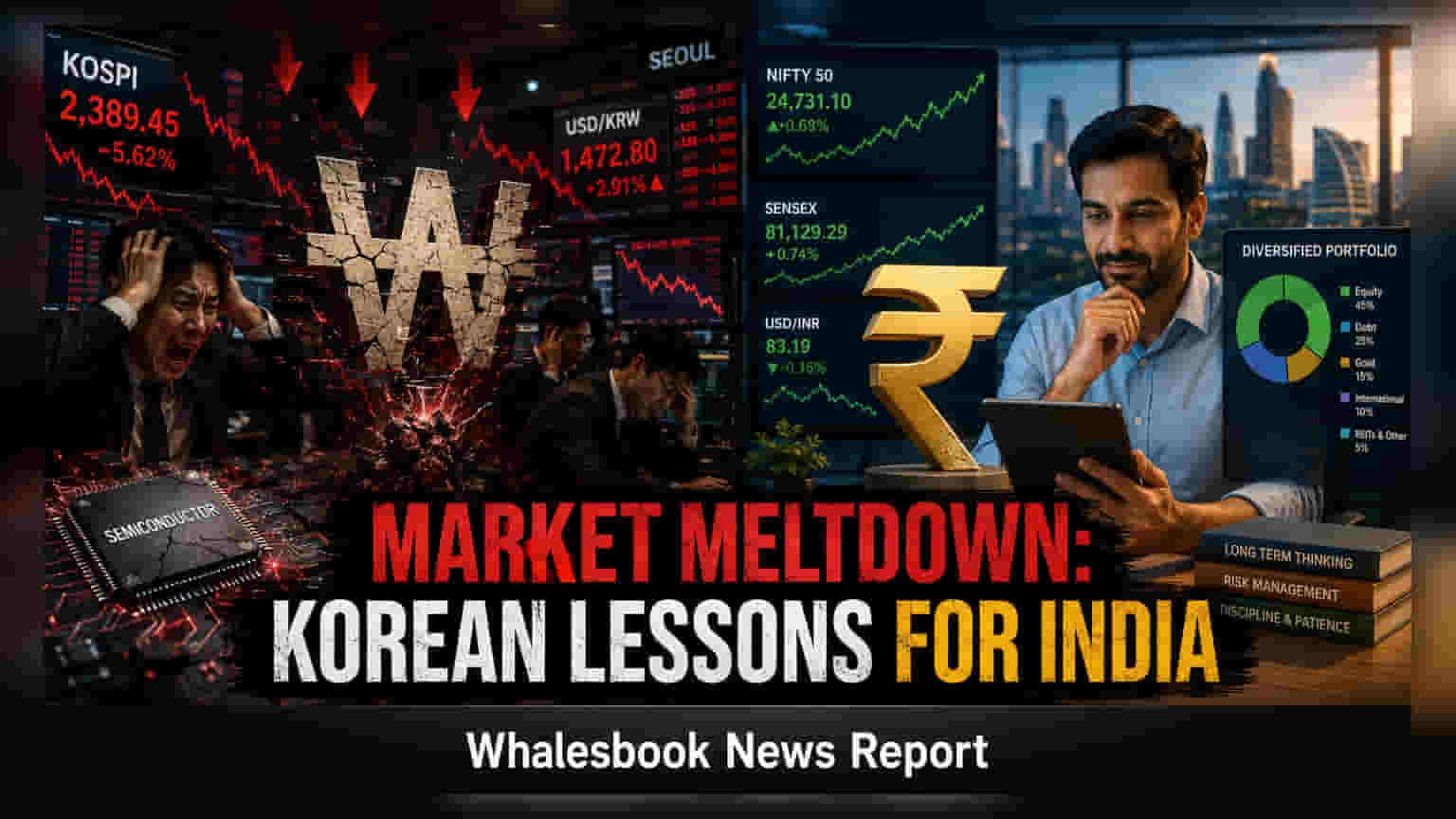
South Korea's KOSPI index plummeted 40% in July 2026, wiping out $2 trillion in value. Driven by excessive leverage and heavy concentration in tech giants, the crash offers a stark warning for Indian investors. Key areas of concern include the rising use of margin trading and portfolio over-concentration, which can significantly amplify losses during market downturns.
The South Korean stock market experienced a sharp and painful reversal in July 2026. After hitting record highs in June, the benchmark KOSPI index dropped by approximately 40% within just six weeks. This rapid decline wiped out over $2 trillion in market value and triggered multiple circuit breakers, a safety mechanism designed to pause trading during extreme volatility. The scale of the crash has prompted South Korean government officials to review market stabilization measures and apologize for the regulatory environment that permitted risky investment products.
The Dangers of Borrowed Money
A primary factor behind the rapid descent was the extensive use of leverage. Many retail investors in South Korea utilized newly introduced single-stock leveraged ETFs—financial products that borrow money to magnify daily stock returns. When share prices began to slide, these leveraged positions triggered automatic selling, which pushed prices down further. This creates a dangerous loop where selling begets more selling. For Indian investors, the parallel lies in the growing use of the Margin Trading Facility (MTF). With the total MTF book in India recently exceeding ₹1 trillion, the risk profile of retail portfolios has changed. When using borrowed money to trade, investors often lose the ability to wait out a market dip, as brokers may be forced to sell their holdings if the collateral value drops below a certain level.
Concentration Risk in Portfolios
Another major reason for the KOSPI’s instability was extreme concentration. The index was heavily weighted toward two semiconductor giants, Samsung Electronics and SK Hynix, which together accounted for over 50% of the index's value. When the broader market turned negative on AI sector growth and semiconductor demand, these two companies took the brunt of the selling. This meant that even investors who thought they were diversified through broad index funds were actually exposed to the specific performance of these two firms. This highlights a critical lesson: check the underlying holdings of your investments. If a significant portion of a portfolio or a passive fund is tied to just a handful of stocks, the entire investment becomes vulnerable if that specific sector or company underperforms.
Avoiding Behavioral Traps
The crash also highlights the role of human behavior. Anecdotal reports from South Korea suggest that the Fear of Missing Out (FOMO) drove thousands of retail investors to pile into the market at its peak, often using leverage to chase quick returns. This emotional decision-making, combined with a lack of geographic diversification, left many with significant losses. The most important lesson for investors is to ensure that their portfolios are not overly reliant on a single market, a single sector, or a single set of momentum stocks. Diversifying across different asset classes and geographies is not just about chasing gains; it is the primary method for protecting wealth when specific segments of the market face a correction. Investors may monitor their own exposure to high-beta stocks and ensure their debt levels remain manageable in volatile market conditions.