 Whalesbook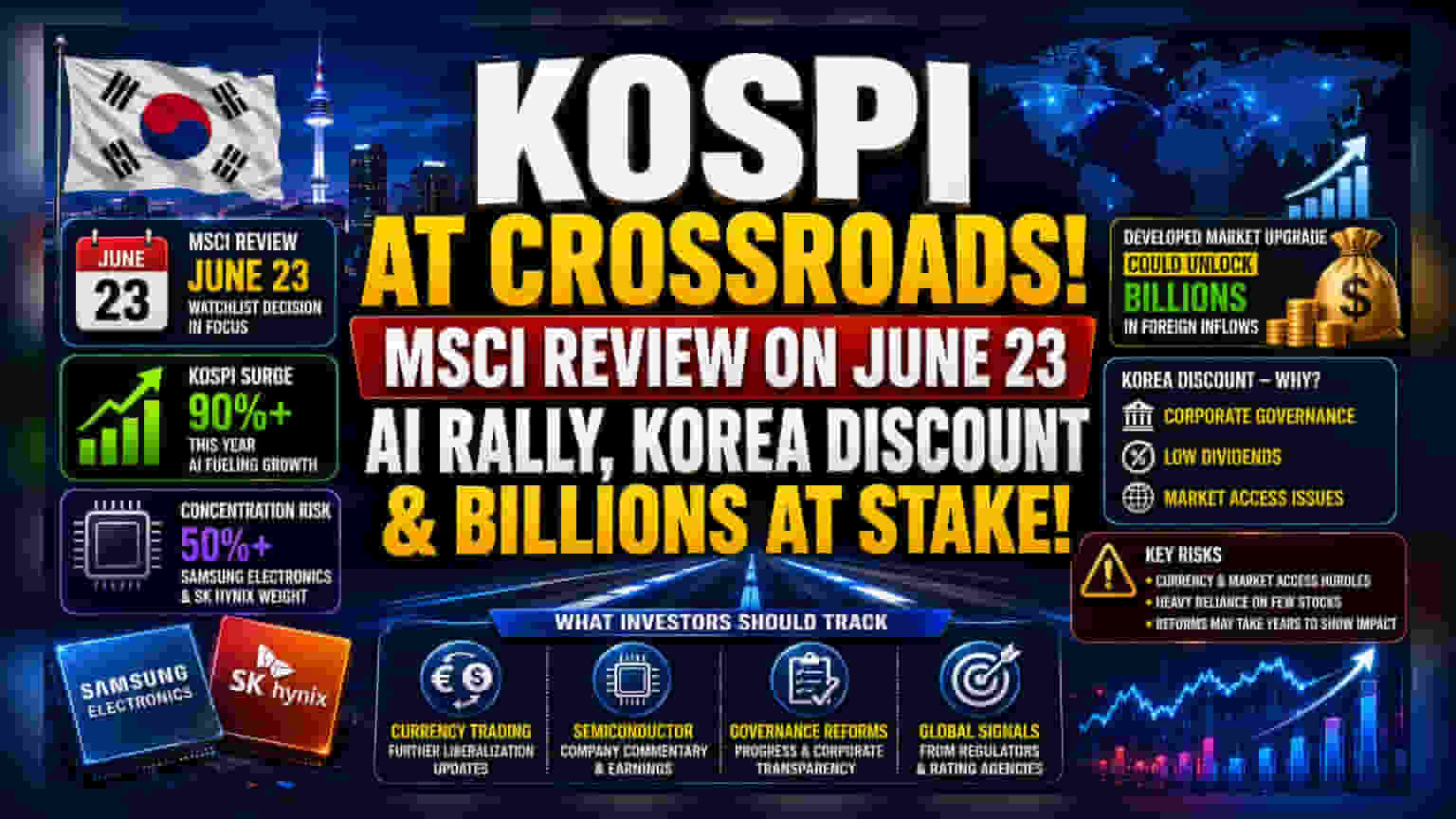


South Korea’s KOSPI index has rallied over 90% this year, driven by strong growth in AI-related semiconductor stocks. As the market approaches the MSCI annual review on June 23, investors are watching for a potential upgrade from 'emerging' to 'developed' market status. This move could bring significant foreign investment but also depends on the success of ongoing financial reforms and balancing the market's heavy reliance on a few technology giants.
What Happened
The South Korean stock market, represented by the KOSPI benchmark, is currently facing a significant turning point. Investors are closely watching the upcoming annual market-classification review by MSCI, a major provider of global equity indexes, scheduled for June 23. This review is critical because it will determine if South Korea earns a spot on the watchlist for a reclassification to 'developed-market' status. While many market watchers believe an immediate upgrade is unlikely due to the need for further regulatory and transparency reforms, the event remains a key focus for global institutional investors.
The AI Rally and Concentration Risk
The KOSPI has seen a massive surge of over 90% this year, largely fueled by global investor enthusiasm for artificial intelligence. However, this growth highlights a significant risk for the index: heavy concentration. Semiconductor giants Samsung Electronics and SK Hynix together account for over half of the index's total weight. This means the overall index performance is highly sensitive to the fortunes of just two companies. While this has been a major advantage during the current AI boom, it also poses a risk. If demand for AI-related technology cools or these specific companies face operational challenges, the entire index could see heightened volatility, regardless of how other sectors are performing.
The 'Korea Discount' and Market Access
For years, South Korean stocks have often traded at lower valuations compared to their global peers, a phenomenon known as the 'Korea Discount.' Investors have historically cited issues such as complex corporate governance, low dividend payouts, and difficulties for foreign investors in accessing the local market as reasons for this gap.
South Korea has been working to address these concerns to qualify for developed-market status. Recent government efforts include reforms to the foreign exchange system and changes to short-selling rules. The goal of these changes is to make the market more transparent and accessible to international money managers. If MSCI eventually grants a developed-market status, it could lead to billions of dollars in passive foreign inflows, as index-tracking funds would be required to rebalance their portfolios to include more Korean stocks.
Why the MSCI Review Matters
The MSCI classification acts as a global stamp of approval. Markets classified as 'developed' are generally seen as more stable, transparent, and easier to trade in. Currently, South Korea is classified as an 'emerging' market. While emerging markets can offer high growth potential, they are also prone to higher volatility. A move to developed status would likely attract a different class of long-term investors, such as pension funds and large institutional investors who prioritize stability and sustainability alongside growth.
What Could Go Wrong
Investors should remain cautious about the risks associated with this potential transition. A major hurdle remains: the historical restrictions on currency trading and market access. If the current reforms do not fully satisfy international standards, the upgrade could be delayed further. Additionally, the market's extreme reliance on a small group of tech companies means that any sector-specific downturn could lead to sharp swings in the index. The 'Korea Discount' is also deeply rooted in structural issues that may take years, rather than months, to resolve.
What Investors Should Track
The key to this story is not just the June 23 decision, but the long-term commitment to market reform. Investors should track updates on the liberalization of currency trading hours and any further adjustments to market access regulations. Additionally, management commentary from major semiconductor firms will remain vital, as their performance currently drives the bulk of the index's movement. Finally, watch for any signals from global rating agencies or regulators regarding the success of the recent corporate governance initiatives, as these will be essential in closing the valuation gap with developed-market peers.