

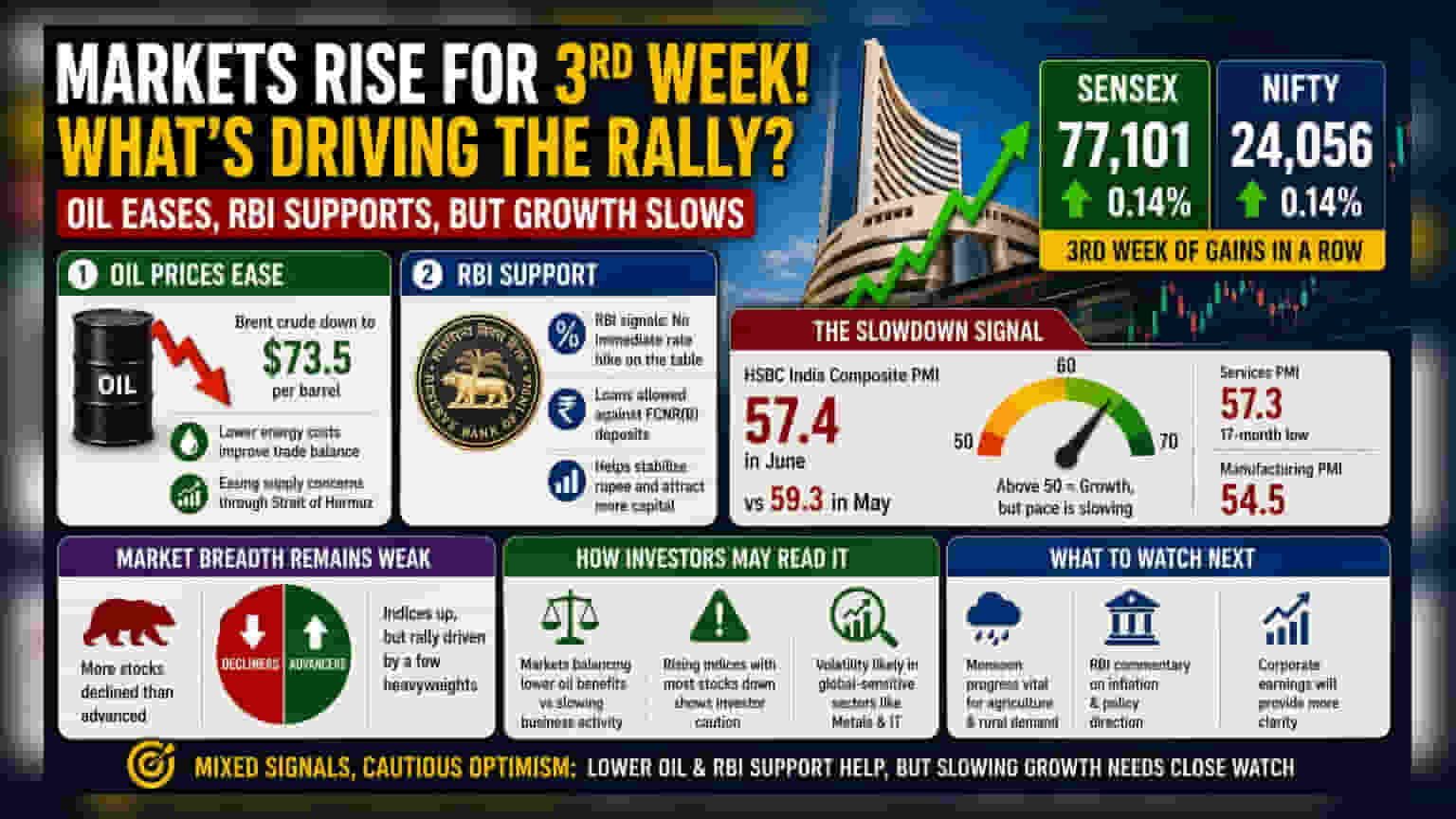
Indian benchmark indices closed higher for the third consecutive week, supported by lower crude oil prices and RBI policy measures. However, data showing a cooling in manufacturing and service activity growth suggests some caution is building in the economy.
What Happened
Indian stock markets continued their winning streak this week, with both the Sensex and Nifty posting gains for the third week in a row. On Thursday, the Sensex closed at 77,101, up 0.14 per cent, while the Nifty ended at 24,056, also rising 0.14 per cent. While this momentum is the longest continuous rise this year, the gains were modest, and market breadth remained weak, meaning more stocks fell than rose during the session.
Why Oil and RBI Support Matter
Two main factors supported the market this week. First, Brent crude oil prices dropped to around $73.5 per barrel. Since India imports a large part of its energy needs, lower oil prices are a positive sign for the trade balance and help keep inflation under control. The easing of supply concerns through the Strait of Hormuz has been a major factor behind this price drop.
Second, the Reserve Bank of India (RBI) provided support through clear signals on interest rates and liquidity. The RBI Governor indicated that immediate rate hikes are not on the table. Additionally, the central bank’s decision to allow lenders to extend loans against foreign currency deposits has helped stabilize the rupee and encouraged more capital to enter the market.
The Slowdown Signal
Despite the positive index movement, the latest business data points to a potential economic deceleration. The HSBC India Composite Purchasing Managers' Index (PMI)—a key indicator of business health—dropped to 57.4 in June, down from 59.3 in May.
While a PMI reading above 50 still indicates growth, the decline shows that activity is expanding at a slower pace than before. Specifically, the services PMI fell to a 17-month low of 57.3, and the manufacturing PMI slipped to 54.5. Investors often watch these figures closely, as they provide a real-time pulse on how businesses are performing before official earnings are released.
How Investors May Read the Market
Although indices are rising, the fact that a majority of stocks declined suggests that many investors remain cautious. The market is currently balancing the benefit of lower energy costs against the reality of slowing business activity. This mixed picture often leads to volatility, particularly in sectors sensitive to global trends, such as metals and IT. When indices rise while most stocks fall, it typically indicates that gains are driven by a few heavy-weight stocks rather than a broad-based rally.
What to Watch Next
For the coming weeks, the most important factor will be the progress of the monsoon. Agriculture and rural demand are vital for the Indian economy, and a good monsoon can often offset other economic slowdown concerns. Investors will also keep a close eye on any further comments from the RBI regarding inflation and upcoming corporate earnings, which will provide more clarity on how companies are handling the current business environment.