

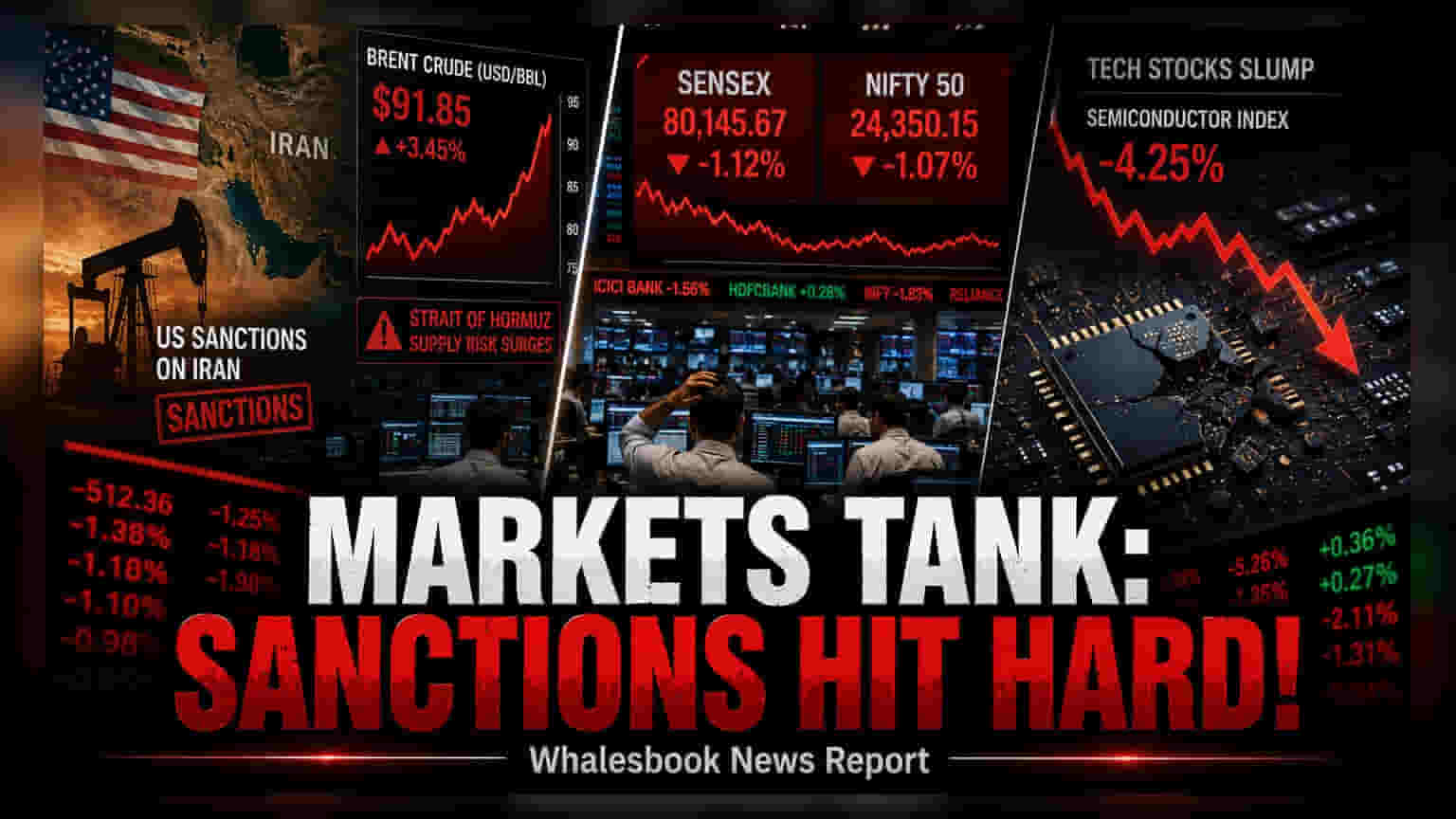
Indian markets opened lower on Tuesday, pressured by US-Iran sanctions and a global tech selloff. Despite the broader market weakness, Tata Consultancy Services (TCS) shares rose after the company announced a €320 million acquisition of Porsche AG’s IT arm, MHP, along with a €1.25 billion strategic partnership.
Indian stock markets began Tuesday’s session on a weak note, with the Nifty and Sensex trading lower. The decline reflects investor caution stemming from fresh US sanctions on Iran and a significant selloff in technology stocks across Wall Street and Asian markets. These geopolitical and global macroeconomic factors have collectively pushed investors toward a more defensive stance.
While the broader market faced selling pressure, Tata Consultancy Services (TCS) shares bucked the trend following a major corporate development. The company announced a definitive agreement to acquire 100% of MHP Management- und IT-Beratung GmbH, the IT consulting subsidiary of Porsche AG, for an enterprise value of €320 million. Alongside this acquisition, TCS has entered into a five-year strategic partnership with Porsche valued at €1.25 billion. This move is aimed at strengthening the company's capabilities in high-growth areas like automotive technology, artificial intelligence, and digital manufacturing.
However, investors are also weighing the potential impact of this expansion on the company's short-term financials. While the deal provides a long-term strategic advantage in the automotive sector, some analysts have noted that the integration and initial investment costs could lead to a temporary dilution of approximately 50 basis points in the company’s EBIT margins. Monitoring the successful integration of MHP and the realization of cost synergies will be important for shareholders over the coming quarters.
The broader market decline is closely tied to concerns over global oil supply. Fresh US sanctions on Iran have created uncertainty regarding shipping through the Strait of Hormuz, causing Brent crude prices to hover near $92 per barrel. For a net oil-importing nation like India, sustained high crude prices can lead to inflationary pressure and strain the country's import bill. Furthermore, the tech-led slump on Wall Street, which mirrors the negative performance in major Asian markets like Japan’s Nikkei and South Korea’s KOSPI, has limited the appetite for riskier assets in the Indian market.
Investors may continue to track the volatility resulting from the monthly derivatives expiry and evolving geopolitical developments. The primary focus for the market will be on how global oil prices react to the ongoing sanctions and whether the technology sector can stabilize after the recent correction.