

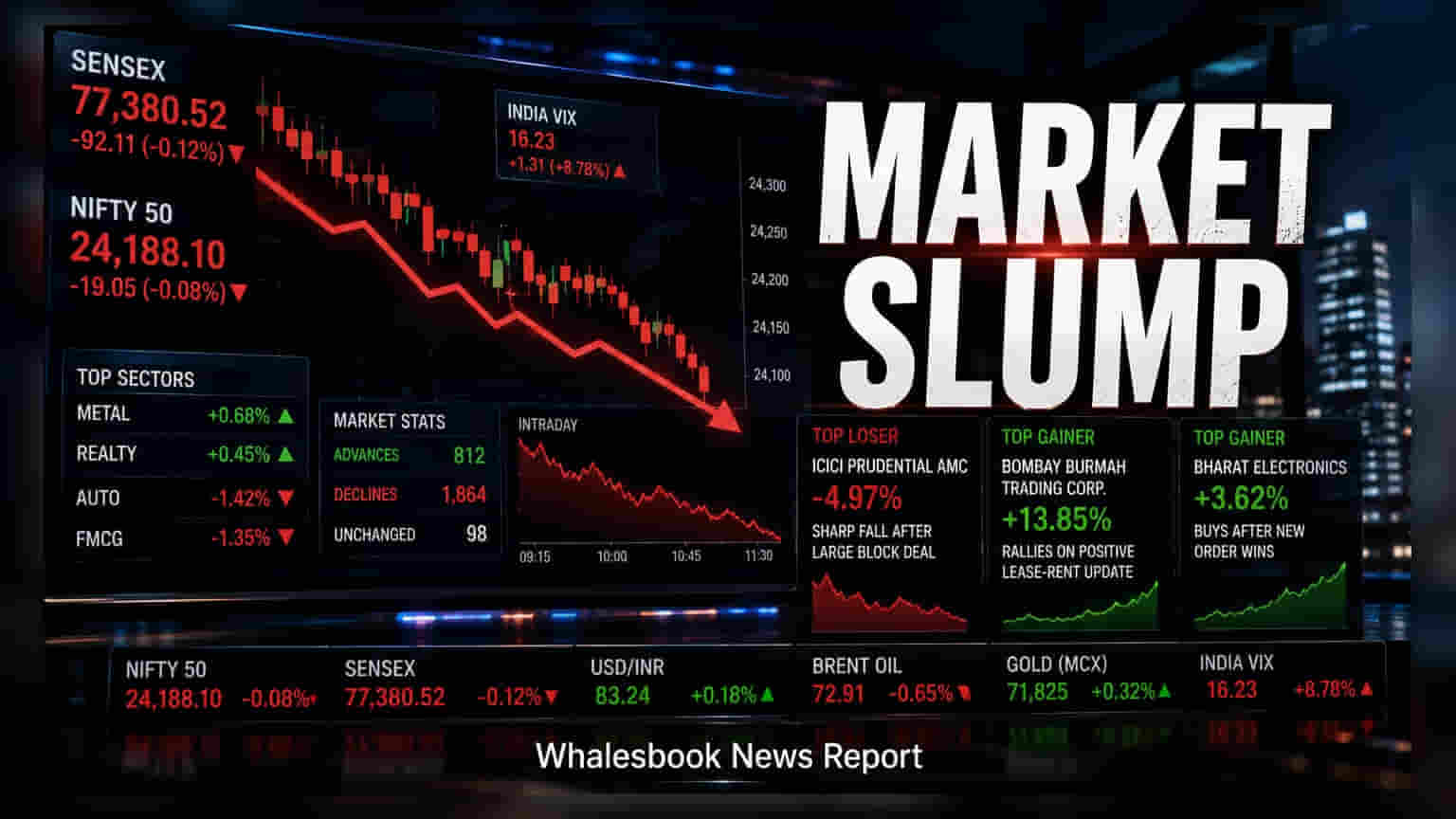
Indian benchmark indices Sensex and Nifty drifted lower on August 27, 2026, as selling in auto and FMCG stocks outweighed early gains. Investors remained cautious, weighing global inflation data, geopolitical tensions, and local liquidity concerns from the ongoing IPO boom. The Sensex traded near 77,380 while the Nifty hovered around 24,188 as markets assessed these mixed domestic and global signals.
Indian benchmark indices struggled to hold early gains on Thursday, August 27, 2026, as selling pressure built up across key sectors. By mid-morning, the Sensex had declined by about 92 points, trading at 77,380, while the Nifty50 dipped approximately 19 points to 24,188. While the market attempted a positive start, the sentiment shifted as investors became more cautious amid a mix of global economic concerns and domestic liquidity constraints.
The selling pressure was most visible in the auto and FMCG sectors, which acted as a drag on the broader market indices. This sector-specific weakness highlights a rotation in investor preference, as funds moved away from consumer-facing stocks. In contrast, the metal and realty sectors showed relative resilience, indicating that investors are selectively choosing segments that may benefit from different economic triggers. The volatility was further underscored by the India VIX, which reflects the caution currently present in the market.
Global headwinds continued to play a significant role in dictating today's price action. Investors are closely tracking upcoming US inflation data and developments regarding Nvidia's earnings, which often influence global tech sentiment. Additionally, ongoing geopolitical instability in West Asia is keeping risk appetite low. Domestically, the current rush of initial public offerings (IPOs) is also drawing significant liquidity from the secondary market, which may be contributing to the lack of strong buying support in blue-chip stocks.
Specific corporate developments caused sharp movements in individual shares, deviating from the overall index trend. Shares of ICICI Prudential AMC faced a steep decline of nearly 5% following a large block deal, reflecting the immediate impact of supply-side pressure on stock prices. On the other hand, the market saw positive reactions elsewhere; Bombay Burmah Trading Corporation rallied sharply following favorable news regarding a long-standing lease-rent claim. Similarly, Bharat Electronics saw buying interest after disclosing new order wins, showcasing how company-specific fundamentals can sometimes decouple from the broader market downturn.
From a technical standpoint, traders are watching the 24,150 level on the Nifty as a critical support zone. If the index fails to hold this level, it could invite further selling pressure. Investors will likely keep an eye on how these global and local variables settle as the trading session progresses. The primary focus for the coming days will be whether the broader market can absorb the liquidity demand from new share sales and if the indices can find a stable footing above their immediate support levels.