

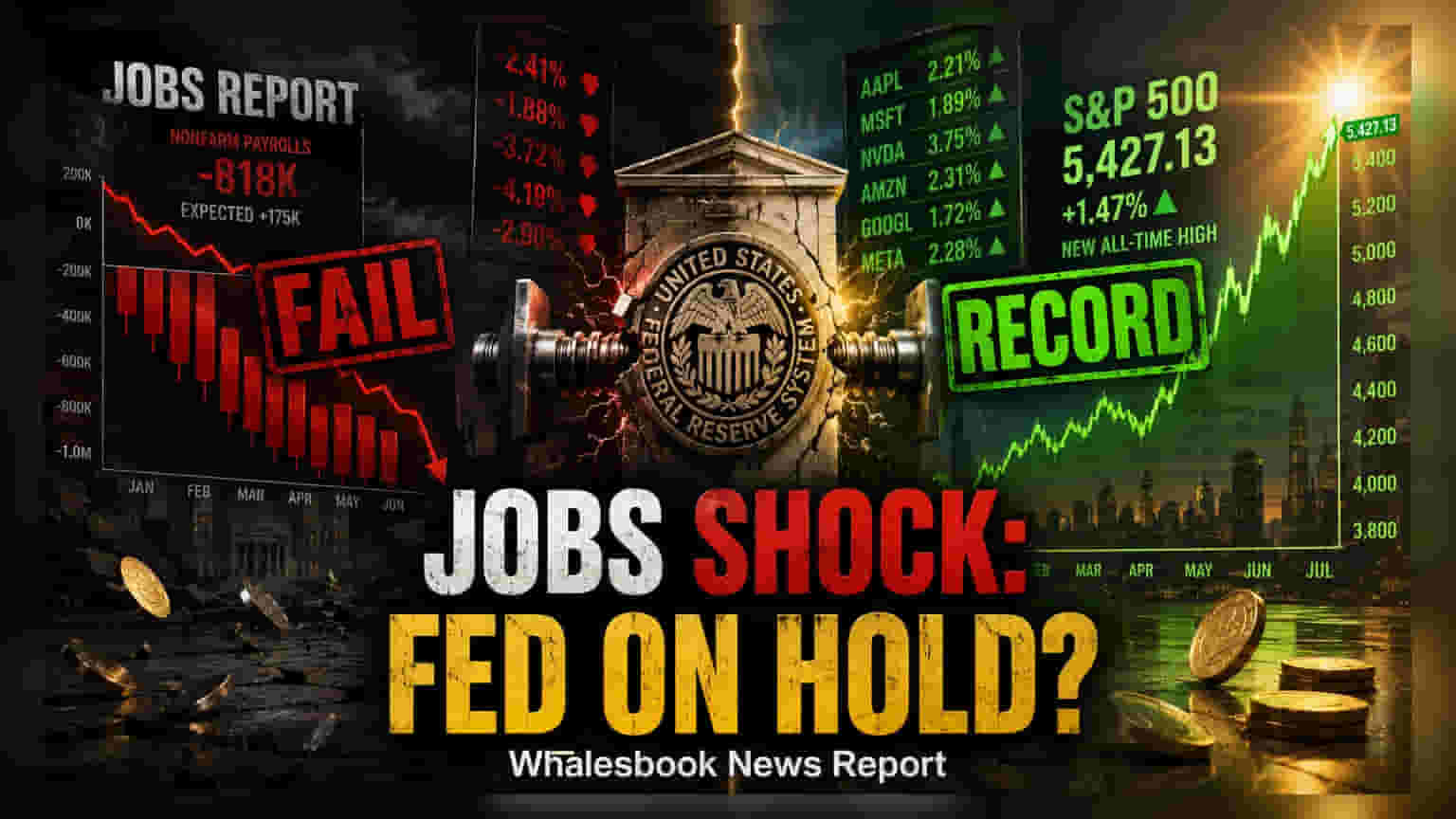
U.S. stocks touched record highs as a surprise drop in July payrolls eased fears of aggressive interest rate hikes. With the probability of a September hike falling, investor sentiment improved despite broader concerns over potential economic cooling. Strong corporate earnings also supported the market rally.
On Friday, August 7, 2026, the S&P 500 closed at a record high of 7,757.64, capping a week of significant gains. The momentum was triggered by a U.S. labor report showing a decline of 23,000 jobs in July. While a drop in job numbers is typically viewed as a sign of an economic slowdown, markets responded positively because it reduced the likelihood of the Federal Reserve raising interest rates at its September meeting.
For investors, the logic is straightforward: when the economy shows signs of cooling, there is less pressure on the central bank to keep raising rates to fight inflation. Market expectations for a rate hike in September have fallen to approximately 44%, down from 67% just a week ago. The Federal Reserve, under the leadership of Chair Kevin Warsh, is currently navigating a period where balancing growth and inflation management remains a primary challenge.
Beyond the macroeconomic news, the market rally has been supported by a robust earnings season. Roughly 85.1% of S&P 500 companies that have reported results so far have beaten analyst expectations. This performance has helped maintain confidence, even as some investors worry about high capital spending by companies focused on artificial intelligence.
Several individual stocks saw notable reactions. SpaceX shares surged following the expiration of an initial lockup period, which released over 911 million shares for potential trading. In the tech and consumer sectors, Atlassian and Airbnb gained ground after issuing positive revenue forecasts, while Microchip Technology also rose on strong guidance. On the other hand, Trade Desk shares fell significantly after its third-quarter revenue forecast did not meet investor expectations.
Despite the optimism, some risks remain. A weaker labor market—where the unemployment rate recently fell to 4.1% as workers left the labor force—can sometimes point to a slow-growth economy rather than a soft landing. Investors are also adjusting to the communication style of the Federal Reserve under Chair Warsh, which differs from historical norms and adds a layer of uncertainty to policy predictions. Moving forward, market participants will likely track upcoming economic reports to see if the U.S. economy can sustain growth while inflation remains under control.