 Whalesbook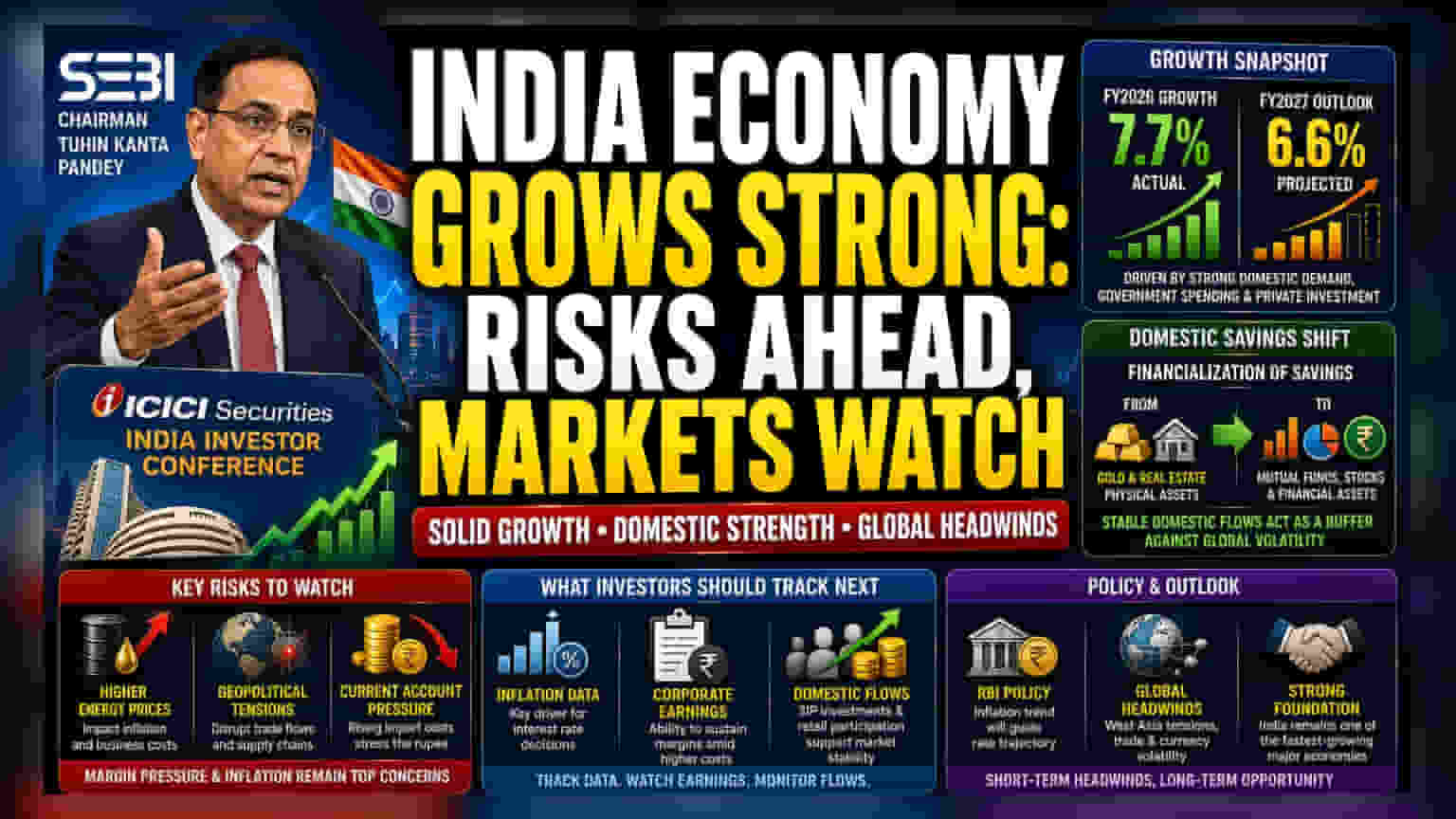


What Happened
SEBI Chairman Tuhin Kanta Pandey spoke at the ICICI Securities India Investor Conference regarding the current state of the Indian economy. He emphasized that India continues to stand out as one of the fastest-growing major economies globally. The official figures show India achieved a growth rate of 7.7% for the fiscal year 2026. This performance was driven by strong domestic consumption, increased government spending, and active private sector participation.
The Growth and Risk Outlook
While the growth numbers for the past year have been robust, the outlook for the next period includes a shift in expectations. Economic projections suggest that growth may moderate to around 6.6% in fiscal year 2027. This potential slowdown is not necessarily a reflection of internal weakness, but rather a response to external factors. The SEBI Chief highlighted that geopolitical developments, particularly in West Asia, are creating global headwinds. These include challenges related to inflation, trade flows, and currency exchange rates, which can impact economies worldwide.
Why Domestic Savings Matter for Markets
A key part of the current economic narrative is the increasing "financialization of savings." For many years, Indian households preferred storing wealth in physical assets like gold or real estate. However, there has been a steady structural shift toward financial instruments such as mutual funds, stocks, and other market-linked products. This transition is important for investors because it creates a more stable base of domestic capital. When foreign investors pull money out of the market during times of global uncertainty, these stable domestic inflows often act as a buffer, preventing sharp liquidity freezes in the stock market.
Key Risks to Watch
Despite the positive domestic momentum, there are specific risks that the market is closely monitoring. Higher energy prices due to ongoing conflicts can increase the cost of doing business and raise inflation. This puts pressure on the current account deficit, which is the difference between what a country spends on imports and what it earns from exports. If the cost of imported goods like oil rises significantly, it can stress the currency and potentially lead to a higher cost of living for consumers. Investors generally view these factors as indicators of potential margin pressure for companies, especially those dependent on raw material imports.
What Investors Should Track Next
Moving forward, market participants will be watching for several indicators to see how the economy handles these global pressures. First, inflation data is critical, as it influences interest rate decisions by the central bank. Second, corporate earnings in the coming quarters will show whether companies are able to maintain profit margins despite rising input costs. Finally, the trend of domestic investor flows—whether individuals continue to commit capital via systematic investment plans—will remain a primary monitorable for market stability. Investors will also look for management commentary on how major companies plan to navigate potential demand slowdowns in the export or consumption sectors.