

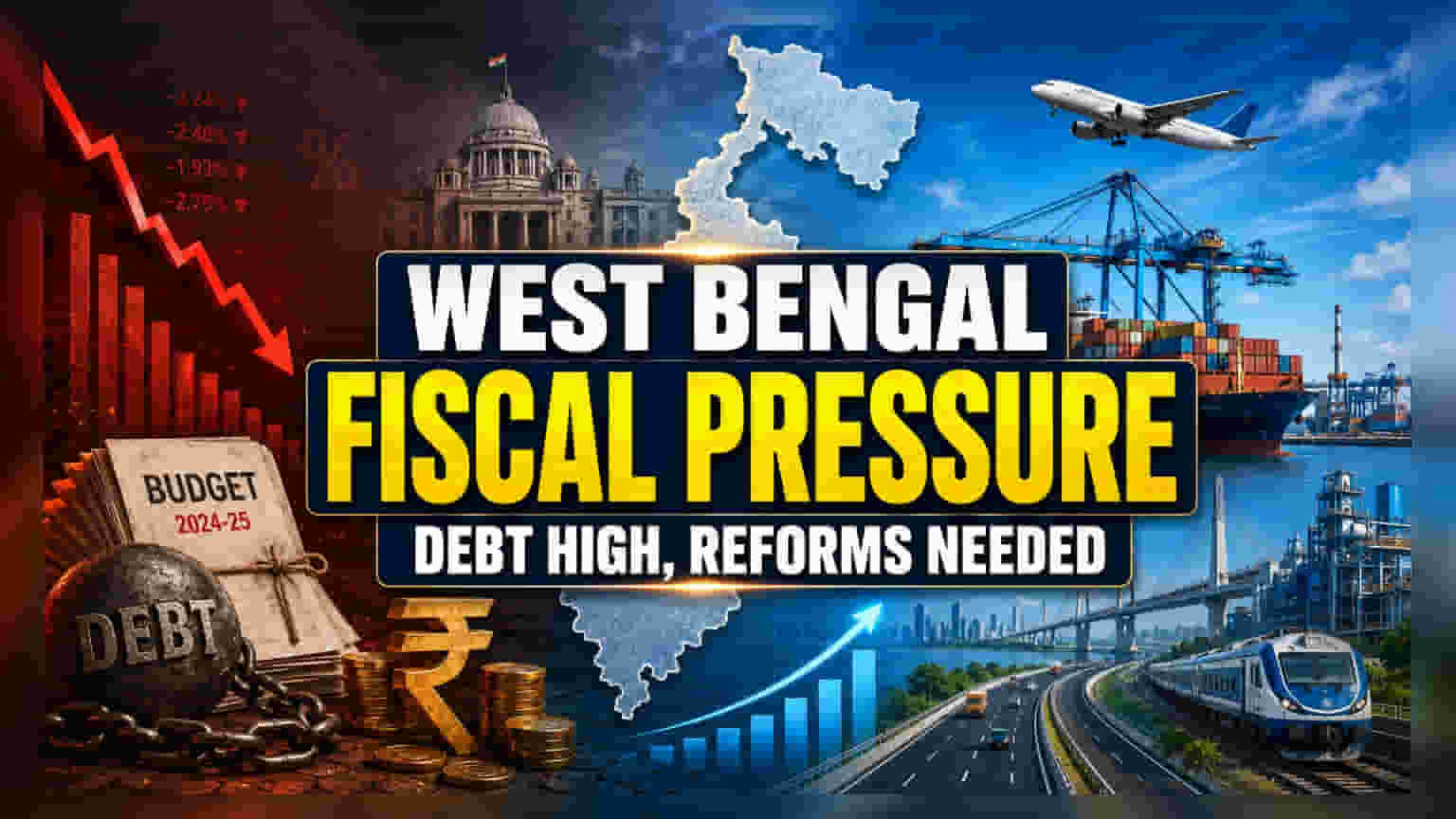
An SBI Research report highlights West Bengal’s rising debt and heavy reliance on central grants, calling for urgent revenue reforms. The study recommends unlocking non-tax income through property tax and asset monetization to improve long-term fiscal health. Investors may watch how these findings influence state policy, borrowing costs, and infrastructure development plans.
What Happened
A new report by State Bank of India (SBI) Research has pointed to fiscal pressures within West Bengal’s state finances. While the state has ambitious plans for industrial growth, the analysis highlights that debt levels remain high, even with steady support from central government grants and tax transfers. The report argues that the state's significant dependency on these transfers—which make up more than half of its tax revenue—has masked underlying fiscal challenges. SBI Research recommends structural reforms to boost non-tax revenue and improve administrative efficiency to ensure long-term stability.
The Fiscal Reality Check
The report notes that fiscal discipline has been difficult to maintain, particularly as the state moved away from specific revenue deficit targets under the Fiscal Responsibility and Budget Management (FRBM) framework in 2020. This shift has contributed to a wider budget gap and higher debt-to-GDP ratios. SBI Research also noted that administrative hurdles and legal disputes have slowed down the realization of some revenue streams. The report emphasizes that while welfare schemes like the Annapurna Yojana and increased staff benefits are part of the state's social roadmap, balancing these commitments with fiscal prudence remains a core challenge.
Unlocking Potential Through Reforms
To improve its financial position, the study suggests that the state should look beyond traditional tax collection. Recommendations include updating property tax systems, better utilization of government-owned land through leasing, and using public-private partnerships to monetize idle public assets. The report also highlights the potential for greater value addition in mineral resources. Specifically, it points to West Bengal’s coal and coalbed methane (CBM) reserves, suggesting the state could become a hub for methanol production rather than relying solely on mining royalties.
Infrastructure And The Growth Trade-Off
Despite the fiscal constraints, the report acknowledges the state’s efforts to drive future economic activity. Plans for an Eastern Multimodal Growth Corridor—connecting Bihar, Odisha, West Bengal, and Assam—are highlighted as a key move to integrate regional logistics, including rail, road, and ports. Additionally, the report mentions planned infrastructure projects like a greenfield airport, a deep-sea port, and a semiconductor manufacturing unit. These initiatives are designed to boost private investment, though their success will depend on the state’s ability to manage funding and execution amidst the current fiscal environment.
What Investors Should Track
For investors and market observers, the key takeaway is the balance between ambitious growth plans and the need for fiscal sustainability. Monitorables include the state’s progress on land monetization, actual execution of the highlighted infrastructure projects, and updates on state-level borrowing costs. Investors may also watch for policy shifts aimed at addressing the revenue gaps identified by the report, as these will directly impact the state's credit profile and the overall business environment for companies operating in the region.