

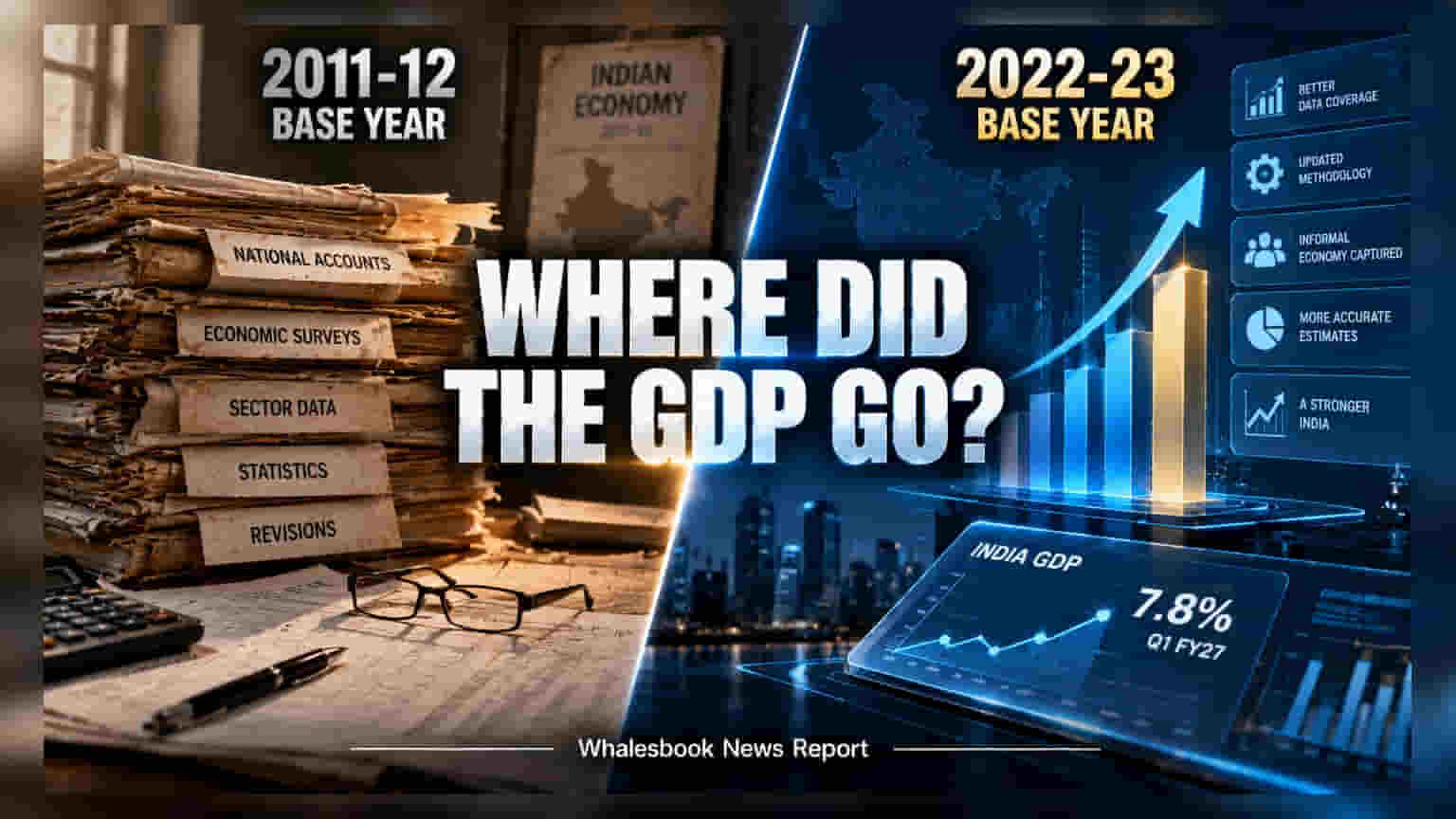
SBI Research has clarified that claims of 'missing' economic activity in India's GDP are based on incorrect comparisons between different statistical base years. The agency explains that the shift from the 2011-12 to the 2022-23 base year caused standard technical revisions, rather than a loss of actual output. This analysis aims to resolve confusion regarding national accounting methods and provides a clearer view of India's current economic performance.
A recent analysis by SBI Research has challenged widespread claims that significant amounts of nominal GDP are 'missing' from India’s economic records. The report addresses concerns that surfaced after Q1 FY27 GDP data was released, clarifying that the perceived gap is a technical outcome of changing the statistical base year rather than a reflection of declining economic activity.
At the heart of the debate is the transition from the old 2011-12 base-year series to the newer 2022-23 series. Economists often use a base year as a reference point to measure economic growth. SBI Research noted that comparing data from the old series with the new one is statistically flawed, as the two sets use different methods and data sources to track the economy. When the reference point changes, adjustments are inevitable.
To put the current situation into context, the research highlighted that revisions to national accounts are a regular feature of data management. Since FY09, there have been 239 such revisions across 70 quarters. The report specified that a downward revision of ₹41.8 lakh crore in nominal GDP occurred between Q1 FY23 and Q2 FY26 due to these methodological updates. This change was not a loss of actual output, but rather a realignment to capture more accurate information about the informal economy.
Sector-specific data provides a clearer picture of where these adjustments happened. Approximately 95% of the downward revision in Gross Value Added (GVA) was concentrated in trade, hotels, transport, and communication sectors. Conversely, the finance, insurance, and real estate sectors saw an upward revision of ₹13.6 lakh crore. These shifts are attributed to the government’s use of more detailed data from sources like the Annual Survey of Unincorporated Sector Enterprises (ASUSE) and the Periodic Labour Force Survey (PLFS).
While the technical debate continues, the broader economic trends remain resilient. India’s real GDP grew by 7.8% year-on-year in Q1 FY27. Furthermore, private sector investment, a critical monitorable for long-term growth, has averaged ₹3.5 lakh crore annually since FY23, consistently exceeding pre-pandemic benchmarks.
Despite this clarification, investors should remain aware of broader economic risks. While the GDP figures reflect structural improvements in data gathering, India’s economic trajectory remains sensitive to external factors such as global geopolitical tensions and potential climate-related disruptions. Additionally, the sustainability of growth will depend on whether private investment stays robust, as it acts as a primary driver of domestic capacity expansion. The next important update for market participants will be further commentary from official bodies like the Ministry of Statistics and Programme Implementation (MoSPI) regarding ongoing data mapping efforts.