

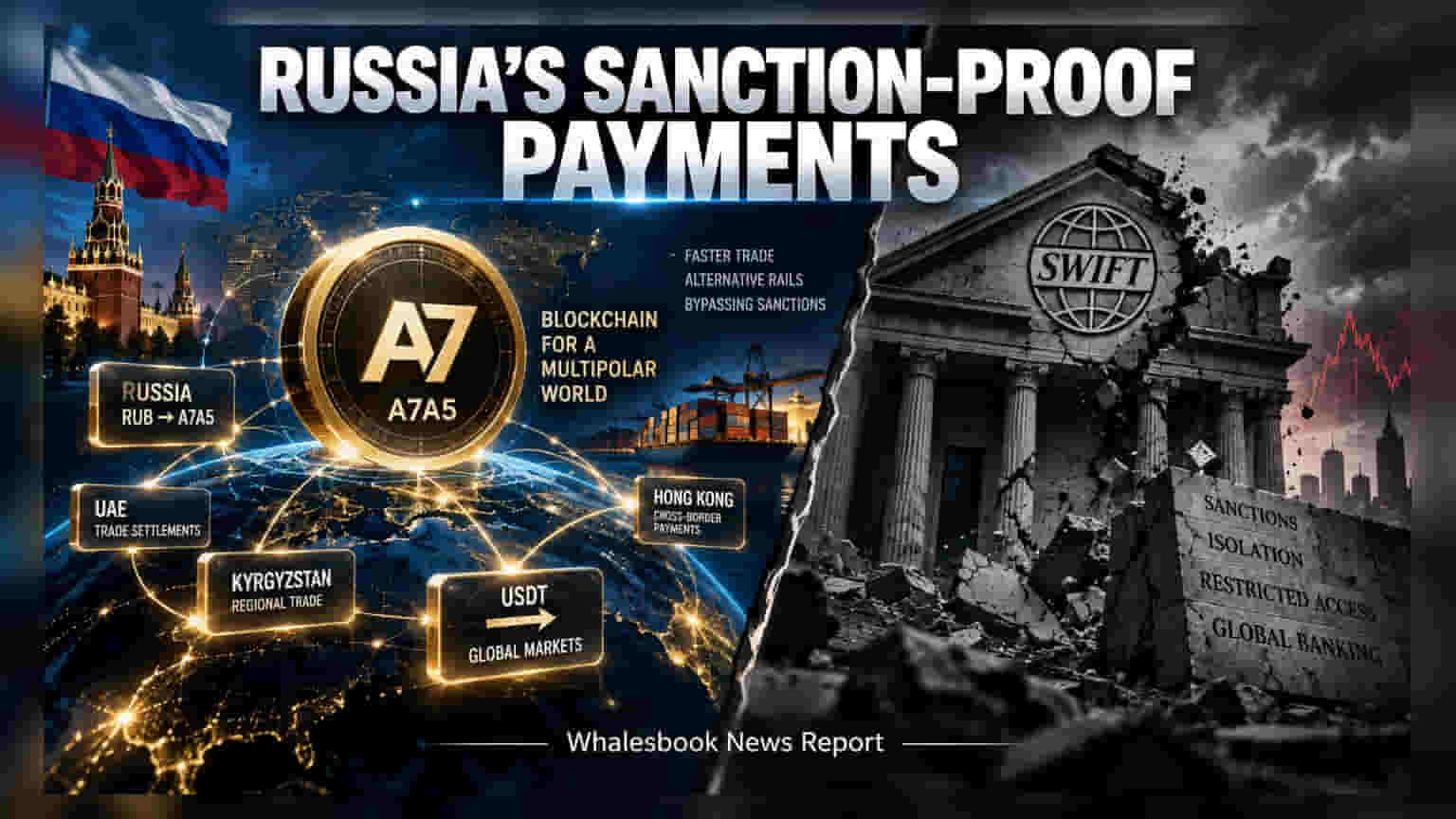
Russia has launched the A7 blockchain-based network to bypass SWIFT and maintain trade under international sanctions. While the platform claims to facilitate cross-border settlements via a ruble-pegged token, it relies on shadow banking channels and faces severe regulatory scrutiny. For India, the development highlights the clear divide between pursuing high-risk, isolated payment rails versus building transparent, compliant global infrastructure like UPI and Project Nexus.
Russia has established the A7 payment network, a state-backed blockchain platform designed to circumvent the Society for Worldwide Interbank Financial Telecommunication (SWIFT) system. Following the exclusion of major Russian financial institutions from the global banking grid in 2022, the Kremlin-backed Promsvyazbank (PSB) partnered with figures including Moldovan fugitive oligarch Ilan Șor to launch this alternative. The system utilizes a digital settlement token, A7A5, which is pegged one-to-one to the ruble to facilitate cross-border trade.
The operational model relies on a network of shadow brokers and intermediaries in jurisdictions such as Kyrgyzstan, the United Arab Emirates, and Hong Kong. Transactions initiated on the A7 network involve converting rubles into the A7A5 token, which is then swapped for Tether (USDT)—a dollar-pegged stablecoin—to complete the final leg of the settlement. While the operators claim this cycle can settle trade within four hours, independent analysis suggests a different reality. Much of the platform's reported volume appears to be driven by circular transfers rather than genuine commercial activity, raising significant concerns about the network's actual liquidity and economic utility.
The High-Risk Nature of Shadow Banking
For investors and global institutions, the A7 network represents a textbook example of high-risk 'shadow' infrastructure. The reliance on private stablecoin issuers and opaque intermediaries creates significant counterparty and operational risks. Because the network is explicitly designed to bypass international banking standards, it has been hit by coordinated sanctions from the United States, the European Union, and the United Kingdom.
The structural vulnerability of A7 lies in its dependence on the very global financial systems it attempts to avoid. Tether, the stablecoin utilized for settlement, is a private entity that has previously cooperated with law enforcement to freeze assets. This creates a scenario where the 'sovereign' rail is inherently beholden to external regulatory bodies. Furthermore, entities associated with the A7 network face severe reputational damage, as association with sanction-evasion tools can effectively isolate a firm from the global mainstream financial system.
India’s Strategic Path: Compliance Over Isolation
India’s approach to cross-border payments stands in stark contrast to the A7 model. With the massive success of the Unified Payments Interface (UPI) and the expansion of Special Rupee Vostro Accounts, India is focused on building resilient, transparent, and compliant digital finance.
Rather than seeking shadow workarounds, India is engaging with initiatives like Project Nexus, led by the Bank for International Settlements (BIS). This project aims to create interoperable, inspection-ready links between national fast-payment systems. The strategic lesson for Indian policymakers and corporate treasuries is that long-term resilience is built through global integration and regulatory transparency, not by creating opaque networks that invite isolation. While A7 provides a conceptual lesson in state-driven payment sovereignty, its reliance on illicit financial channels and high-risk intermediaries makes it an outlier rather than a sustainable model for stable, long-term trade.