

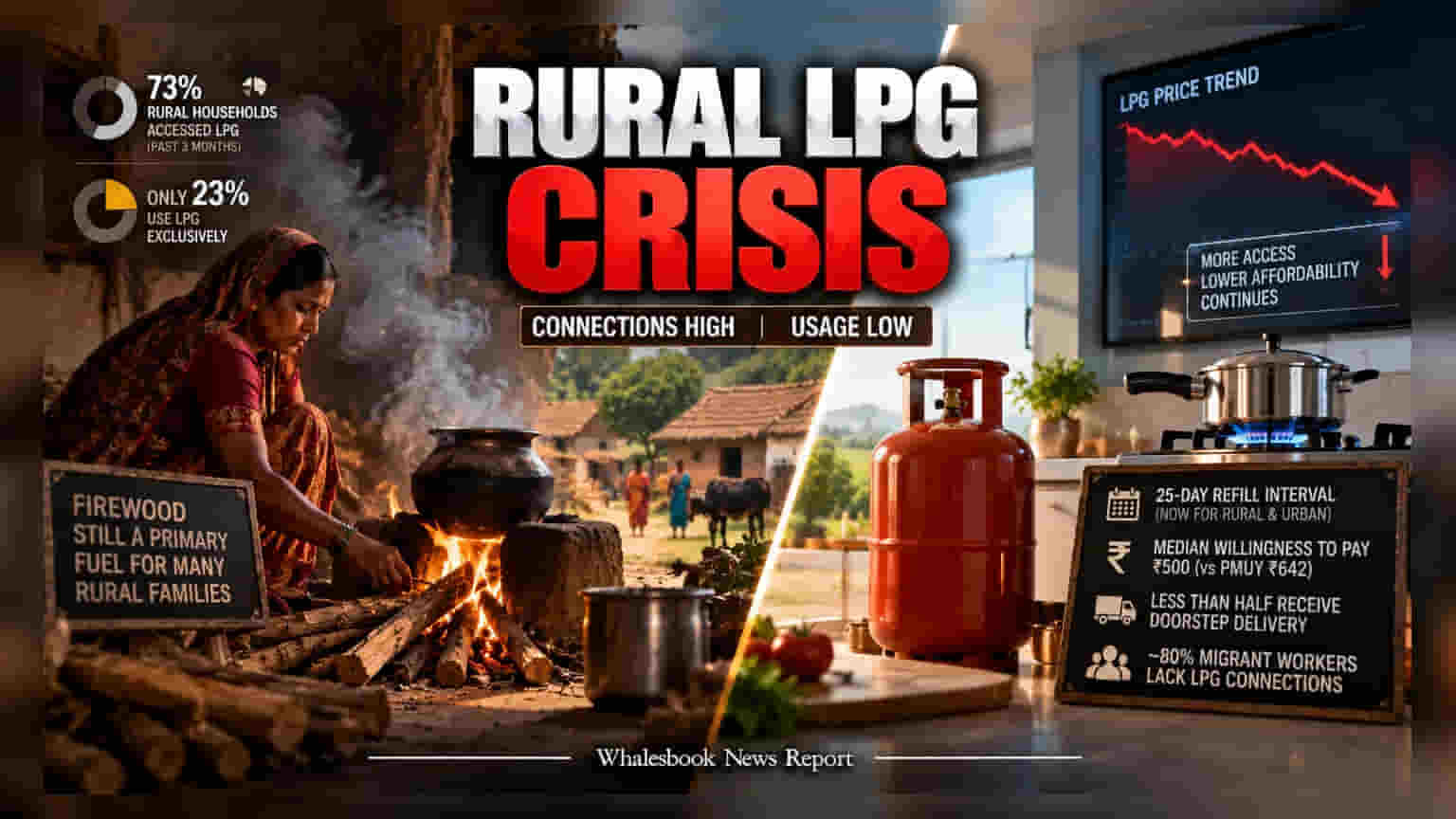
New research shows only 23% of rural households use LPG exclusively, despite wide distribution. To improve availability, the government recently shortened the mandatory refill booking interval from 45 days to 25 days. Investors may monitor whether this policy change helps Oil Marketing Companies boost refill volumes in rural markets.
Despite significant expansion in cooking gas connections across rural India, consistent usage remains a challenge for the sector. A report released in September 2026 by the Council on Energy, Environment and Water (CEEW) reveals that while 73% of rural households accessed LPG in the past three months, only 23% rely on the fuel exclusively. Many families continue to use firewood as a primary or secondary fuel source.
This disconnect between connection count and actual fuel consumption is an important factor for Oil Marketing Companies (OMCs) like Indian Oil Corporation, Hindustan Petroleum, and Bharat Petroleum. Revenue for these companies from the LPG segment depends largely on consistent refill volumes rather than just the initial connection setup under the Pradhan Mantri Ujjwala Yojana (PMUY).
To address service accessibility, the government has mandated a uniform 25-day LPG refill booking interval for both urban and rural consumers, reduced from the previous 45-day window. This policy adjustment, effective as of early September 2026, aims to improve the frequency of availability and streamline supply chains in areas where access has historically been inconsistent.
Logistical and economic barriers remain key hurdles. The CEEW report notes that fewer than half of rural households receive doorstep delivery. This forces many users to depend on informal supply channels, which often carry higher costs. Additionally, there is a clear price sensitivity among rural consumers. Data shows that the median willingness to pay for a 14.2 kg cylinder is roughly ₹500, which is lower than the subsidized PMUY rate of ₹642. This gap between cost and affordability encourages continued dependence on traditional solid fuels.
Migrant workers also face specific challenges. The report highlights that approximately 80% of these users lack formal LPG connections, with less than 4% enrolled in the PMUY scheme. This exclusion limits the potential consumer base for OMCs in rapidly urbanizing and transitional rural regions.
For investors and market observers, the effectiveness of the new 25-day refill policy in changing consumption habits will be a key metric. Moving forward, monitoring whether this change improves refill frequency and helps close the gap between connection numbers and active, exclusive usage will be essential. The sustainability of clean fuel adoption will ultimately depend on whether OMCs can bridge these logistical and affordability gaps to convert occasional users into regular, exclusive customers.