

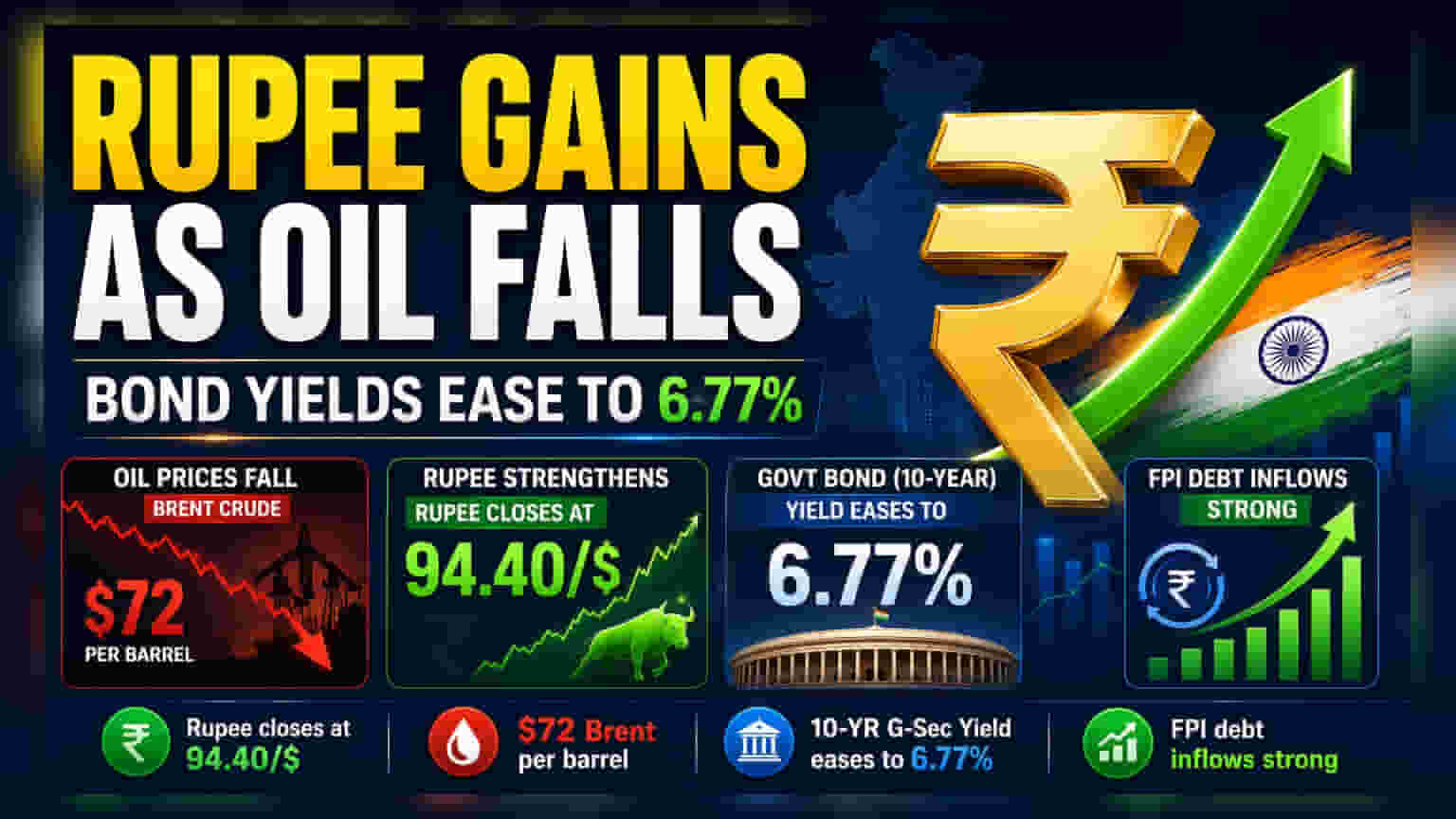
The Indian rupee rose to 94.40 per dollar, supported by crude oil prices dropping to $72 per barrel. Simultaneously, 10-year government bond yields declined to 6.77% as foreign investors poured ₹8,109 crore into debt markets. These trends are positive for the Indian economy as they lower import costs and signal confidence in local assets.
What Happened
On Thursday, June 25, 2026, the Indian rupee gained value for the fourth straight day, closing at 94.40 against the U.S. dollar. This currency appreciation happened alongside a decline in government bond yields, which settled at 6.77% for the 10-year benchmark. The catalyst for this market movement was a sharp drop in global Brent crude oil prices, which fell to approximately $72 per barrel from previous levels of $75.52. This decline follows the normalization of tanker movement through the Strait of Hormuz, easing global supply fears.
Why Lower Oil Prices Help The Indian Economy
India is one of the world's largest importers of crude oil. When global oil prices drop, India’s total import bill decreases, which reduces the amount of dollars the country needs to spend. This naturally lowers the pressure on the Indian rupee to weaken. For investors, this is a positive development because lower oil prices can help control inflation and reduce the country’s current account deficit. Many Indian companies in sectors like paints, chemicals, aviation, and logistics rely heavily on crude oil derivatives. A sustained price drop often helps these businesses improve their profit margins by reducing raw material costs.
The Shift In Bond Market Sentiment
The bond market saw significant activity as the 10-year government bond yield dropped 3 basis points to 6.77%. This trend is supported by strong foreign portfolio investment (FPI) into domestic debt, which reached ₹8,109 crore on June 24, 2026, marking the highest single-day inflow for the year. When yields fall, it generally indicates that bond prices are rising, reflecting high demand. Foreign investors are currently showing confidence in Indian debt instruments, which signals that they find Indian interest rates and the overall macro environment attractive compared to other global markets.
Why Investors Are Watching These Trends
Investors follow oil prices and bond yields because they dictate the broader economic health. If oil stays at lower levels, it may provide the Reserve Bank of India with more flexibility regarding interest rates, as inflationary pressure from energy costs would likely subside. Furthermore, the robust inflow of foreign money into bonds suggests that global investors view Indian assets as stable. While this is positive, the market remains sensitive to global developments. Any sudden spike in oil prices or change in U.S. inflation data could reverse these trends quickly.
What Investors Should Track Next
The primary monitorables for the coming days include ongoing developments in global oil supply chains and upcoming U.S. inflation data, which often influence currency and bond markets. Domestically, investors will be observing whether the recent surge in FPI debt inflows continues and how the central bank adjusts its stance in light of these changing macro conditions. A steady, lower oil price environment is generally favorable for domestic stocks, while high volatility in oil could create uncertainty for export-import businesses.