

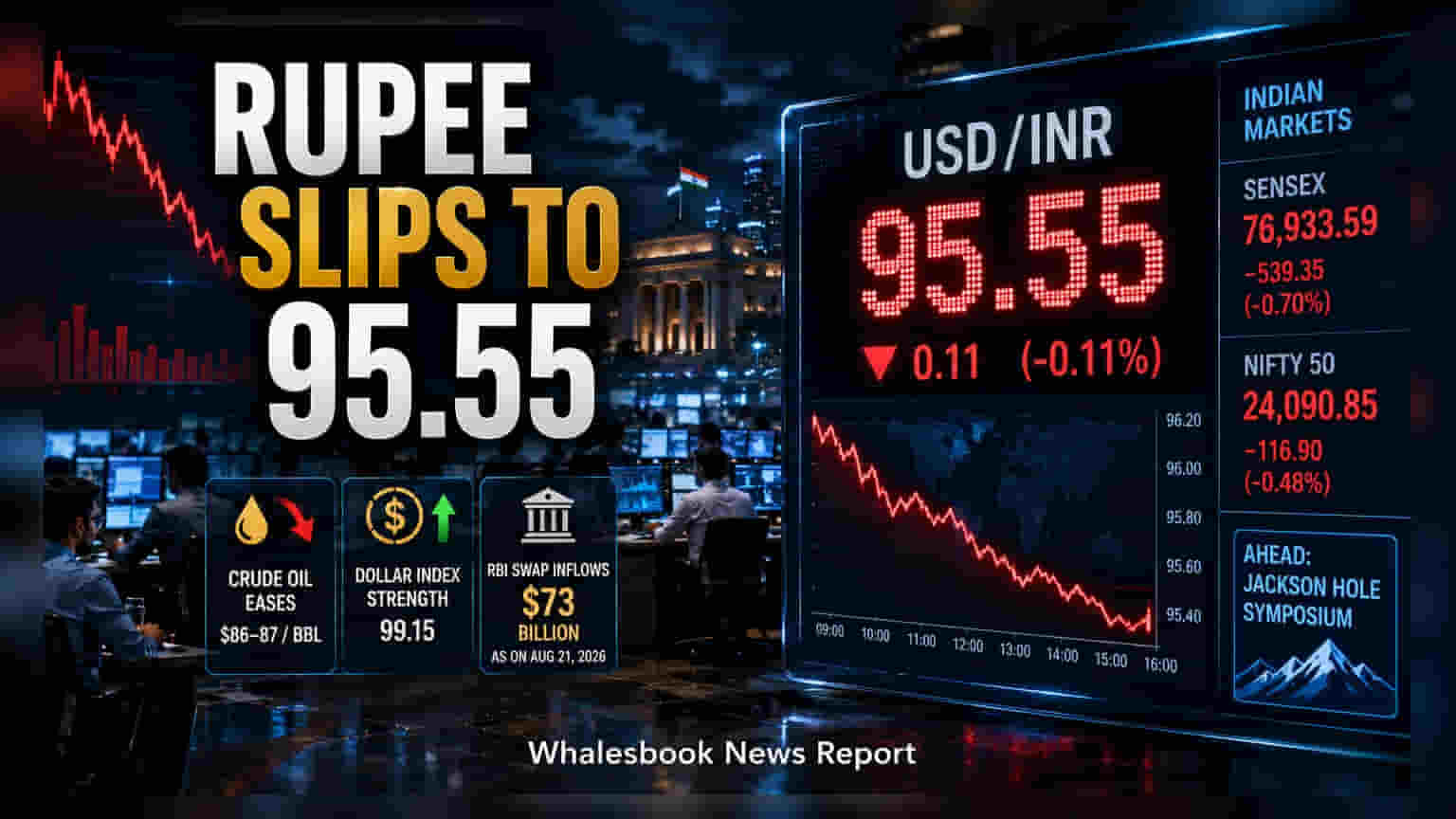
The Indian rupee closed at 95.55 against the US dollar on Thursday, August 27, 2026, dropping 11 paise. Despite lower Brent crude oil prices easing some import pressure, a stronger dollar driven by persistent US inflation concerns pulled the currency down. Equity markets also saw selling pressure as investors await crucial comments from US Federal Reserve officials.
On Thursday, August 27, 2026, the Indian rupee fell 11 paise to end the trading session at 95.55 against the US dollar. The currency faced a difficult day due to competing global factors that created uncertainty for investors.
Usually, when crude oil prices drop, the Indian rupee tends to gain value because India imports a large amount of its oil. Brent crude prices were trading in a range of USD 86 to USD 87 per barrel, helped by diplomatic discussions between Iran and Oman regarding the security of shipping corridors through the Strait of Hormuz. While this lower oil price is a positive factor for the Indian economy, it was not strong enough to protect the rupee on Thursday.
The main problem for the rupee was the strength of the US dollar. The dollar index, which tracks the greenback against a basket of other global currencies, remained strong at approximately 99.15. This strength is largely due to sticky US inflation data, which has kept the market worried that the US Federal Reserve might need to keep interest rates high for a longer time. When US interest rates remain high, global money often moves toward the dollar, which puts pressure on currencies like the Indian rupee.
This negative sentiment spilled over into the domestic equity markets. The BSE Sensex fell 539.35 points to close at 76,933.59, and the Nifty 50 dropped 116.90 points to end at 24,090.85. The selling pressure in stocks, combined with the currency's slide, shows that investors are feeling cautious ahead of the upcoming Jackson Hole Symposium. This annual meeting is a major event where central bank officials, including the US Federal Reserve, discuss monetary policy.
For investors monitoring the situation, the Reserve Bank of India has established a significant safety net. Recent data shows that inflows under special swap facilities have reached nearly USD 73 billion as of August 21. This massive amount of foreign capital provides a buffer for the central bank to manage excessive volatility in the currency market, helping to prevent sharp, uncontrolled drops even when global factors are negative.
The most important update for investors to track in the coming days will be the commentary from the Jackson Hole Symposium. If officials signal that US interest rates will stay high, the dollar could remain strong, keeping pressure on the rupee. Conversely, any hints of a shift in policy direction could change the mood in global currency and stock markets.