 Whalesbook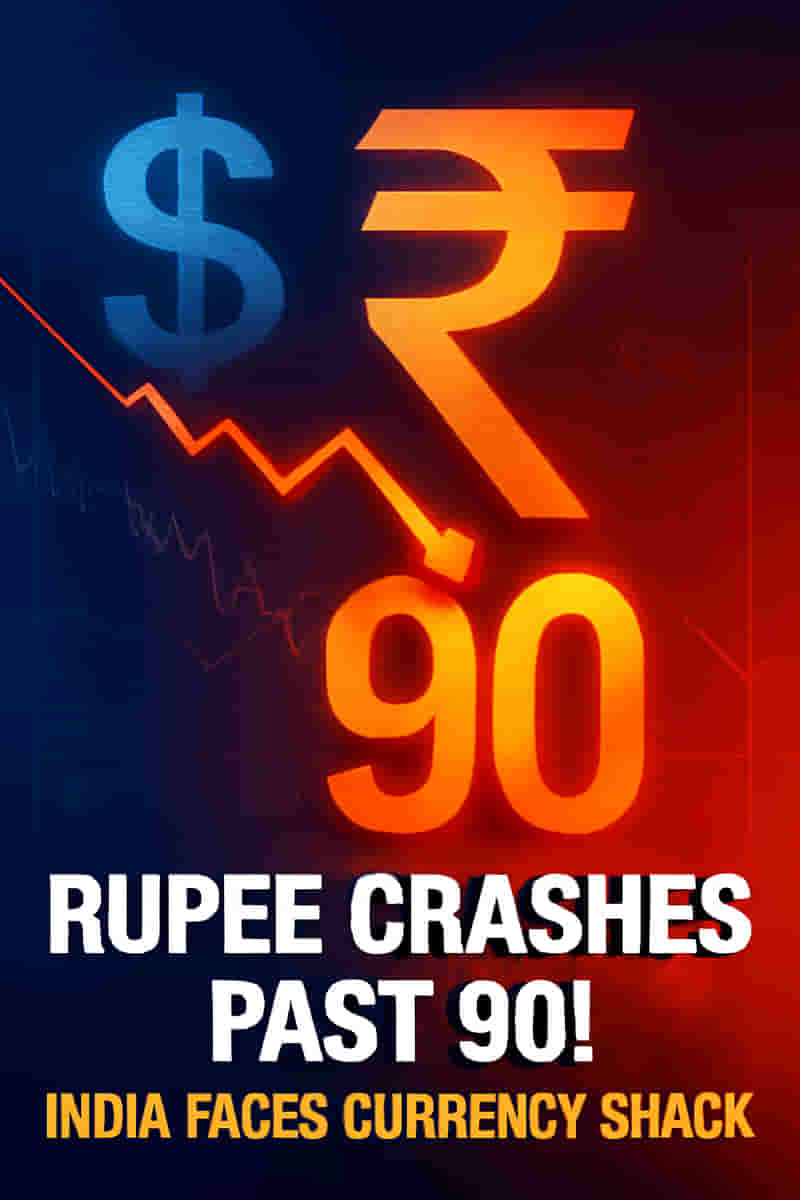
The Indian Rupee has crossed a significant psychological and technical barrier, falling below 90 against the US Dollar for the first time. This marks a critical juncture for India's currency, which is now the worst-performing in Asia this year. The rapid depreciation, moving from 80 to 90 per dollar in just 773 trading sessions, has raised concerns among investors and analysts.
Key Numbers and Data
- The Rupee hit an intraday low of 90.30 on Wednesday before paring some losses, closing at 90.20, down from 89.88 the previous day.
- Year-to-date in 2025, the Rupee has fallen over 5.1% against the Dollar, making it the weakest currency in the Asian region.
- It has also weakened significantly against other major currencies, dropping over 12% against the Euro and nearly 8% against the Chinese Renminbi in 2025.
- As of November 21, India's foreign exchange reserves stood at $688 billion, covering approximately 11 months of imports.
- The net short position in the forward market had swelled to $59 billion by the end of September, which could exert further pressure as it matures.
- India's merchandise trade deficit widened significantly in 2025, reaching $41.7 billion in October.
Reasons for Depreciation
- Capital Outflows: Persistent outflows from Foreign Portfolio Investors (FPIs), particularly from equities after two years of strong inflows, are a major driver.
- Trade Deal Uncertainty: Lingering uncertainty over trade negotiations between the US and India is creating apprehension in the market.
- Dollar Demand: Steady demand for dollars, especially from importers, and reluctance from exporters to sell their dollar holdings, have exacerbated the pressure.
- Limited Intervention: Traders observe limited market intervention by the Reserve Bank of India (RBI), suggesting a focus on smoothing volatility rather than halting the downward trend.
Official and Analyst Perspectives
- Chief Economic Advisor Anantha Nageswaran expressed confidence that the Rupee would recover next year, stating it is not currently hurting exports or inflation. He commented, "If it has to depreciate, now probably is the right time."
- The International Monetary Fund (IMF) recently reclassified India's exchange rate regime from a "stabilised arrangement" to a "crawl-like arrangement," acknowledging more gradual adjustments.
- Barclays revised its forecast for the Rupee to 94 per dollar by 2026, up from 92 previously, noting that the RBI may not strongly resist the current 'crawl' if it aligns with inflation differentials.
- Soumya Kanti Ghosh, group chief economic advisor at State Bank of India, highlighted the "trifecta of limbo in the US-India trade deal, FPI outflows... and the RBI’s clear stance of distancing itself from an ‘interventionist regime’."
- Radhika Rao, an economist at DBS Bank, suggests the currency will be allowed to find its equilibrium to reflect macro shifts, keeping it competitive for manufacturing and exports.
- Anshul Chandak of RBL Bank believes significant appreciation will only occur after the US trade deal is signed, expecting the Rupee to move to 89–89.50 by the end of the fiscal year.
Market Reaction and Outlook
- The Rupee has weakened beyond the RBI's previous defence level near 88.80.
- Market participants observe continuous dollar buying on any dip, indicating that potential recoveries are likely to be shallow.
- The RBI is expected to manage volatility rather than reverse the depreciation trend, with further weakening into next year being a base case for many analysts.
- The Monetary Policy Committee's upcoming meeting is being watched to see if the Rupee's slide influences rate decisions, though benign rates and robust growth make the outlook balanced.
Impact
- The depreciation makes imports more expensive, potentially increasing inflation for consumers and businesses.
- It enhances the competitiveness of Indian exports, which could boost demand for goods manufactured in India.
- Foreign investors may become more cautious due to currency risk, potentially slowing down capital inflows or leading to further outflows.
- The overall cost of servicing foreign debt can increase for Indian companies.
- A weaker Rupee can make foreign travel and education more expensive for Indians.
- Impact Rating: 9/10
Difficult Terms Explained
- Psychological barrier: A level that holds significant importance in traders' minds, influencing their decisions even if not strictly based on technical data.
- Capital outflows: The movement of money or investments out of a country's financial markets.
- FPI (Foreign Portfolio Investor): An investment made by investors located in foreign countries into a country's financial assets, like stocks and bonds.
- REER (Real Effective Exchange Rate): A measure of a currency's value relative to a basket of other currencies, adjusted for inflation. It indicates a currency's international purchasing power.
- Crawl-like arrangement: An exchange rate regime where the currency is allowed to adjust gradually in small steps, often in line with inflation or other economic indicators, rather than being fixed.
- Taper Tantrum: A period of financial market turmoil in 2013 that occurred when the US Federal Reserve signaled its intention to reduce its quantitative easing program.
- Merchandise trade deficit: The difference between the value of a country's merchandise exports and imports, where imports exceed exports.