

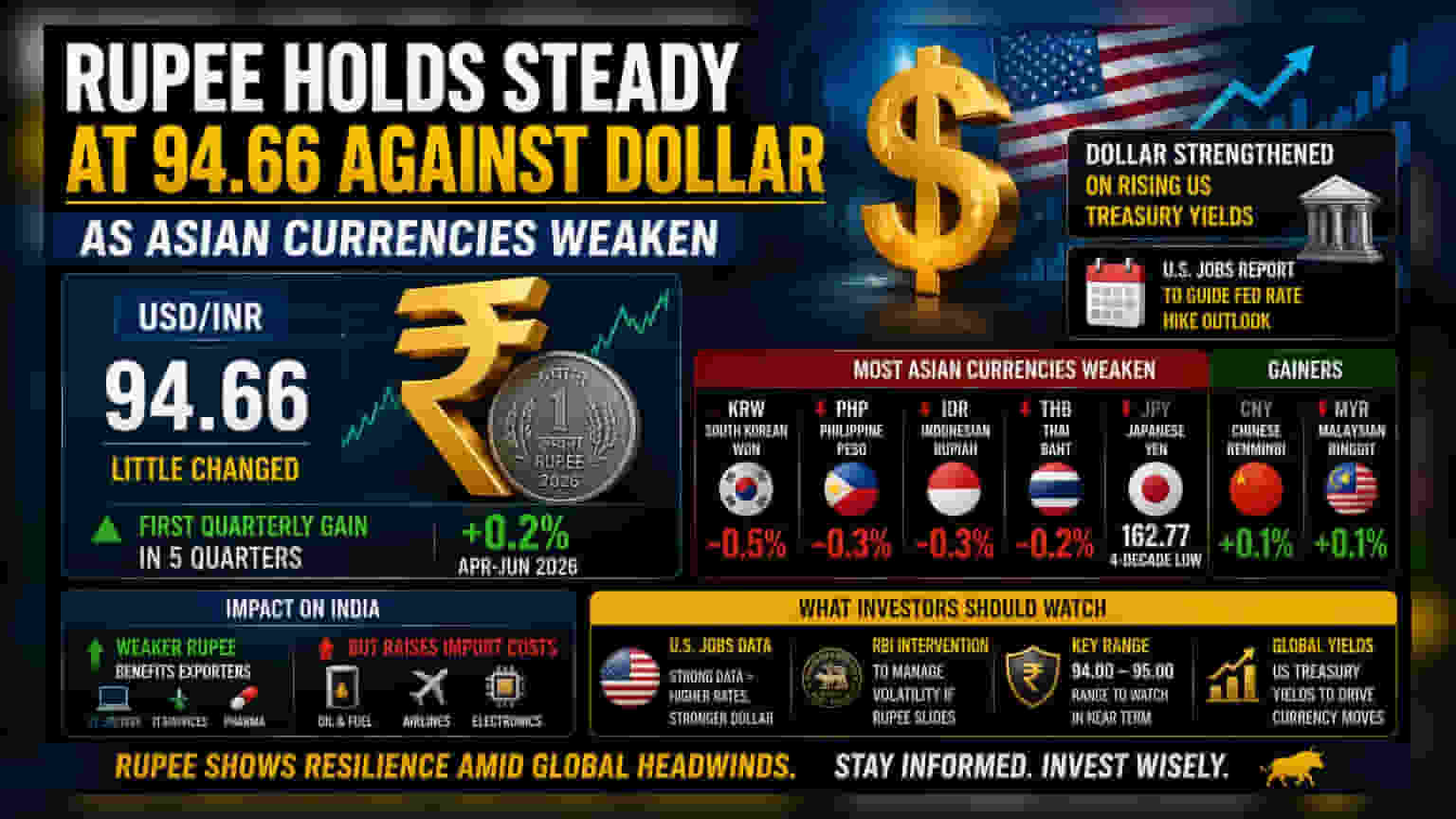
The Indian rupee opened flat against the US dollar on Wednesday, maintaining stability despite a broader slump in Asian currencies. Investors are now looking toward upcoming US employment data and Federal Reserve policy updates to gauge the currency's next move.
What Happened
The Indian rupee began trading on Wednesday at 94.66 against the US dollar, showing little change from the previous closing level. This stability is notable given the broader weakness seen across other Asian markets. The rupee's performance comes after a period of volatility, during which it recorded its first quarterly gain in five quarters, rising about 0.2% between April and June.
The Wider Asian Currency Picture
While the rupee held its ground, most of its Asian peers faced downward pressure. The South Korean Won led the declines, weakening by over 0.5%. The Philippine Peso, Indonesian Rupiah, and Thai Baht also saw losses. Even the Japanese Yen, which has been in focus, hit a four-decade low of 162.77 against the dollar in early trading. Conversely, currencies like the Chinese Renminbi and Malaysian Ringgit managed to stay in positive territory, highlighting a mixed but largely bearish environment for regional currencies.
Why The Dollar Is Strengthening
The primary force behind the dollar's strength is a sharp rise in US Treasury yields. Higher yields in the US often attract capital away from emerging markets, putting pressure on currencies like the rupee. This trend is being driven by market expectations that the Federal Reserve may continue with its interest rate hike cycle. A crucial upcoming US jobs report is expected to provide more clarity on the health of the US economy and dictate the future path of interest rates.
What This Means For Indian Investors
Currency movements act as a double-edged sword for the Indian stock market. A weaker rupee, while beneficial for export-oriented sectors like IT services and pharmaceuticals, increases the cost of imports. This is particularly significant for India's oil marketing companies, airlines, and electronic manufacturers, which rely heavily on imported raw materials or fuel. When the rupee depreciates, their input costs rise, which can put pressure on profit margins if they cannot pass these costs on to consumers.
What To Watch Next
For investors, the immediate monitorable is the upcoming US jobs data. Strong employment numbers often reinforce the case for higher interest rates, which could keep the dollar strong and continue to weigh on Asian currencies. Additionally, market participants will track if the Reserve Bank of India (RBI) intervenes to manage volatility if the rupee begins to slide further. The currency's ability to maintain the 94.00-95.00 range will be a key indicator of its current strength against global headwinds.