

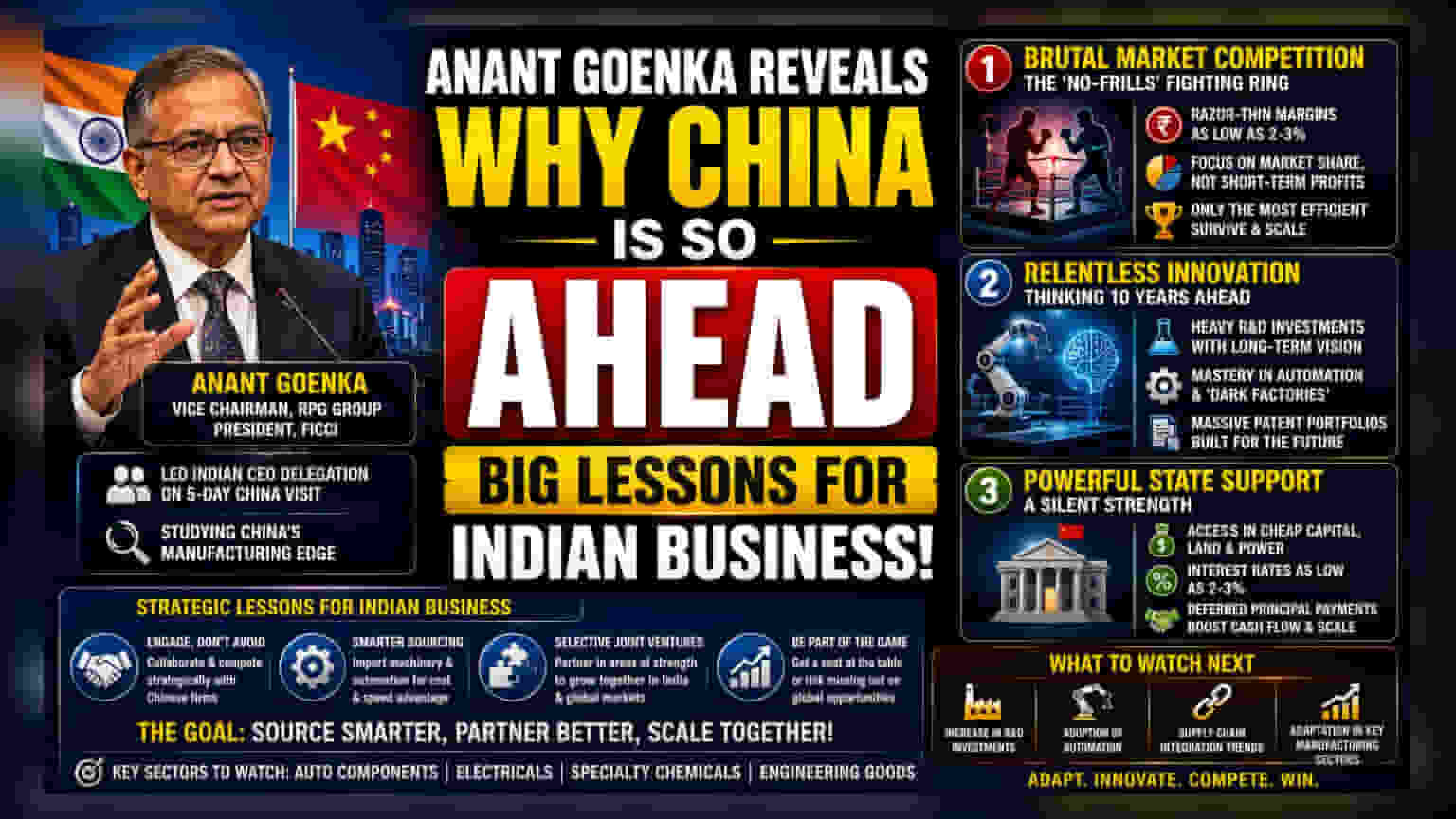
After leading a CEO delegation to China, FICCI President Anant Goenka highlighted why Chinese manufacturing firms are difficult to compete with. He pointed to ultra-thin profit margins, aggressive long-term R&D, and substantial state support as key advantages, urging Indian businesses to shift their strategy from avoidance to smarter engagement and partnership.
What Happened
Anant Goenka, Vice Chairman of the RPG Group and President of FICCI, recently led a delegation of Indian CEOs on a five-day tour of China to study its manufacturing ecosystem. Following the visit, Goenka shared key insights on why Chinese companies have built such a strong global competitive advantage. His observations centered on three core factors: the extremely competitive domestic market environment, a deep commitment to long-term innovation, and significant support from the state.
The 'No-Frills' Margin Challenge
Goenka described the Chinese market as a “no-frills fighting ring,” where businesses operate on razor-thin profit margins, often as low as 2-3%. In such an environment, the primary goal for many companies is to capture market share rather than chase immediate high returns on investment.
For Indian companies, which often prioritize profitability and healthy returns to satisfy stakeholders and boards, this creates a difficult competitive landscape. Companies that survive in China’s intense market are often the most efficient and toughest, allowing them to scale quickly and compete aggressively in global markets.
Innovation and Long-Term Vision
Another major factor Goenka highlighted is the commitment to research and development (R&D). Leading Chinese firms are investing with a ten-year outlook rather than focusing on quarterly financial results. This long-term approach has allowed them to master automation, file extensive patent portfolios, and build highly efficient “dark factories” (factories that operate with minimal human intervention). By prioritizing innovation over short-term gains, these firms secure a competitive edge that is difficult to replicate without similar patience and capital allocation.
The State Support Advantage
Government backing acts as a silent but powerful partner for many Chinese manufacturing giants. Goenka noted that state support provides advantages such as access to cheap capital, land, and power. This financial cushion allows companies to manage interest rates as low as 2-3% and defer principal repayments. This structure fundamentally changes the unit economics of manufacturing, making it cheaper to produce goods and scale operations compared to competitors who must operate without such state-provided cost advantages.
Strategic Lessons for Indian Business
Rather than suggesting that Indian companies should avoid China, Goenka advocates for strategic engagement. His recommendations include shifting the focus from simple import-based relationships to smarter sourcing, such as importing machinery and automation solutions that offer clear cost and speed advantages. He also suggested that Indian companies should explore selective joint ventures.
His core message is that if Indian firms do not find a way to integrate or compete at the table, they risk losing out to global supply chain shifts. The goal is for Indian businesses to not only source from China but also position themselves as essential partners to Chinese firms that are expanding their footprints both within India and in international markets.
What To Watch Next
For investors and industry followers, the monitorable is how Indian manufacturing sectors—such as auto components, electricals, and specialty chemicals—adapt these lessons. Success will depend on whether companies can increase investment in R&D, improve automation, and navigate the challenges posed by global competitors with state-backed advantages. Strategic shifts toward partnerships or deeper supply chain integration will be the trends to track in the coming quarters.