

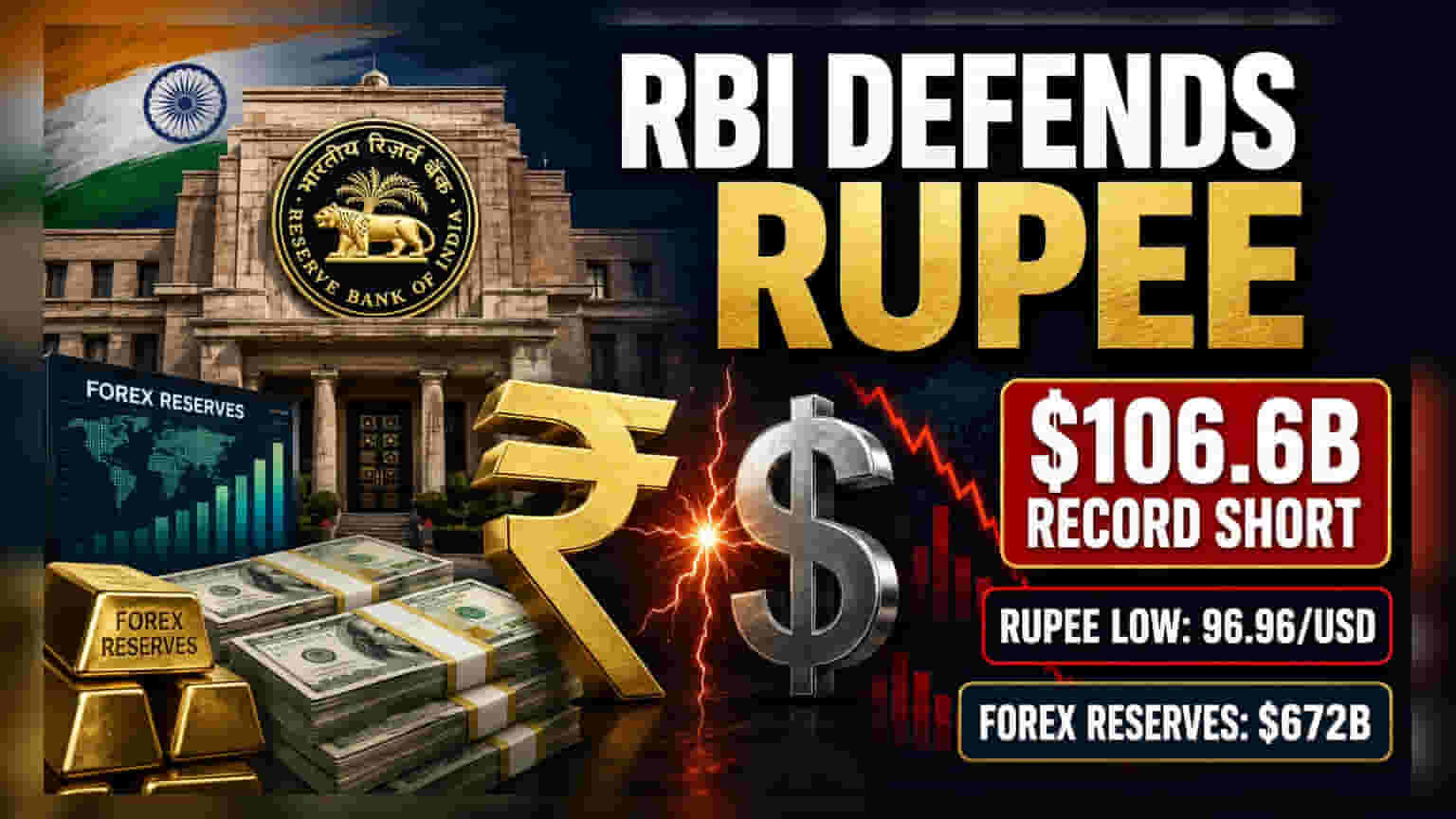
The Reserve Bank of India’s net short forward position in forex markets climbed to a record $106.6 billion in May. This record level highlights the central bank's active intervention to stabilize the rupee amid global volatility. Investors are now tracking expected foreign capital inflows, which are crucial for the RBI to manage this position and rebuild its foreign exchange reserves.
What Happened
The Reserve Bank of India (RBI) saw its net short forward position in the foreign exchange market climb to a record $106.6 billion in May 2026. This is a significant jump from the $95 billion recorded in April. In simple terms, this means the central bank has intervened heavily in the foreign exchange market to prevent the rupee from falling too sharply against the US dollar. By entering into these forward contracts, the RBI is essentially promising to sell dollars at a future date to manage liquidity and support the rupee today without immediately depleting its physical dollar reserves.
Why This Matters For The Business Environment
The Indian rupee has faced significant pressure this year, partly due to global volatility stemming from the ongoing Middle East conflict. The rupee touched an all-time low of 96.96 against the US dollar in May. Without the RBI's active intervention, the currency might have breached critical psychological levels, potentially leading to further market instability. This large short position acts as a safety valve, allowing the central bank to manage rupee fluctuations while maintaining a semblance of stability in the forex market.
The Reserves and Intervention Picture
Maintaining the value of the rupee comes at a cost to the country's foreign exchange reserves. While India’s reserves remain substantial, they have declined to approximately $672 billion from their peak of $728 billion reached in late February. The widening of the net short forward position reflects the intense effort required to cushion the rupee against a strong US dollar and foreign fund outflows. For investors, this data is an indicator of how hard the central bank is working to balance currency stability with the need to preserve an adequate buffer of foreign currency.
The Outlook for Inflows
Market participants are closely watching for signs of significant capital inflows to help ease this pressure. Expectations are building that measures by the government and the RBI to attract overseas funds could result in inflows of $40 billion to $70 billion. These inflows, expected through sources like external commercial borrowings and FCNR(B) deposits, are seen as the primary mechanism for the RBI to gradually unwind its record net short forward position. If these inflows materialize, they could help the central bank rebuild its reserves and reduce its forward obligations.
What Investors Should Track Next
The key monitorable for the market is the actual arrival of these expected capital inflows. If inflows are delayed or smaller than projected, the RBI may continue to face pressure to manage the currency. Investors should also watch the monthly updates on forex reserves and any official commentary on the rupee's trajectory. Furthermore, currency volatility remains a factor; significant spikes in the dollar-rupee exchange rate will likely trigger further defensive actions from the central bank, which will continue to be reflected in future forward position data.