

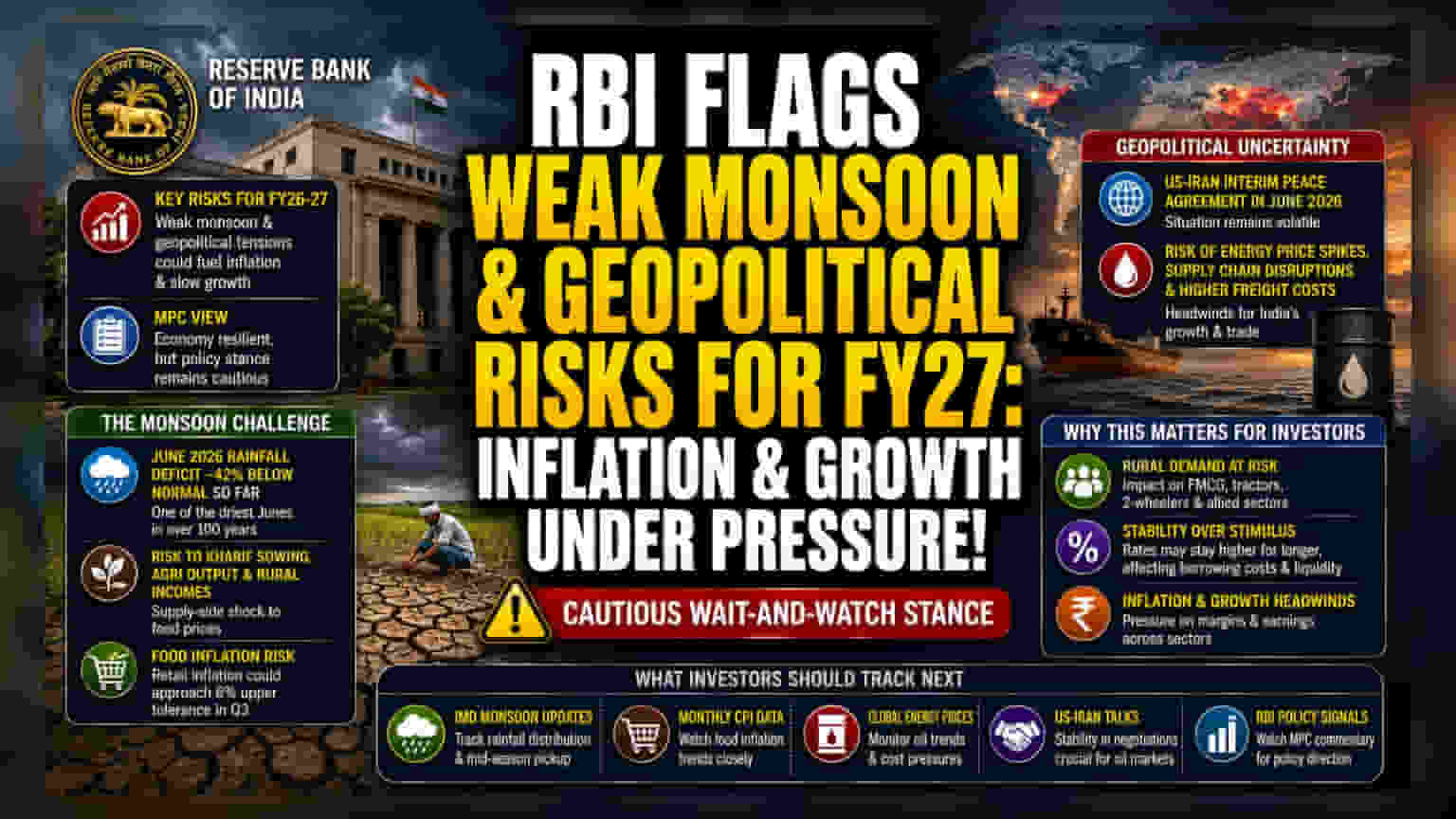
The Reserve Bank of India has identified a weak southwest monsoon and fragile global geopolitical conditions as primary risks for India's economic growth and inflation outlook in FY27. With rainfall in June significantly below normal, policymakers are concerned about potential food inflation and dampened rural demand.
What Happened
The Reserve Bank of India (RBI) has flagged a weak southwest monsoon and persisting global geopolitical tensions as key risks to the domestic economy for the 2026-27 financial year. In its latest bulletin and recent Monetary Policy Committee (MPC) minutes, the central bank highlighted that these twin factors could put upward pressure on inflation and create headwinds for economic growth. Policymakers noted that while the economy has shown resilience, these external and domestic variables have led the committee to adopt a cautious, "wait-and-watch" approach regarding future monetary policy.
The Monsoon Challenge
The monsoon's progress is critical for India, as it directly influences agricultural output, rural incomes, and food prices. Reports indicate that June 2026 has experienced a significant rainfall deficit—roughly 42% below normal so far—marking it as one of the driest Junes in over a century. A deficient monsoon poses a direct risk to kharif crop sowing and can trigger a supply-side shock to food prices. With food inflation already a sensitive area for policymakers, the central bank has warned that retail inflation could approach the 6% upper tolerance limit in the third quarter if these weather-related pressures persist.
Geopolitical Uncertainty
Beyond domestic weather risks, the RBI emphasized that the global economic environment remains fragile. Although an interim peace agreement was signed between the United States and Iran in mid-June 2026 to help stabilize energy markets, the situation remains highly volatile. Recent developments, including strained talks and ongoing regional conflicts, mean that energy prices, supply chains, and freight costs remain vulnerable to sudden spikes. For the Indian economy, which relies on energy imports, this translates to persistent uncertainty in input costs and trade stability.
Why This Matters For Investors
The combination of weather-related supply risks and global commodity volatility creates a complex backdrop for the markets. Rural demand, which drives sectors like fast-moving consumer goods (FMCG), tractors, and two-wheelers, is closely tied to the monsoon's performance. If rainfall does not improve, rural consumption could face pressure, potentially impacting earnings for companies dependent on this segment. Furthermore, the RBI's focus on "stability over stimulus" suggests that interest rates may remain higher for longer, influencing borrowing costs and liquidity conditions.
What Investors Should Track Next
Investors should monitor the India Meteorological Department’s (IMD) updates on rainfall distribution over the coming weeks, as a mid-season pickup could mitigate the initial June deficit. Key economic data points to watch include monthly Consumer Price Index (CPI) readings for signs of food inflation and any official commentary on global energy price trends. Additionally, tracking the stability of the US-Iran negotiations and any further impact on global oil markets will be essential to understanding the near-term economic risk profile.