 Whalesbook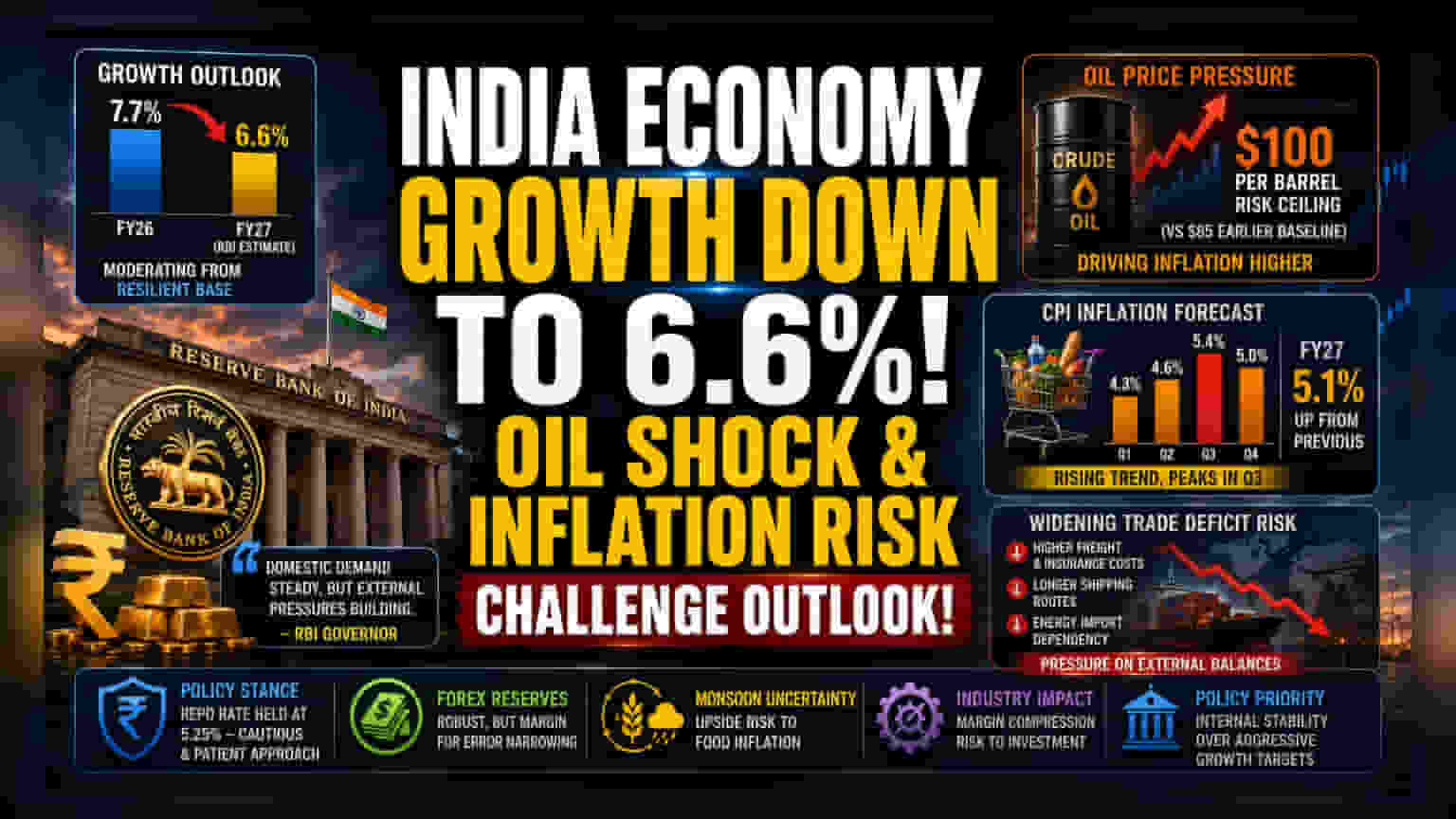


The Valuation of Economic Resilience
The Reserve Bank of India’s decision to temper its growth outlook to 6.6% for the 2026-27 fiscal year arrives as the economy confronts a convergence of external headwinds. While India’s GDP clocked a resilient 7.7% expansion in FY26, the central bank’s revision acknowledges the growing drag from prolonged supply-chain disruptions and energy price volatility. Governor Sanjay Malhotra emphasized that while domestic demand in services and manufacturing sectors remains steady, the cost of imported inflation is no longer negligible. This downward adjustment aligns with broader market concerns that the energy shock—exacerbated by logistical constraints in the Strait of Hormuz—is beginning to filter through to domestic input costs and wholesale price indices.
The Oil-Inflation Feedback Loop
Chief Economic Advisor Anantha Nageswaran has explicitly linked the stability of India’s inflation path to the $100-per-barrel ceiling for crude oil. With global markets remaining skittish due to regional instability, the landed cost of crude has hovered at elevated levels, significantly surpassing previous policy baselines of $85 per barrel. The central bank has responded by lifting its CPI inflation projection to 5.1%, with quarterly estimates showing a firming trend that peaks in the third quarter. Unlike previous periods of stability, the current environment presents a structural challenge where import diversification—while necessary—inevitably comes at a higher fiscal premium, further complicating the government's efforts to anchor price expectations.
Structural Pressure on External Balances
The anticipation of a widening trade deficit for FY27 reflects a sustained departure from the more favorable dynamics observed in prior years. Merchandise exports, despite holding ground in sectors like services, face mounting pressure from higher freight insurance premiums and longer shipping routes. This external imbalance is compounded by the country’s dependency on energy imports, which remain the primary driver of volatility in the balance of payments. Even with robust foreign exchange reserves, the fiscal and monetary authorities are clearly signaling that the margin for error has narrowed, requiring a more cautious approach to policy that prioritizes internal stability over aggressive growth targets.
Risk Factors and Policy Constraints
A central concern for the remainder of the fiscal year is the potential for these pressures to become entrenched. Beyond the immediate energy shock, the uncertainty surrounding the southwest monsoon poses a distinct upside risk to food inflation, which remains a core component of the consumption basket. Critics and market observers also note that while the current interest rate of 5.25% is held steady, the persistent gap between actual inflation and the medium-term 4% target leaves little room for monetary easing. Should supply-side constraints in wholesale energy persist, the potential for margin compression across industrial sectors could dampen private investment, forcing a recalibration of the 6.6% growth expectation if the current geopolitical uncertainty does not abate.