

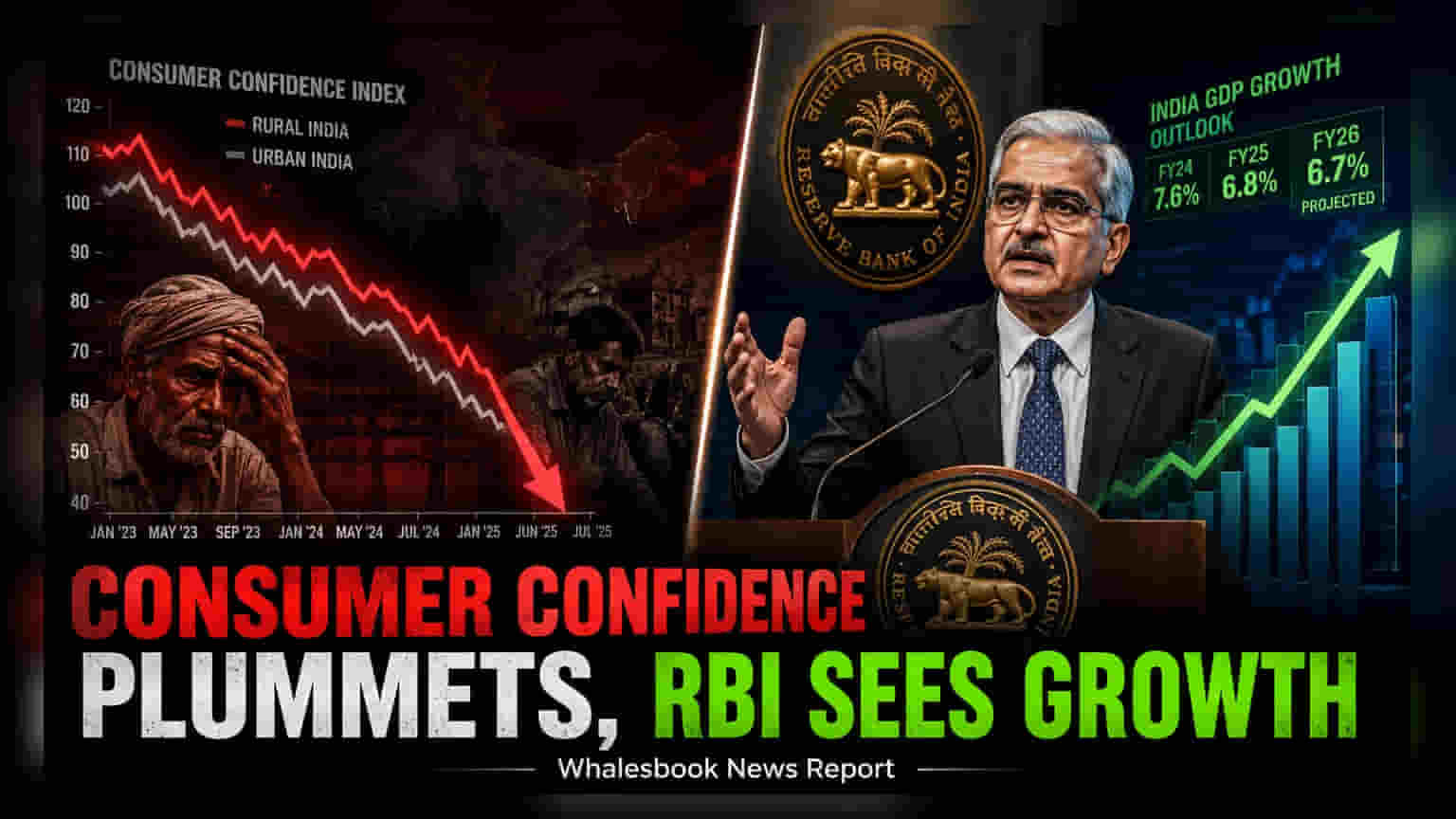
The Reserve Bank of India has increased its FY27 GDP growth forecast to 6.7%, citing strong urban consumption. However, the central bank’s latest surveys show a sharp dip in household confidence, particularly in rural areas due to inflation and monsoon risks. This divergence between overall economic growth and mass-market consumer sentiment creates a complex outlook for consumption-heavy sectors.
The Reserve Bank of India (RBI) has projected a resilient path for the Indian economy, raising its real GDP growth forecast for the 2026-27 financial year to 6.7% from 6.6%. During the August 2026 monetary policy meeting, where the central bank also maintained the repo rate at 5.25%, officials highlighted that domestic private consumption remains a key driver of growth. This official optimism, however, stands in stark contrast to the RBI’s own consumer confidence surveys, which reveal a deep sense of pessimism among households.
The Growing Divergence
There is an increasing gap between the macro-level economic data and what individual households are experiencing. The RBI’s assessment points to strong discretionary spending in urban areas, which keeps aggregate demand figures high. Essentially, the growth numbers are being supported by a smaller, more affluent segment of the population that continues to spend on high-end goods and services.
In contrast, the broader household sentiment has deteriorated significantly. The latest survey data shows rural confidence at a historic low, with the Current Situation Index (CSI) falling to 91.7, while urban confidence has dropped to 88.3. This pessimism suggests that for the average family, the cost of living—driven by food inflation and economic uncertainty—is weighing heavier than the headline GDP growth figures suggest.
Challenges for Mass-Market Consumption
This shift in sentiment has material implications for industries that rely on mass-market demand, such as FMCG and automobiles. While luxury and premium segments have shown resilience, the volume growth in mass-market products remains under pressure. The current sentiment data suggests that unless there is a recovery, the upcoming festive season may not see the broad-based consumption bounce that many companies hope for.
Adding to this pressure is the outlook for the agricultural sector. The India Meteorological Department has projected below-normal rainfall for the second half of the monsoon season. A weak monsoon can directly impact rural income, reduce agricultural output, and keep food inflation elevated. This creates a difficult cycle: rising food prices hurt household budgets, which then forces families to cut back on non-essential spending, further weakening consumer confidence.
Investor Monitorables
For investors, the key to navigating this environment lies in tracking how different business segments respond. While the RBI’s GDP forecast provides a positive backdrop, the internal weakness in household sentiment acts as a significant headwind for companies dependent on volume growth in semi-urban and rural markets.
Market participants will likely watch for upcoming quarterly earnings results to see if the divide between premium and mass-market performance is widening. Additionally, any data points regarding festive season demand, rural employment, and trends in food inflation will be critical to determine if consumption can stabilize or if the current caution will persist in the coming months.