 Whalesbook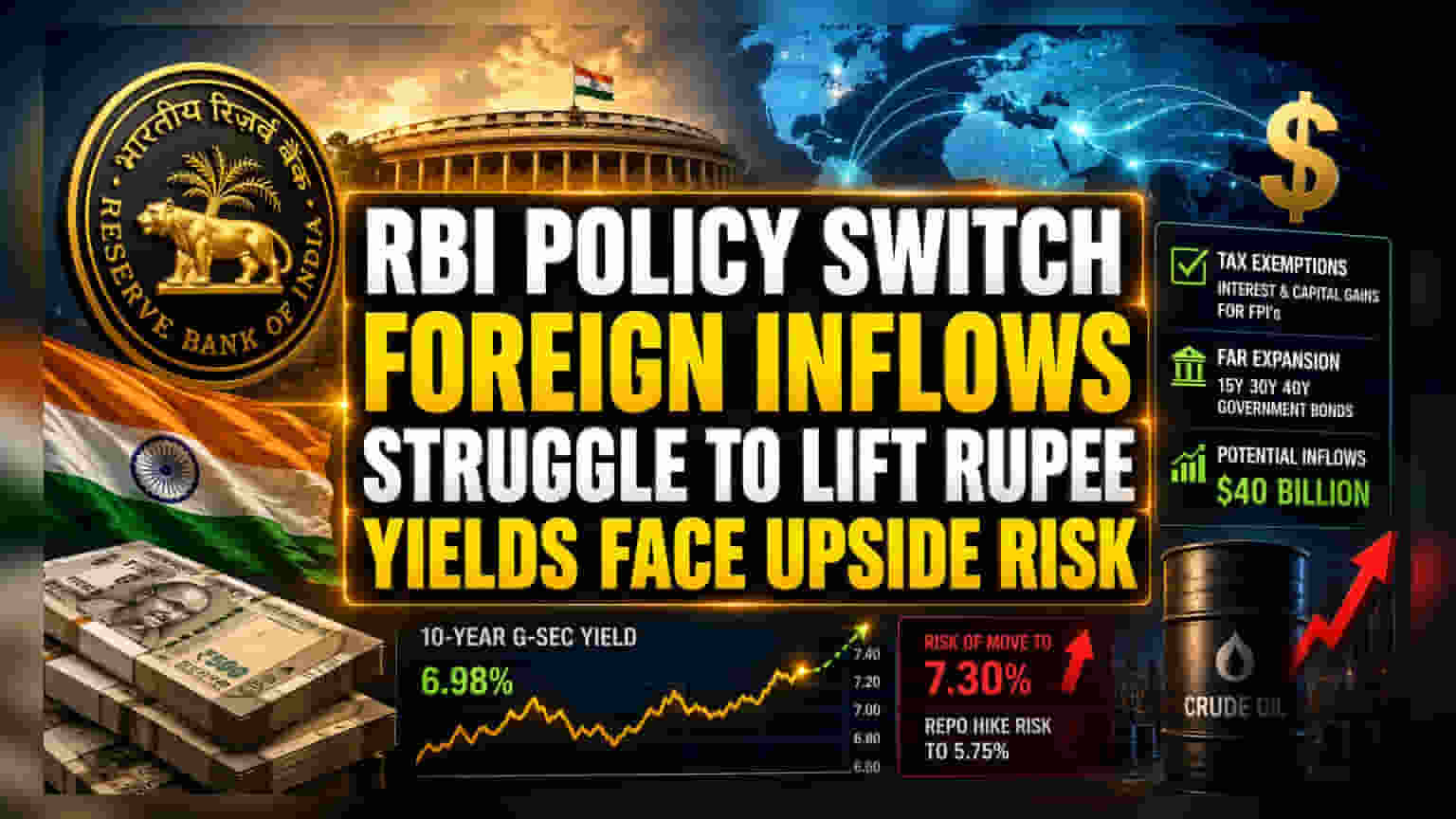


The Valuation Gap
The recent synchronized policy pivot by the Reserve Bank of India and the government seeks to fortify the rupee through a structural increase in foreign inflows. By granting full tax exemptions on interest and capital gains for foreign institutional investors—applied retroactively from April 1, 2026—and expanding the Fully Accessible Route (FAR) to include 15, 30, and 40-year government bonds, authorities are effectively subsidizing the cost of capital. Market estimates suggest these mechanisms could catalyze up to $40 billion in inflows, theoretically creating a floor for the balance of payments. However, live market data indicates that these incentives are struggling to overcome macroeconomic gravity. The 10-year G-Sec yield, currently hovering near 6.98%, remains susceptible to volatility as traders weigh the promised liquidity against persistent external threats.
The Analytical Deep Dive
Unlike previous cycles where yield compression was driven by domestic demand, the current narrative hinges on global index inclusion and foreign participation. Competitor benchmarking against regional emerging markets shows that while India’s real yields remain relatively attractive, the risk premium is expanding. Crude oil prices, which have averaged roughly $110 per barrel recently, act as a primary anchor, dragging on sentiment. Fund managers are increasingly bifurcating their portfolios; while the front end of the curve benefits from liquidity-injected stability, the long end is trapped in a defensive posture. Unlike the optimistic projections surrounding the $40 billion inflow target, the consensus among fixed-income desks is that until the inflation trajectory settles, yield additions at the long end are premature. Analysts are eyeing a potential move toward 7.30% on the 10-year benchmark as market participants price in the likelihood of a 50-basis-point hike in the repo rate to 5.75% later this year.
The Forensic Bear Case
The central bank's June decision to maintain the 5.25% repo rate masked a significant hawkish shift in underlying forecasts. The RBI's decision to hike its FY27 inflation projection by 50 basis points to 5.1%—despite an upwardly revised growth risk—signals that the central bank is prepared to sacrifice growth to maintain price stability. The bear case is structural: if global supply chains remain fractured and crude prices stay elevated, the current 'neutral' policy stance will likely collapse into a renewed tightening cycle. Furthermore, the reliance on foreign inflows to stabilize the rupee creates a dangerous feedback loop; if global risk appetite shifts due to continued West Asia instability, these same inflows could rapidly reverse, exacerbating volatility and pushing yields higher precisely when the government needs them to be contained.
The Future Outlook
Forward-looking sentiment remains guarded, with institutional desks adopting a wait-and-see approach. Expectation is that any meaningful duration additions will only occur following clear signs of crude price moderation or a definitive shift in the RBI's inflation mandate. As it stands, the market is pricing in a 'higher-for-longer' environment, keeping yields anchored to inflation-adjusted expectations rather than the short-term sugar rush of new foreign investment policy.