 Whalesbook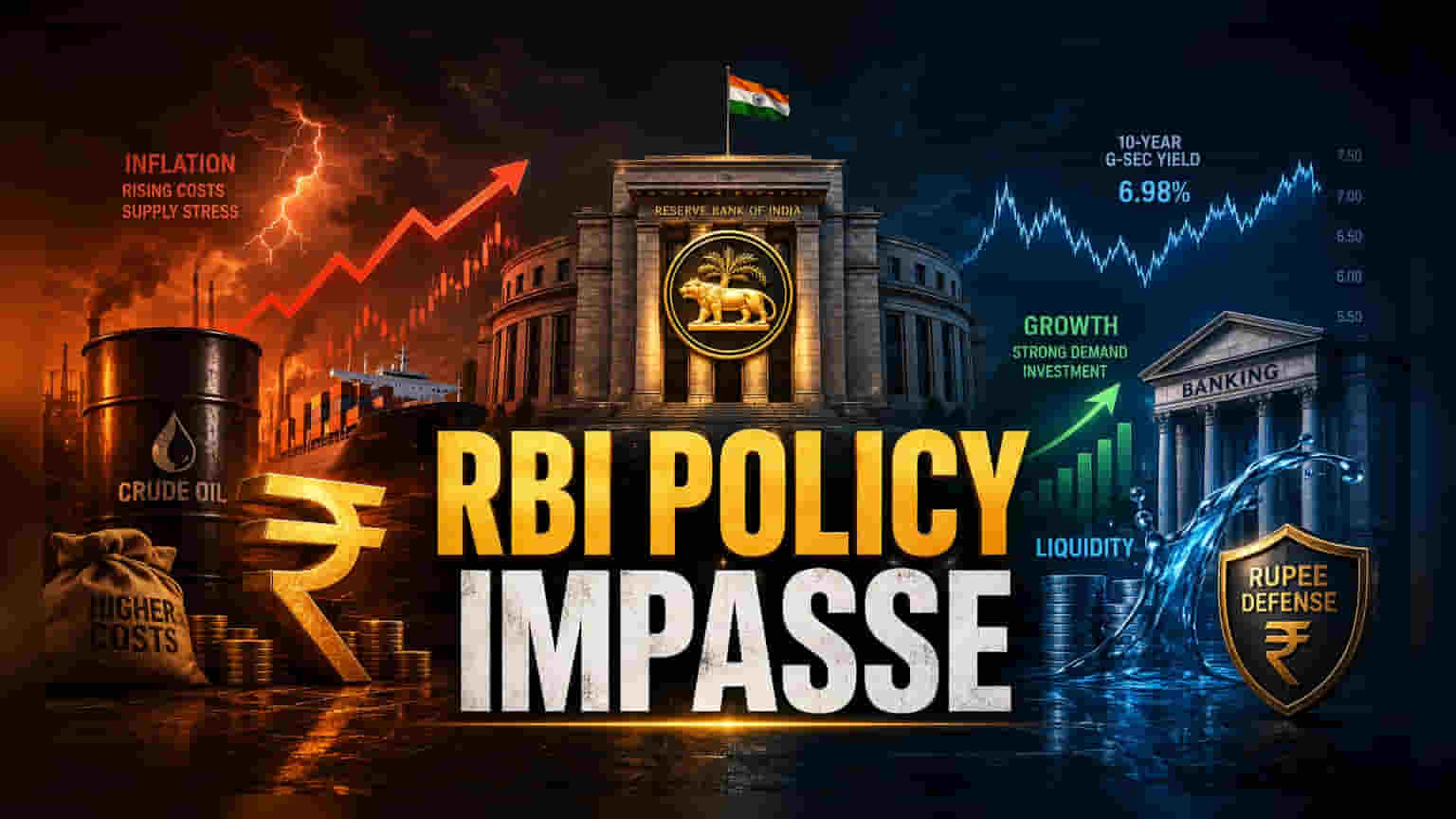


The Policy Impasse
The Reserve Bank of India’s Monetary Policy Committee initiates its three-day deliberation on June 3, tasked with balancing internal economic resilience against an increasingly hostile external environment. With market consensus heavily favoring a status quo on the repo rate at 5.25%, the meeting has evolved into a exercise in signaling. The central bank is no longer operating under the assumption that geopolitical shocks in West Asia are transitory; instead, policymakers must now integrate the reality of elevated crude prices and logistics disruptions into their medium-term projections.
The Inflation-Growth Trade-off
While headline Consumer Price Index inflation has remained within the 2-6% tolerance band—recorded at 3.48% in April—the structural risks are mounting. Wholesale price inflation, which hit 8.30%, underscores the pass-through effect of rising fuel and energy costs. The committee is widely expected to adopt a more hawkish tone, with forecasts for FY27 inflation likely to be nudged toward the 5% mark. Concurrently, the growth narrative faces a reality check. While India's FY26 GDP growth remains resilient, reaching an estimated 7.3-7.6% range, the outlook for FY27 is darkening. Multiple global institutions have trimmed their forecasts to the 6.4-6.6% range, citing the dampening effects of trade volatility and the erosion of private consumption power caused by imported inflation.
Liquidity and The Rupee Defense
Beyond interest rates, the operational focus has shifted to the liquidity corridor and foreign exchange management. The rupee, having suffered a significant slide in 2026, has placed the RBI in a difficult position. Unlike previous cycles where rate hikes were the primary tool, there is a growing institutional preference for utilizing non-monetary interventions—such as targeted liquidity swaps and calibrated use of foreign exchange reserves—to manage currency volatility. The 10-year G-Sec yield, hovering near 7.00%, reflects a heightened risk premium that the central bank will likely attempt to contain without triggering a broad-based tightening of financial conditions that could choke the current credit expansion cycle.
The Risk of Policy Inertia
The primary risk to the current status-quo approach is the potential for domestic inflation to unanchor if commodity prices sustain their current trajectory. Critics argue that by choosing to "look through" supply-side shocks, the central bank risks falling behind the curve. Management of the liquidity stance remains the most sensitive lever; any shift from 'adequate' to 'neutral' could tighten market conditions abruptly, impacting sectors such as banking and infrastructure that rely on sustained credit growth. Furthermore, the reliance on non-monetary tools to defend the rupee may prove insufficient if foreign institutional outflows accelerate, forcing the committee to choose between higher rates or further currency depreciation.