

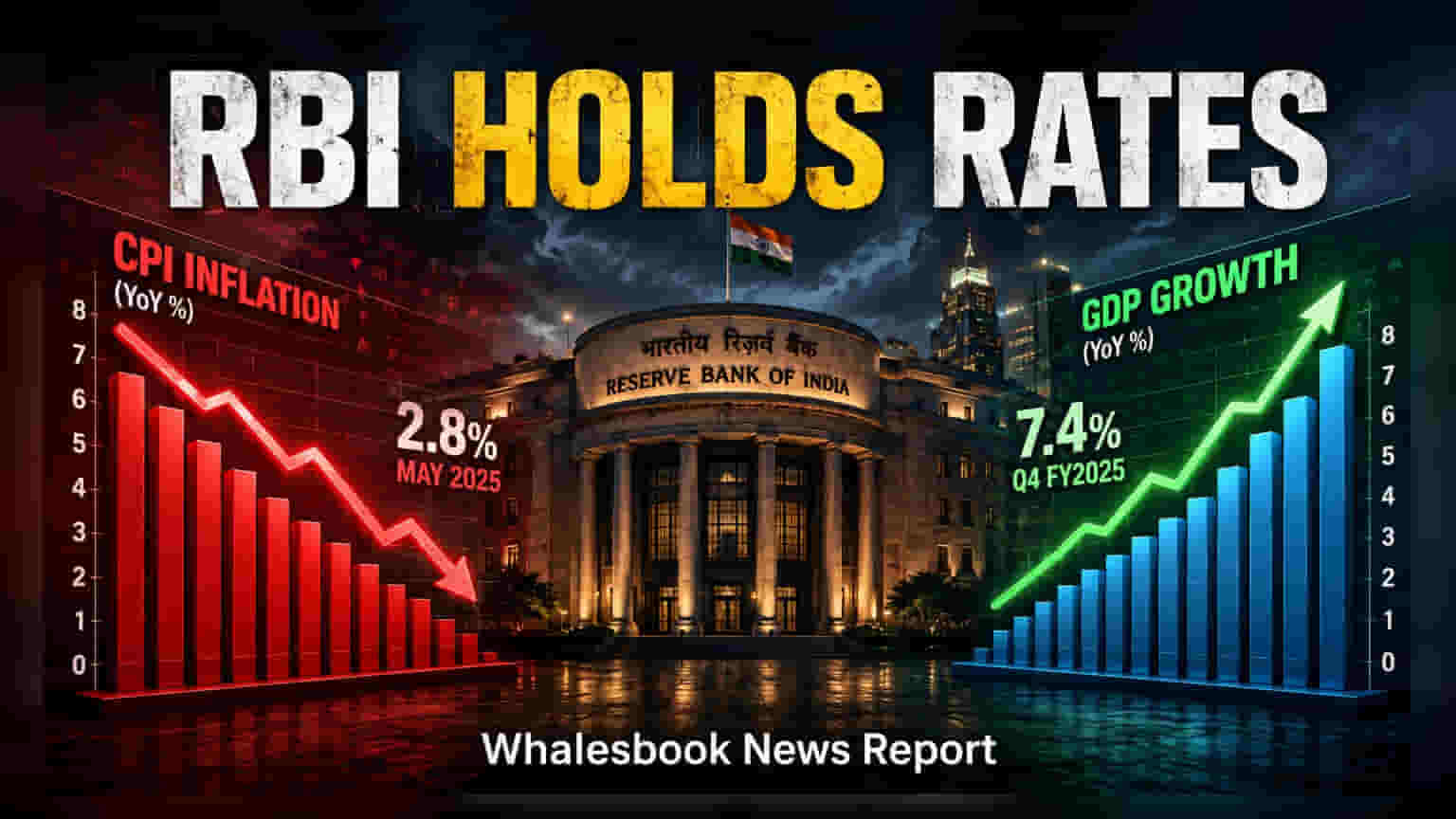
The Reserve Bank of India kept the benchmark repo rate unchanged at 5.25% during its August meeting, while retaining a neutral stance. The central bank raised its FY27 GDP growth projection to 6.7% and lowered the CPI inflation estimate to 5.0%. Financial markets remained steady following the announcement, though the RBI highlighted risks from geopolitical tensions and monsoon uncertainty.
The Reserve Bank of India (RBI) Monetary Policy Committee (MPC) unanimously decided to maintain the benchmark repo rate at 5.25% in its latest policy review. This decision keeps borrowing costs unchanged for the fourth consecutive time, signaling a focus on balancing economic growth with controlled inflation. The committee also retained its neutral policy stance, providing no immediate signal of a shift in direction.
In a move reflecting confidence in the domestic economy, the RBI revised its real GDP growth forecast for the 2026-27 fiscal year to 6.7%, up from the earlier estimate of 6.6%. Alongside this growth optimism, the central bank lowered its Consumer Price Index (CPI) inflation projection to 5.0% for the current fiscal year, down from 5.1%. These revisions suggest that the central bank sees a favorable environment where economic activity remains resilient while price pressures show signs of easing.
The domestic equity markets responded positively to the announcement, with both the S&P BSE Sensex and the Nifty 50 indices closing in the green on August 5. The Indian Rupee also saw a strengthening trend against the US Dollar as investor sentiment aligned with the central bank’s stable outlook.
Despite the positive forecast, the RBI warned that the economic path is not without challenges. The committee specifically pointed to rising geopolitical tensions in West Asia as a primary risk. This uncertainty has the potential to cause volatility in global energy markets and crude oil prices, which could feed into domestic inflation. Additionally, the unpredictable nature of the southwest monsoon remains a concern, as it directly impacts agricultural output and rural consumer demand.
While the current environment is stable, the central bank maintains that supply-side constraints, particularly regarding food and fuel, could trigger inflationary pressure if they persist. Investors may monitor future monthly inflation data and global oil price movements as key indicators of the central bank's next steps. The focus remains on how the economy handles these external pressures, with the RBI’s next policy meeting expected to provide further clarity on the trajectory of interest rates.