

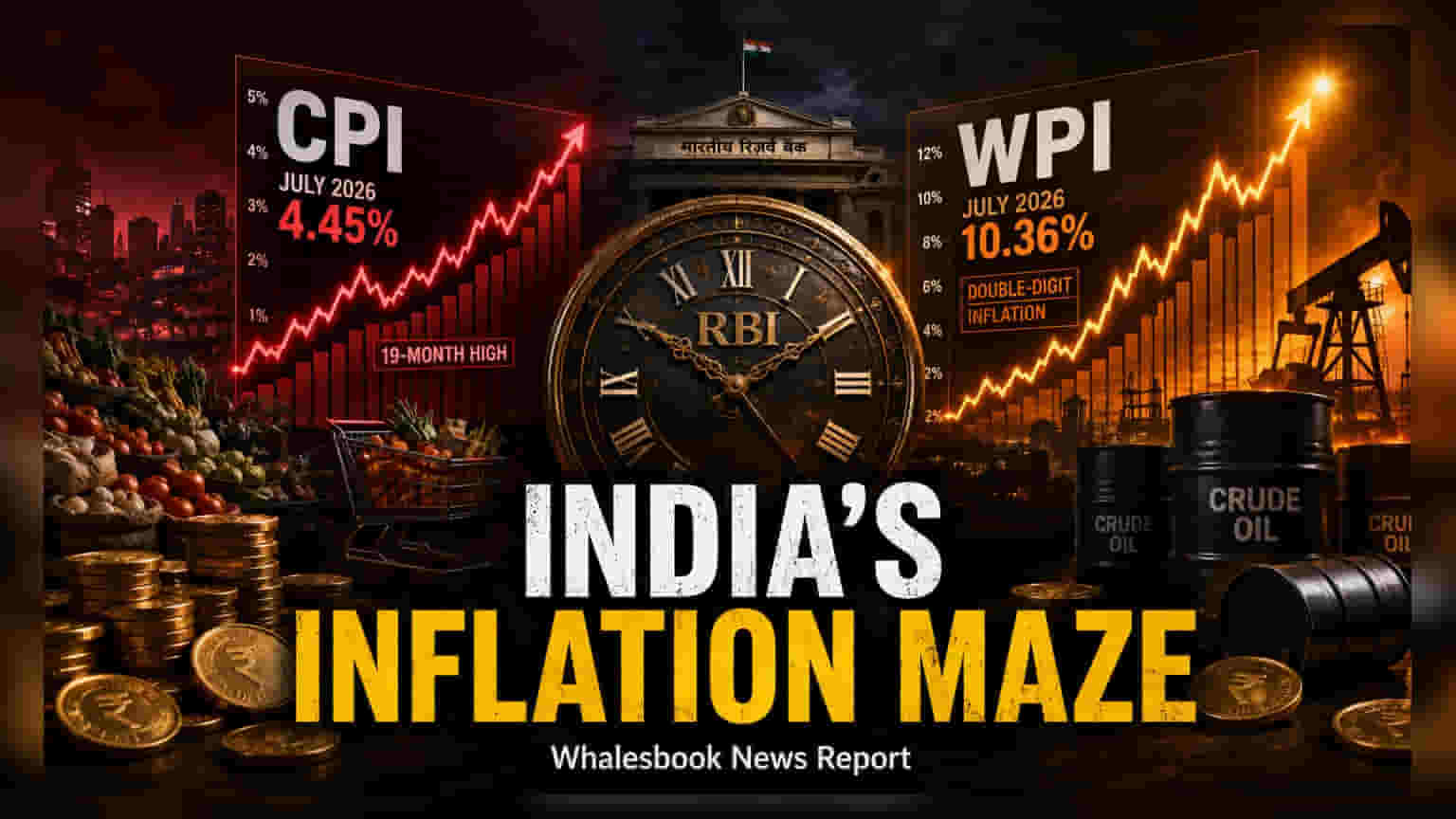
The Reserve Bank of India (RBI) has kept the repo rate steady at 5.25% in its August 2026 meeting while navigating conflicting inflation signals. While headline retail inflation reached a 19-month high of 4.45% in July, the central bank is balancing this with a revised GDP growth forecast of 6.7%. Investors are now closely watching global crude price trends and monsoon progress for future interest rate cues.
The Reserve Bank of India’s Monetary Policy Committee (MPC) voted unanimously to keep the benchmark repo rate unchanged at 5.25% during its August 2026 meeting. This decision comes as the central bank grapples with a distinct separation between consumer and wholesale inflation, a challenge described by market analysts as a "chalk and cheese" dilemma due to conflicting signals on economic health.
Retail inflation, measured by the Consumer Price Index (CPI), climbed to 4.45% in July 2026, marking a 19-month high. While this figure remains within the RBI's broader comfort zone, the upward trend has created caution. In contrast, Wholesale Price Index (WPI) inflation has surged into double digits, heavily impacted by rising commodity prices and supply chain pressures. This divergence forces policymakers to determine if these price spikes are temporary or if they will filter through to the broader economy.
Internal communications have added another layer of complexity. Reports, including analysis from SBI Research, have highlighted a notable gap between the hawkish tone reflected in the MPC's official meeting minutes and the more patient, data-dependent communication style adopted by Governor Sanjay Malhotra. This difference in messaging has left market participants uncertain about the timeline for future interest rate actions.
Despite these inflationary headwinds, the central bank maintains a constructive outlook on domestic growth. The RBI has raised its FY27 GDP growth forecast to 6.7% from 6.6%, indicating resilience in domestic demand. Furthermore, the RBI has lowered its annual CPI inflation projection to 5.0% from 5.1%, suggesting a belief that inflation will moderate after an expected peak of 5.9% in the third quarter of this fiscal year.
The economic outlook is not without significant risks. Global geopolitical tensions, particularly those impacting crude oil suppliers, remain a primary concern for the central bank. Additionally, the impact of uneven monsoon conditions on food prices and rural demand remains a wildcard that could force a change in policy stance. If food and fuel prices do not stabilize, there is a risk that these pressures could transition into generalized inflation.
Indian equity markets, including the Sensex and Nifty, have faced downward pressure in late August as investors weigh these mixed economic signals against global uncertainties. The path forward for the Indian economy will depend heavily on the RBI's ability to navigate these divergent inflation trends without stifling the current growth momentum. Market participants will be looking for any shifts in management commentary or significant movements in global energy costs, which remain the most critical variables for the central bank’s upcoming policy decisions.