

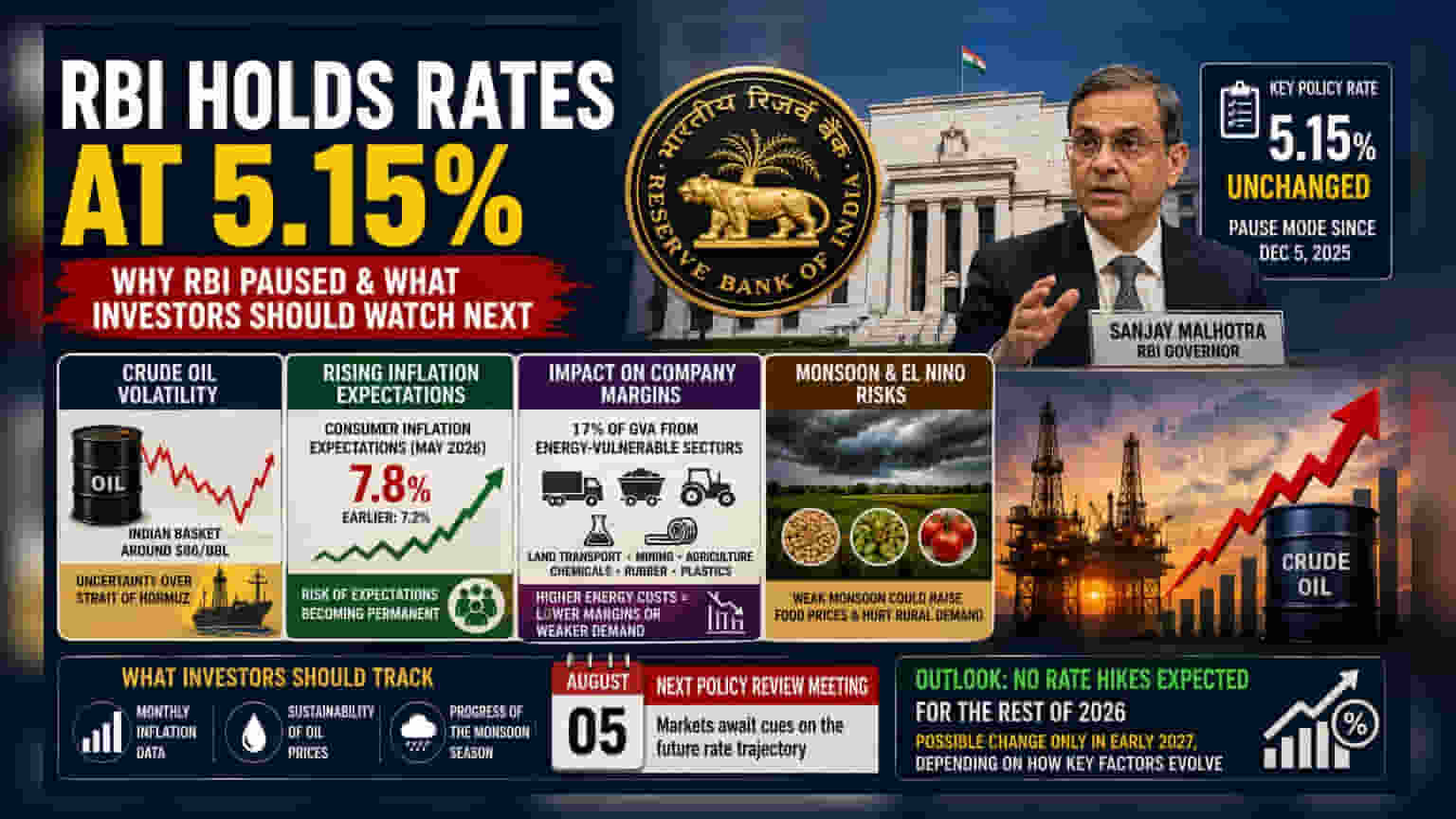
The Reserve Bank of India has maintained its key interest rate at 5.15%, preferring a 'wait and watch' approach due to uncertainty over crude oil prices and inflation. While the central bank focuses on long-term stability, investors should watch for potential margin pressure in sectors sensitive to energy costs. The next policy review is scheduled for August 5, with analysts pointing to monsoon trends and supply-side shocks as critical variables.
What Happened
The Reserve Bank of India (RBI) has decided to keep its key interest rate steady at 5.15%. This pause comes as the central bank monitors the global economic environment, specifically the volatility in crude oil prices. RBI Governor Sanjay Malhotra stated that it is currently too early to consider an interest rate hike, emphasizing that reactive policy changes based on minor fluctuations could harm overall economic growth. The central bank has been in a pause mode since December 5, 2025, and is now waiting to see if recent inflationary pressures are temporary or here to stay.
The Inflation And Energy Puzzle
Even though the price of the Indian basket of crude oil has recently eased to around $86 a barrel, the central bank remains cautious. A major concern is the reduced traffic through the Strait of Hormuz, which creates uncertainty about future energy supplies and prices. Households also appear concerned; according to the RBI's May 2026 survey, consumer inflation expectations rose to 7.8% from 7.2% earlier. The RBI is watching to see if these expectations become permanent, which would make it harder to control inflation.
Impact On Company Margins
For investors, the key issue is how this economic environment affects company profitability. Ratings agency Crisil has noted that sectors vulnerable to energy price shocks contribute about 17% to the Gross Value Added (GVA). Companies in industries like land transport, mining, agriculture, chemicals, rubber, and plastics are at the highest risk. When energy costs rise, these companies face a difficult choice: pass the costs on to customers, which may hurt demand, or absorb the costs, which results in lower profit margins.
Risks From The Monsoon And El Nino
Beyond oil prices, experts are looking closely at the agricultural sector. Weak monsoon conditions, driven by El Nino, could lead to crop failures or lower production. Economists, including Indranil Pan of Yes Bank, have highlighted that pressures on food items like oilseeds, pulses, and tomatoes could hurt rural demand and real wages. If food inflation rises, it complicates the RBI's job, as it may force the central bank to keep rates higher for longer to manage overall price stability.
What Investors Should Track Next
The next major date for the market is the policy review meeting on August 5. Until then, investors should keep a close watch on three things: monthly inflation data, the sustainability of oil prices, and reports on the progress of the monsoon season. Most analysts do not expect any rate hikes for the remainder of calendar year 2026, with the possibility of a change pushed to early 2027 depending on how these economic variables evolve.