 Whalesbook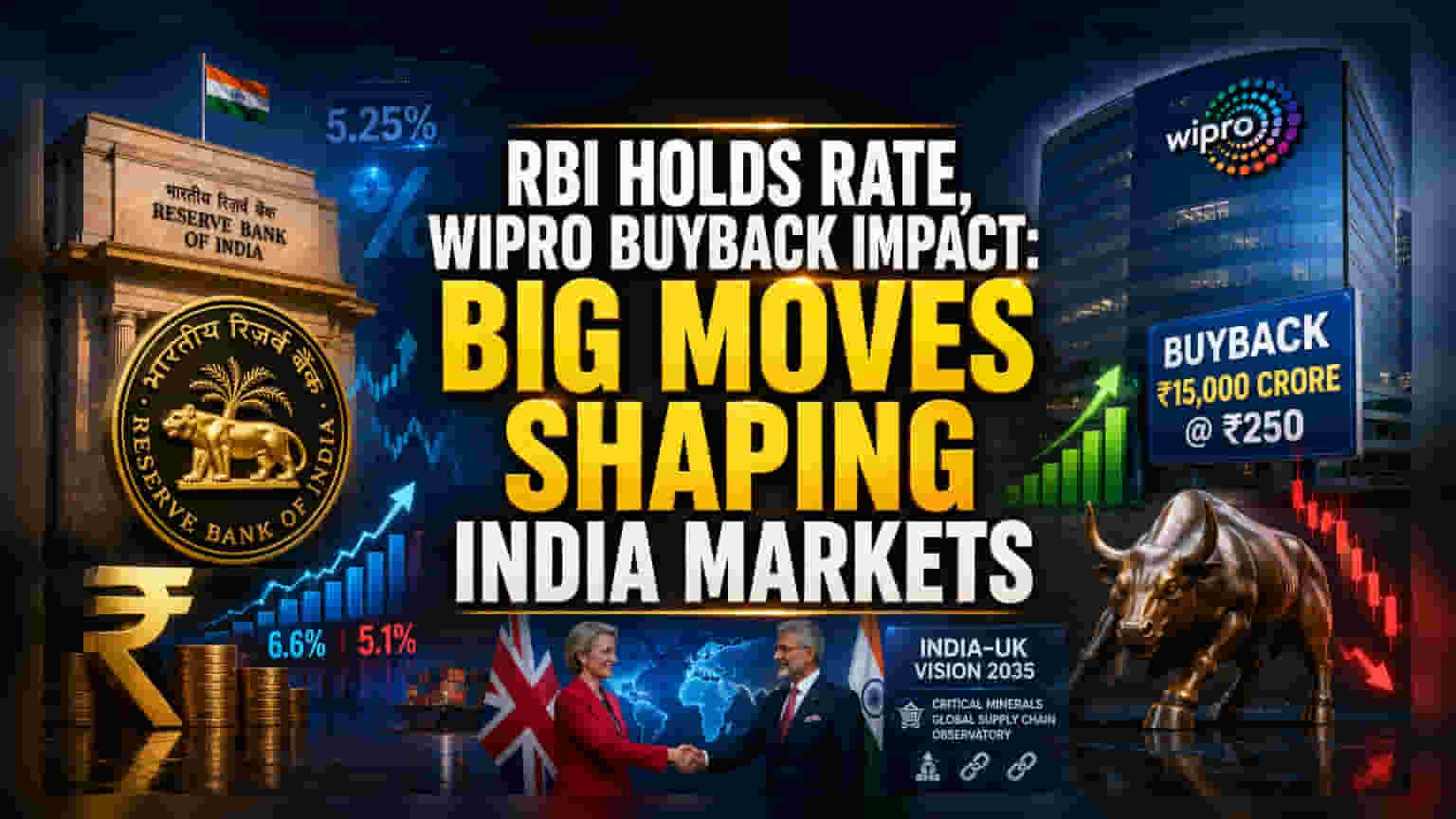


The Monetary Policy Pause
The Reserve Bank of India’s Monetary Policy Committee (MPC) voted unanimously to maintain the benchmark repo rate at 5.25% during its second bi-monthly meeting for FY27. This decision, led by Governor Sanjay Malhotra, reflects a strategic pivot toward neutrality in an increasingly volatile global environment. Policymakers cited the adverse economic impacts of the ongoing West Asian conflict, specifically elevated crude oil prices and supply chain disruptions, as primary drivers for their conservative stance. Notably, the committee revised its growth outlook downward to 6.6%, a cooling from previous projections, while inflation forecasts were adjusted upward to 5.1%. To support stability, the central bank expanded its Fully Accessible Route (FAR) to include 15, 30, and 40-year government securities, a move intended to anchor long-term debt inflows.
The Wipro Buyback Mechanics
Wipro’s market performance on Friday reflected the standard technical adjustment associated with significant corporate actions rather than fundamental deterioration. As the stock turned ex-buyback on the record date, shares saw downward pressure, dropping roughly 4% in early trading. Investors who had not finalized purchases by the June 4 deadline are no longer eligible for the ₹15,000 crore tender offer, which repurchases shares at a fixed price of ₹250. With the buyback covering approximately 5.7% of the firm's paid-up equity, the market is currently recalibrating the stock's valuation to account for this massive liquidity event. This is the largest repurchase program in the company’s recent history, and its execution remains a critical test of management’s capital allocation strategy during a period of sluggish sector growth.
Structural Risks and Sector Sentiment
While the buyback offers a short-term premium for shareholders, the broader IT sector faces persistent headwinds. Wipro, in particular, has seen its share price struggle throughout 2026, and the reliance on corporate buybacks to bolster shareholder returns often invites scrutiny regarding organic growth capabilities. Unlike peers that may prioritize reinvestment in AI and cloud infrastructure, Wipro’s substantial cash distribution highlights a tactical shift toward dividend-like payouts to satisfy investors. Furthermore, the volatility in smaller, high-growth stocks like Sterlite Technologies, which recently hit a 5% lower circuit after an aggressive 270% rally, serves as a reminder of the heightened risk appetite currently circulating in the microcap and midcap segments.
Diplomatic and Economic Integration
Beyond domestic policy, high-level diplomatic efforts between India and the UK have gained momentum. During a visit to New Delhi, UK Foreign Secretary Yvette Cooper and External Affairs Minister S. Jaishankar reviewed the India-UK Vision 2035 roadmap. Beyond existing agreements, the launch of a new Critical Minerals Global Supply Chain Observatory signals a deepening strategic alliance. These efforts, combined with the RBI’s liberalized norms for foreign investment in debt, suggest that policymakers are actively working to buffer the Indian economy against external shocks by strengthening trade resilience and diversifying long-term capital sources.