 Whalesbook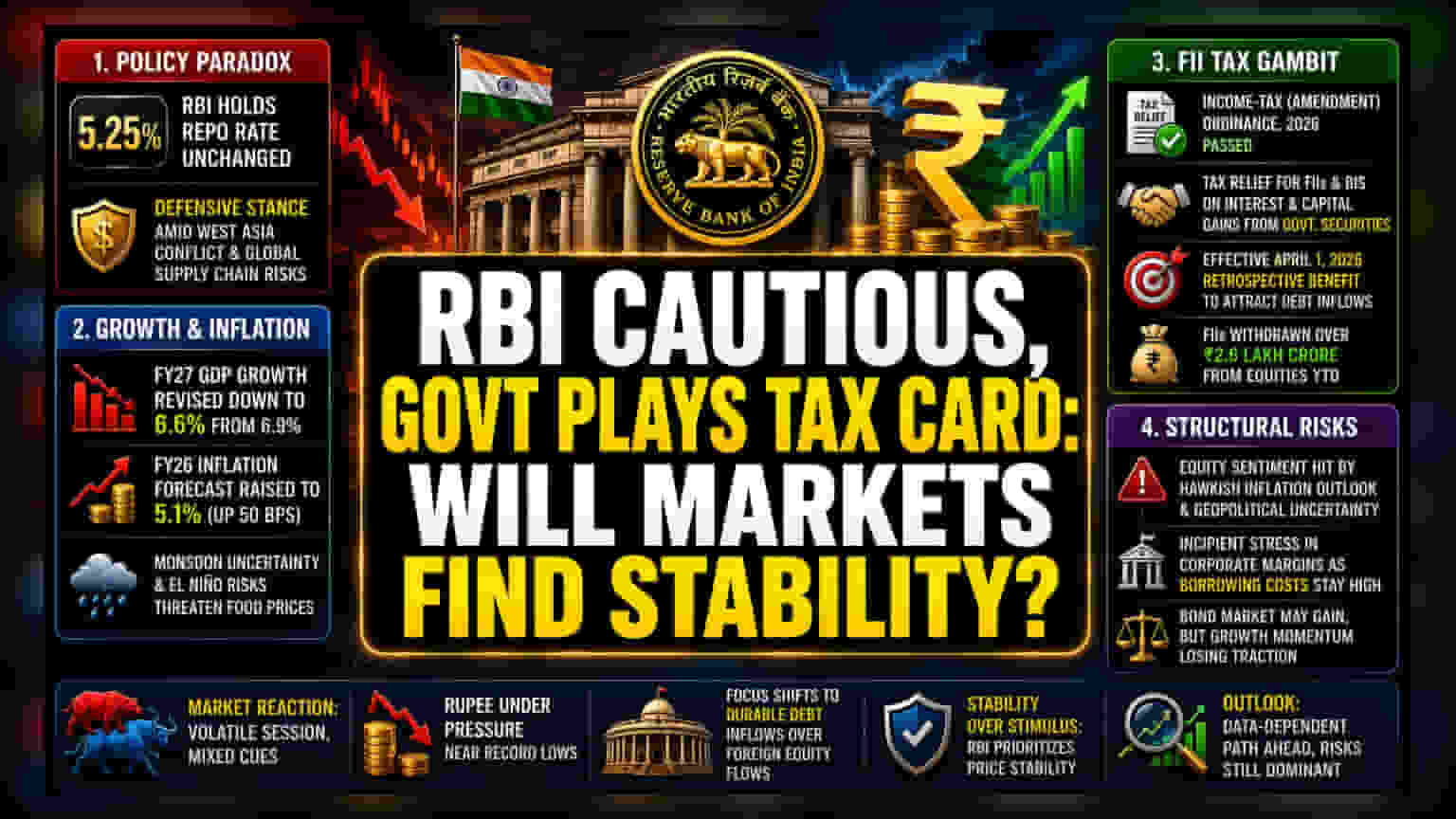


The Policy Paradox
Indian equity markets navigated a volatile Friday session, caught between the gravity of sobering central bank projections and a legislative attempt to lure back foreign capital. The Reserve Bank of India’s Monetary Policy Committee, led by Governor Sanjay Malhotra, elected to maintain the repo rate at 5.25%. This decision reflects a defensive posture, prioritizing stability as the central bank grapples with the fallout of the West Asia conflict, which continues to exert pressure on global supply chains and energy costs.
Inflationary Headwinds and Growth Revision
The central bank's updated economic outlook provides a challenging backdrop for local markets. The Monetary Policy Committee downwardly revised its FY27 real GDP growth projection to 6.6%, a notable reduction from the earlier 6.9% estimate. Compounding this, the inflation forecast for the current fiscal year was hiked by 50 basis points to 5.1%. Governor Malhotra highlighted significant uncertainty regarding the southwest monsoon—citing the potential for El Niño conditions to disrupt agricultural output—as a key variable that could exacerbate food price volatility. While core inflation currently remains stable, policymakers have signaled that the pass-through of global price shocks is being monitored with increasing vigilance.
The FII Tax Gambit
In a clear effort to stabilize the rupee and support the domestic bond market, the government issued the Income-tax (Amendment) Ordinance, 2026. This move grants retrospective tax relief, effective from April 1, 2026, to Foreign Institutional Investors and the Bank for International Settlements regarding interest income and capital gains from government securities. This policy change serves as a direct response to the massive exodus of foreign capital, with FIIs having withdrawn over Rs 2.6 lakh crore from Indian equities year-to-date. By eliminating tax barriers on sovereign debt, the government is attempting to pivot toward more durable, debt-focused foreign inflows, hoping to provide a necessary buffer against the current currency volatility.
Structural Risks and Institutional Outlook
The market's lukewarm reception to the tax exemption highlights a deepening skepticism regarding the broader macro environment. While the bond market may benefit from the new tax treatment, equity sentiment remains heavily tied to the RBI's hawkish tone on inflation and the potential for prolonged geopolitical instability. Institutional analysts remain wary of 'incipient stress' in corporate margins as borrowing costs stay elevated. Investors are now forced to weigh the benefit of improved debt-market liquidity against the reality of a growth trajectory that is clearly losing momentum.