

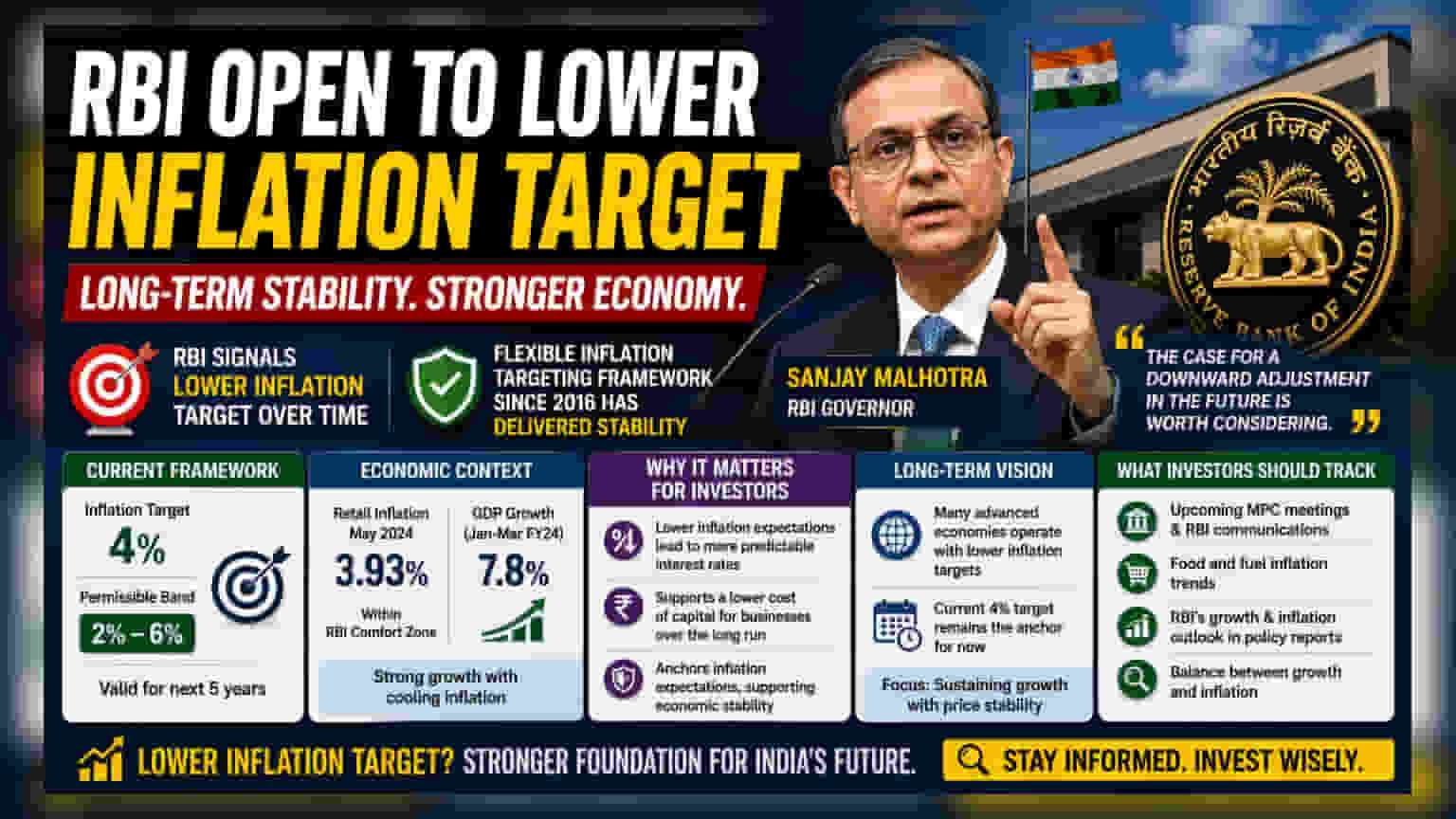
Reserve Bank of India Governor Sanjay Malhotra suggested that India may eventually consider a lower inflation target. While the current 4% benchmark is expected to remain in the near term, this shift would signal confidence in long-term macroeconomic stability. Investors should watch how this potential policy direction influences future interest rate trends and broader economic growth expectations.
What Happened
Reserve Bank of India (RBI) Governor Sanjay Malhotra has indicated that India could consider a lower inflation target over the long term. Speaking at the Bank of Russia’s Financial Congress, he noted that while the current inflation target is unlikely to rise, there is a case for a downward adjustment in the future. He credited the flexible inflation-targeting framework, adopted in 2016, with successfully keeping average inflation in check and providing a stable foundation for the Indian economy.
Why This Matters For Investors
A central bank's inflation target acts as a benchmark for monetary policy. A shift toward a lower inflation target often signals confidence that an economy has matured and can maintain price stability without excessive volatility. For investors, this is significant because lower long-term inflation expectations can lead to a more predictable interest rate environment. If the RBI eventually adopts a lower target, it may help in anchoring inflation expectations, which could support a lower cost of capital for businesses over the long run.
The Economic Context
The current inflation-targeting framework sets a target of 4%, with a permissible band of 2% to 6% for the next five years. India’s retail inflation was recorded at 3.93% in May, which is comfortably within the RBI's comfort zone. This stability has occurred alongside strong economic performance, with the nation achieving a year-on-year growth rate of 7.8% in the January-March quarter of the last fiscal year. This combination of growth and cooling inflation provides the central bank with more flexibility to manage policy decisions.
Understanding the Long-Term Goal
Governor Malhotra pointed out that many advanced economies operate with lower inflation targets. By suggesting that India could eventually move toward a similar objective, the central bank is signaling that the focus remains on sustaining macroeconomic resilience. However, this is a long-term conversation. The current 4% target remains the anchor, and the central bank is expected to maintain its existing approach for the foreseeable future. The primary challenge for any central bank is to keep inflation low enough to protect purchasing power without stifling the growth momentum needed for a developing economy.
What Investors Should Track
While this announcement is about long-term policy thinking rather than an immediate change, investors should continue to monitor upcoming Monetary Policy Committee (MPC) meetings and official RBI communications. Key factors to observe include the trajectory of food and fuel inflation, as these components often cause short-term fluctuations in the headline inflation number. Additionally, tracking how the RBI balances growth and inflation in their quarterly outlooks will provide clues about the central bank's confidence in the economy's stability.