

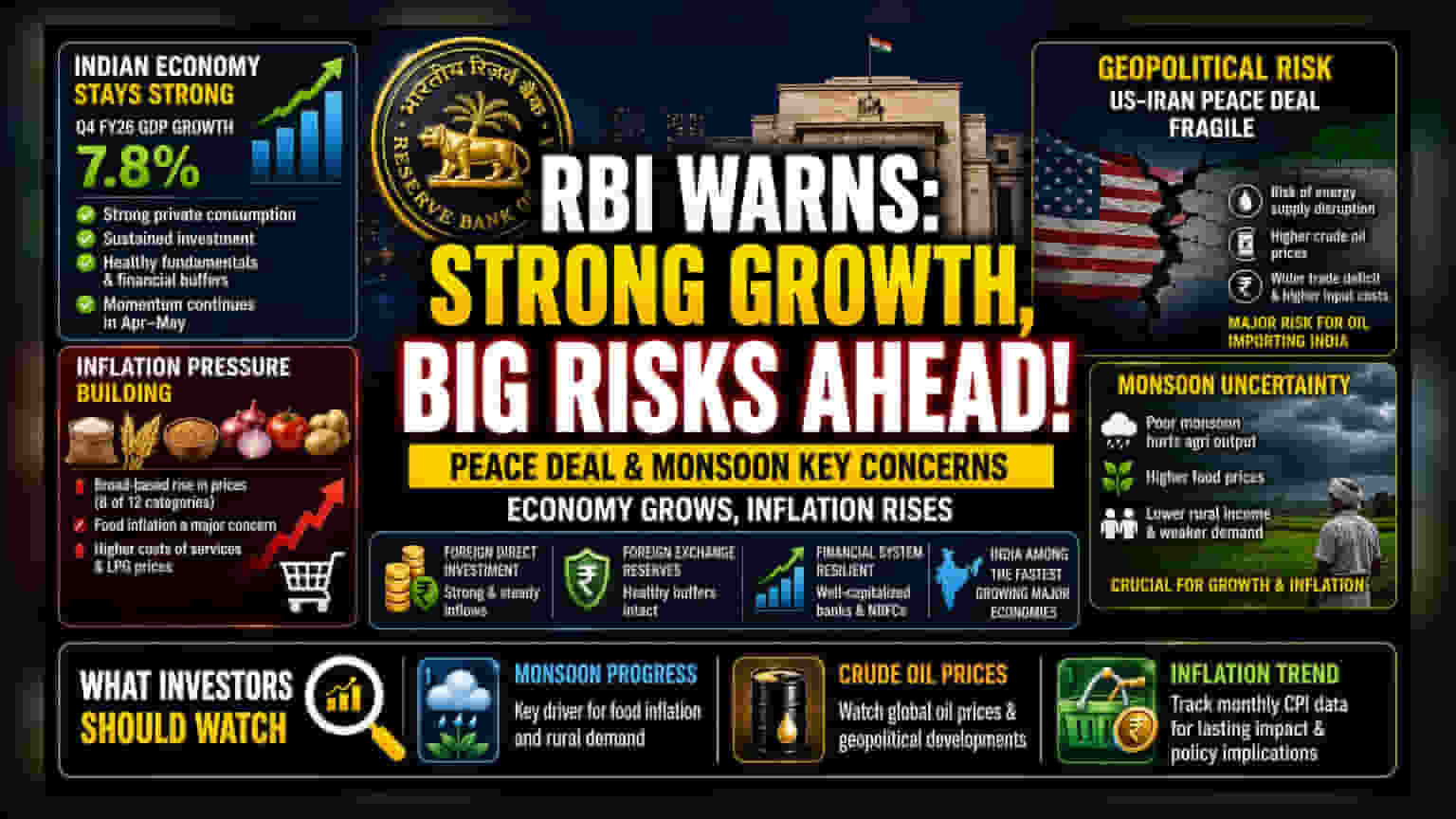
India’s economy expanded by 7.8% in Q4 FY26, showing resilience against global challenges. However, the Reserve Bank of India has cautioned that geopolitical tensions, specifically regarding the US-Iran peace deal, and monsoon uncertainty pose risks to the growth outlook. Rising food and energy costs also remain key monitorables.
What Happened
The Reserve Bank of India (RBI) has issued a cautious outlook in its June "State of the Economy" bulletin. While the Indian economy showed strong performance with a 7.8% growth rate in the fourth quarter of FY26, the central bank highlighted two major external and natural threats: the potential instability of the US-Iran peace agreement and the unpredictability of the southwest monsoon. These factors, combined with persistent inflationary pressures, are viewed as the primary hurdles for the economy in the coming months.
The Growth And Resilience Story
Despite a complex global environment, India's economic fundamentals have remained steady. The 7.8% growth figure for Q4 FY26 was driven by healthy private consumption and sustained investment. The central bank noted that India entered this period with stronger financial buffers than many other nations, which has helped the country absorb global shocks. Early indicators from April and May suggest that this momentum has continued into the current fiscal year, supported by consistent foreign direct investment and healthy foreign exchange reserves.
Understanding The Inflation Pressure
While the economy is growing, domestic inflation has started to show signs of stress. Data from May indicates a broad-based increase in consumer prices, affecting eight out of twelve categories. Food inflation, in particular, has become a significant point of concern. Prices for staples such as rice, wheat, pulses, potatoes, onions, and tomatoes have seen an upward trend, driven by both seasonal factors and supply-side pressures. Additionally, the cost of services, such as personal care and restaurant dining, has risen, partly due to higher commercial LPG prices. These costs impact consumer spending power, which investors monitor closely for signs of a slowdown in demand.
Why Geopolitics And Weather Matter
For investors, the RBI’s concerns boil down to two main risks: energy security and input costs. The US-Iran peace deal is considered fragile. If this agreement breaks down, it could disrupt energy supply lines and reignite global inflation. Because India remains a major importer of crude oil, any spike in oil prices directly impacts the economy, widening the trade deficit and increasing production costs for businesses.
Similarly, the monsoon remains a critical factor. A poor monsoon affects agricultural output, which can lead to higher food prices and lower rural income. When food prices rise, it leaves less money in the hands of consumers for discretionary spending, which can hurt sectors dependent on mass-market demand.
What Investors Should Track Next
Investors may monitor three key areas in the coming months. First, the progress of the southwest monsoon is critical, as it will dictate food inflation and rural demand levels. Second, developments in international crude oil prices will be essential to watch, as they affect both retail fuel prices and company profit margins. Finally, tracking the monthly Consumer Price Index (CPI) reports will provide clarity on whether the recent uptick in inflation is temporary or a more lasting trend that could influence future policy decisions.