

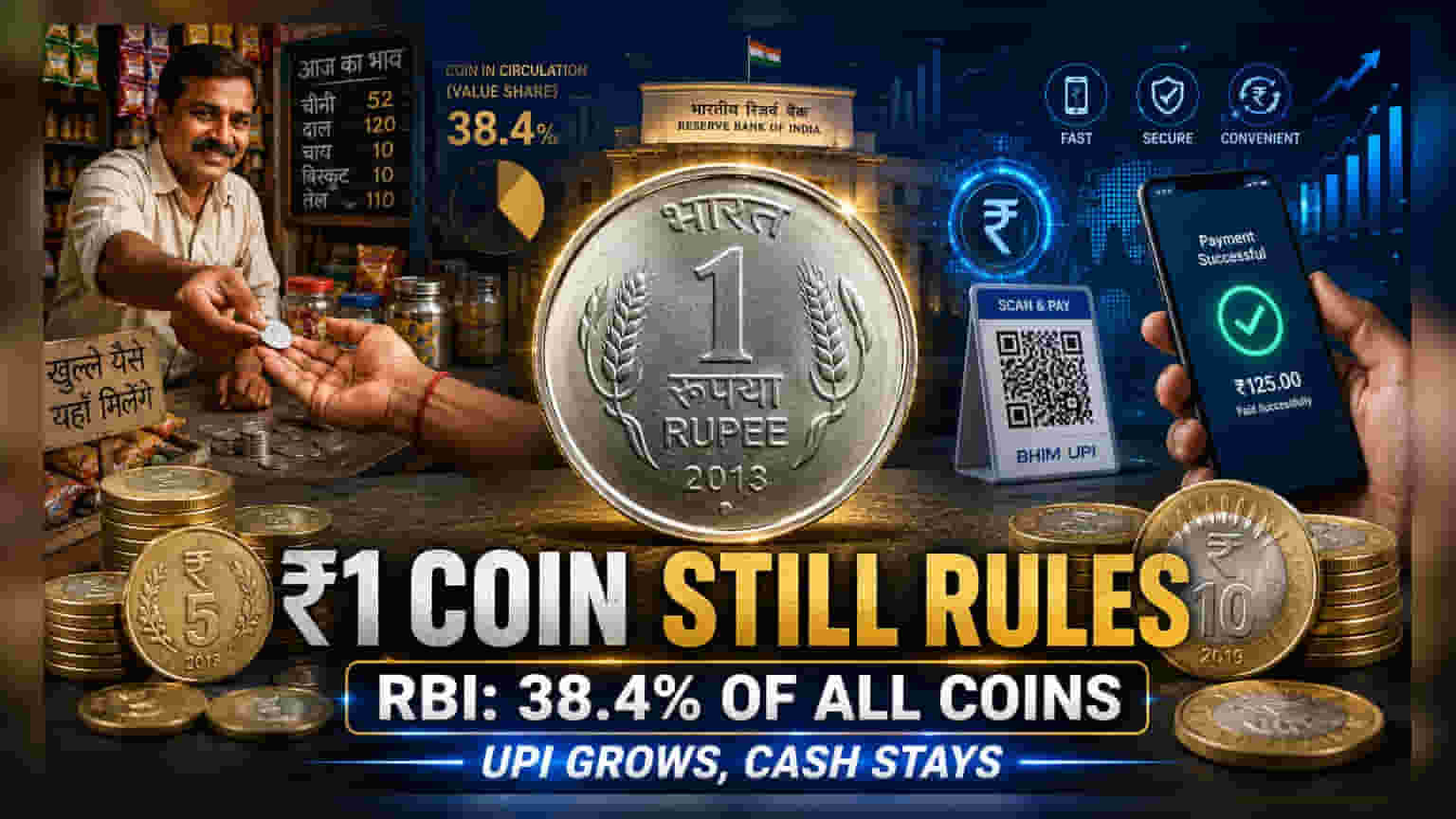
Despite India's digital payment surge, the one-rupee coin remains the most widely circulated denomination. RBI data as of March 2026 shows nearly 5,500 crore units in circulation, accounting for 38.4% of total coins. This reliance reflects the continued need for physical cash in rural markets, informal retail, and small-value transactions, showing that cash remains vital even in a digital era.
What Happened
The Reserve Bank of India’s (RBI) latest annual report reveals that the one-rupee coin remains the most common denomination in terms of volume in the Indian economy. As of March 2026, there are approximately 5,499 crore (54.99 billion) one-rupee coins in circulation. This single denomination accounts for 38.4% of all coins circulating in the country, ranging from 50 paise to 20-rupee coins. Despite the widespread adoption of Unified Payments Interface (UPI) and other digital payment methods, this specific coin continues to hold a significant physical presence.
The Volume vs. Value Reality
While the one-rupee coin leads in sheer quantity, it plays a different role in terms of total monetary value. The RBI data highlights a clear split between high-volume, low-value coins and lower-volume, high-value coins. For instance, as of June 19, 2026, coins of 5-rupee and 10-rupee denominations accounted for only 23.5% of the total coin count, yet they held 53.5% of the total value of all coins, amounting to Rs 22,209 crore. This indicates that while the one-rupee coin is everywhere, it is used primarily for small-scale adjustments rather than as a primary store of monetary value.
Why Cash Remains Relevant
The persistence of the one-rupee coin is tied to the structure of India’s informal economy. Small-ticket transactions at kirana stores, roadside vendors, and rural markets often require exact change. Even with digital payments becoming common, the 'last rupee' settlement—the small change needed to complete a transaction—frequently involves physical coins. Additionally, these coins remain essential for traditional purposes such as donations at places of worship and public transport fares in various regions. This demonstrates that for millions of people operating outside the organized digital ecosystem, physical currency is still the most efficient way to transact.
Business Impact and Cash Management
The continued demand for physical coins, even in the digital age, is a relevant factor for the cash management and logistics sector. Companies involved in cash handling, vaulting, and transport continue to see demand because the circulation of physical currency remains high in tier-2 and tier-3 cities, as well as rural areas. The reliance on physical cash by the unorganized retail sector suggests that the transition toward a fully digital economy is happening at different speeds across various segments of society.
What Investors Should Track
Investors monitoring the consumption and retail sectors may observe how the gap between digital and cash-based transactions narrows over time. The key monitorable is the pace at which the informal economy moves toward digital adoption. While UPI transaction volumes continue to rise, the RBI’s data on cash circulation provides a reality check on the actual usage patterns on the ground. Future RBI reports will be useful to see if the volume of one-rupee coins begins to decline as digital payment penetration reaches deeper into rural and informal markets.