

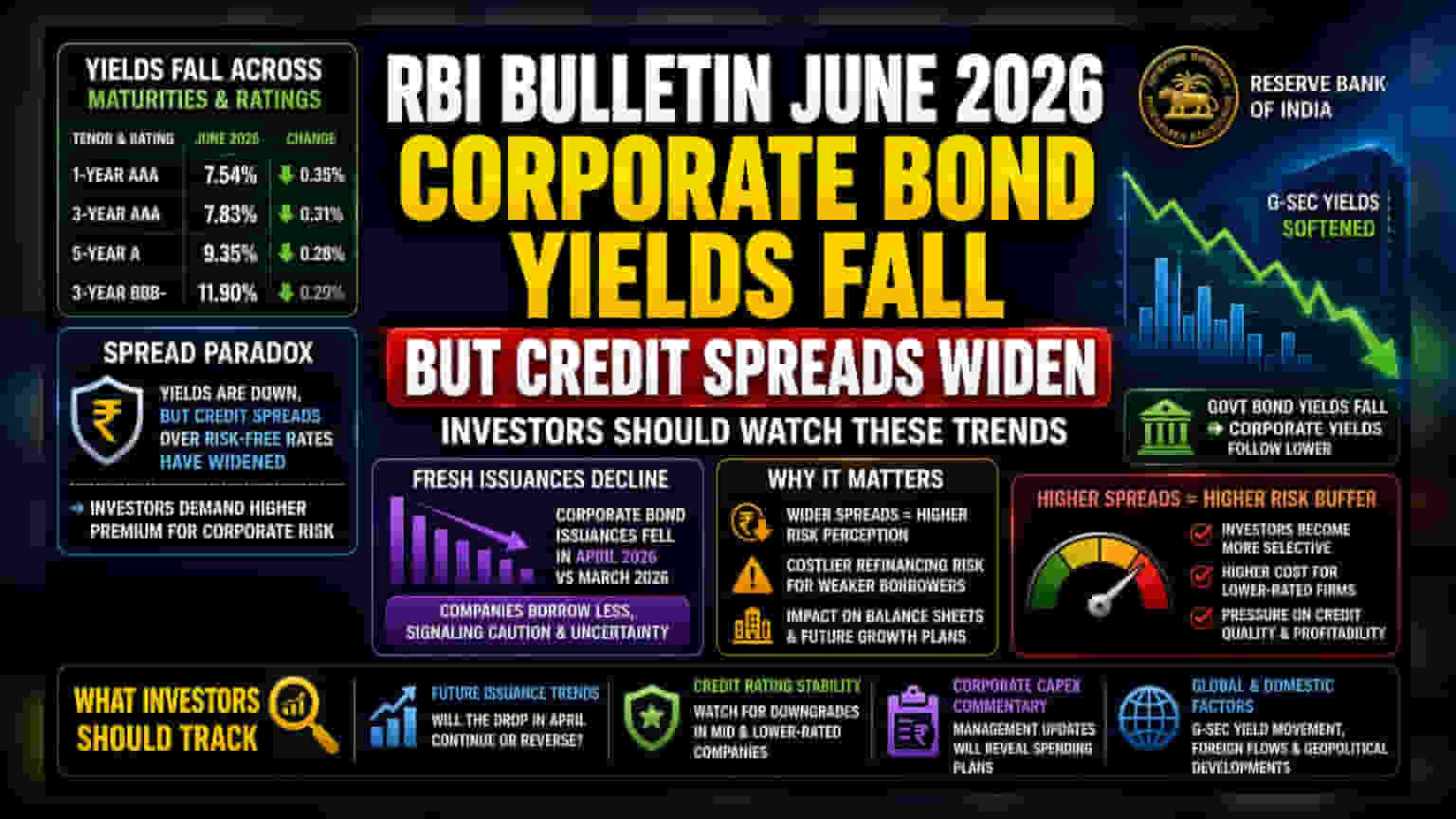
In June, corporate bond yields dropped across various ratings, following a decline in government bond yields. However, credit spreads increased, indicating that investors are asking for a higher risk premium. Additionally, new bond issuances fell in April, potentially pointing to a cautious approach by companies regarding debt-funded expansion.
What Happened
The Reserve Bank of India’s (RBI) latest bulletin for June 2026 shows that corporate bond yields have decreased across different maturities and risk categories. This trend tracks the movement in government security (G-sec) yields, which also softened during the same period. For instance, yields on one-year AAA-rated bonds fell by 0.35 percentage points to 7.54%. Similarly, lower-rated debt, such as three-year BBB-minus bonds, saw yields ease by 0.29 percentage points to 11.90%.
The Spread Paradox
While the headline numbers show lower borrowing costs for companies, the data reveals a deeper trend: credit spreads over risk-free rates have widened. A credit spread is the extra interest or "premium" that investors demand to lend to companies instead of the government.
When yields fall but spreads widen, it suggests that while the overall market interest rates might be dropping, investors are becoming more selective and cautious. They are essentially asking for a higher buffer to compensate for the potential risks associated with corporate borrowers, even as the government's own borrowing costs decrease.
Impact on Corporate Borrowing
The RBI report also noted that fresh corporate bond issuances declined in April 2026 compared to the previous month. This is a critical indicator for investors. A decline in new bond issuances often means companies are not borrowing as aggressively to fund new projects or capital spending.
Several reasons could explain this: companies may be relying more on internal cash flows, preferring bank loans over bond markets, or simply postponing expansion plans due to economic uncertainty. For investors, this shift can be a sign that companies are being conservative with their balance sheets.
Connection to Government Bonds
Corporate bond yields in India are heavily influenced by the yields on government securities, which act as the benchmark for the entire market. The RBI noted that government bond yields, which had risen in May due to geopolitical tensions, later softened. This decline was supported by central bank efforts to attract foreign capital and a reported peace deal in the Middle East. When the benchmark G-sec yield drops, corporate bonds usually follow, as investors look for comparable returns elsewhere.
What Investors Should Track
Investors should monitor how these trends impact company balance sheets. The widening credit spread is a signal of risk perception. If spreads continue to widen, companies with high debt loads or lower credit ratings may find it more expensive to refinance their existing debt in the future, even if base interest rates are stable.
Key monitorables include:
- Future Issuance Trends: Whether the decline in new bonds in April is a temporary blip or the start of a trend of slower corporate borrowing.
- Credit Rating Stability: Any signs of credit rating downgrades for mid-sized or lower-rated companies, which would likely face the brunt of widening credit spreads.
- Corporate Capex Commentary: Management updates in upcoming quarterly reports regarding their capital spending plans, which will reveal if the drop in bond issuance is due to delayed expansion or a lack of new project opportunities.