

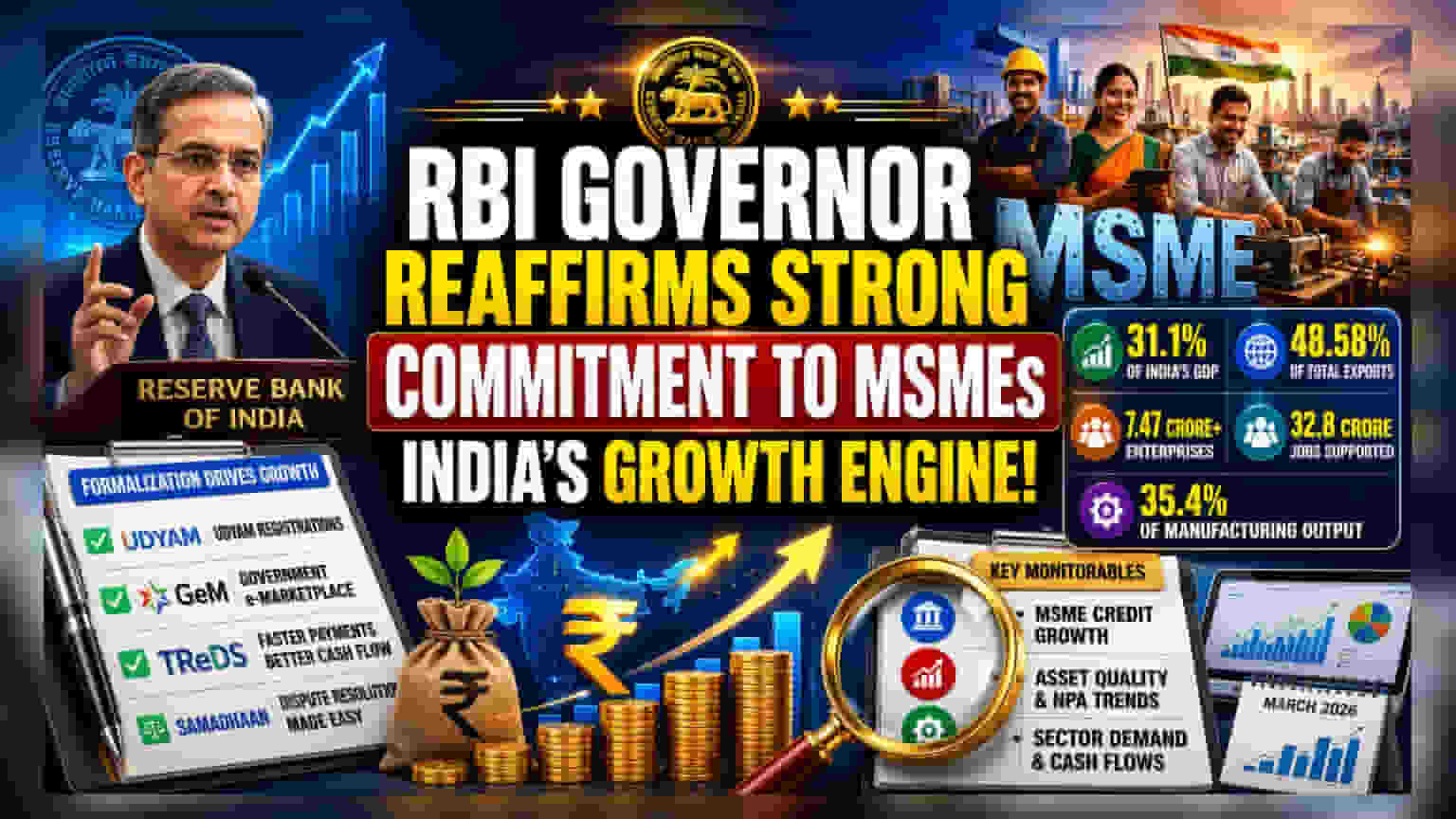
RBI Governor Sanjay Malhotra recently highlighted the MSME sector's critical role, contributing over 31% to India’s GDP. The central bank reaffirmed its focus on enhancing credit access and formalization, a key factor for investors tracking banking sector health and credit growth.
What Happened
Reserve Bank of India (RBI) Governor Sanjay Malhotra has reaffirmed the central bank’s commitment to the Micro, Small, and Medium Enterprises (MSME) sector. During a recent update, the Governor described these businesses as India’s “entrepreneurship nursery,” emphasizing their importance for the broader economy. The RBI intends to continue its policy focus on improving credit accessibility and integrating informal businesses into the formal economy through ongoing development initiatives.
Economic Significance Of MSMEs
The scale of the MSME sector in India remains vast. According to recent data shared by the RBI, MSMEs contribute approximately 31.1% to India’s Gross Domestic Product (GDP) and account for 48.58% of the country’s total exports. The sector supports around 7.47 crore enterprises across manufacturing, trade, and services.
Beyond output, these businesses are vital for employment, providing livelihoods to nearly 32.8 crore individuals. This makes the sector the second-largest employer in the country, trailing only the agricultural sector. MSMEs are also responsible for roughly 35.4% of India’s manufacturing output, highlighting their role in the industrial value chain.
The Move Toward Formalization
A key theme in the RBI’s support strategy is the formalization of small businesses. Government data indicates that over 7.9 crore MSMEs and informal micro-enterprises have registered on the Udyam and Udyam Assist platforms as of March 2026.
From an investor perspective, this transition to formalization is significant. When businesses move into the formal economy, they generate verifiable financial data, which helps banks and financial institutions assess creditworthiness more effectively. Tools such as GeM (Government e-Marketplace), TReDS (Trade Receivables Discounting System), and SAMADHAAN are designed to assist these businesses with market access, legal safeguards, and faster dispute resolution, potentially improving their operational stability.
Credit Risks And Investor Monitorables
While the government and RBI focus on expanding credit to MSMEs, investors often look at the inherent risks associated with this sector. MSMEs are typically more sensitive to economic downturns, liquidity crunches, and supply chain disruptions compared to large corporations.
For investors in banking and financial stocks, the core monitorable is the asset quality of the MSME loan portfolio. While increased formalization helps in better underwriting, the risk of higher Non-Performing Assets (NPAs) remains a structural reality for lenders heavily exposed to this segment. Investors may track the credit growth trends in the MSME segment alongside the NPA ratios reported by banks in their quarterly results. The stability of these loans depends on the sector's ability to maintain cash flow amidst input cost fluctuations and demand changes.