

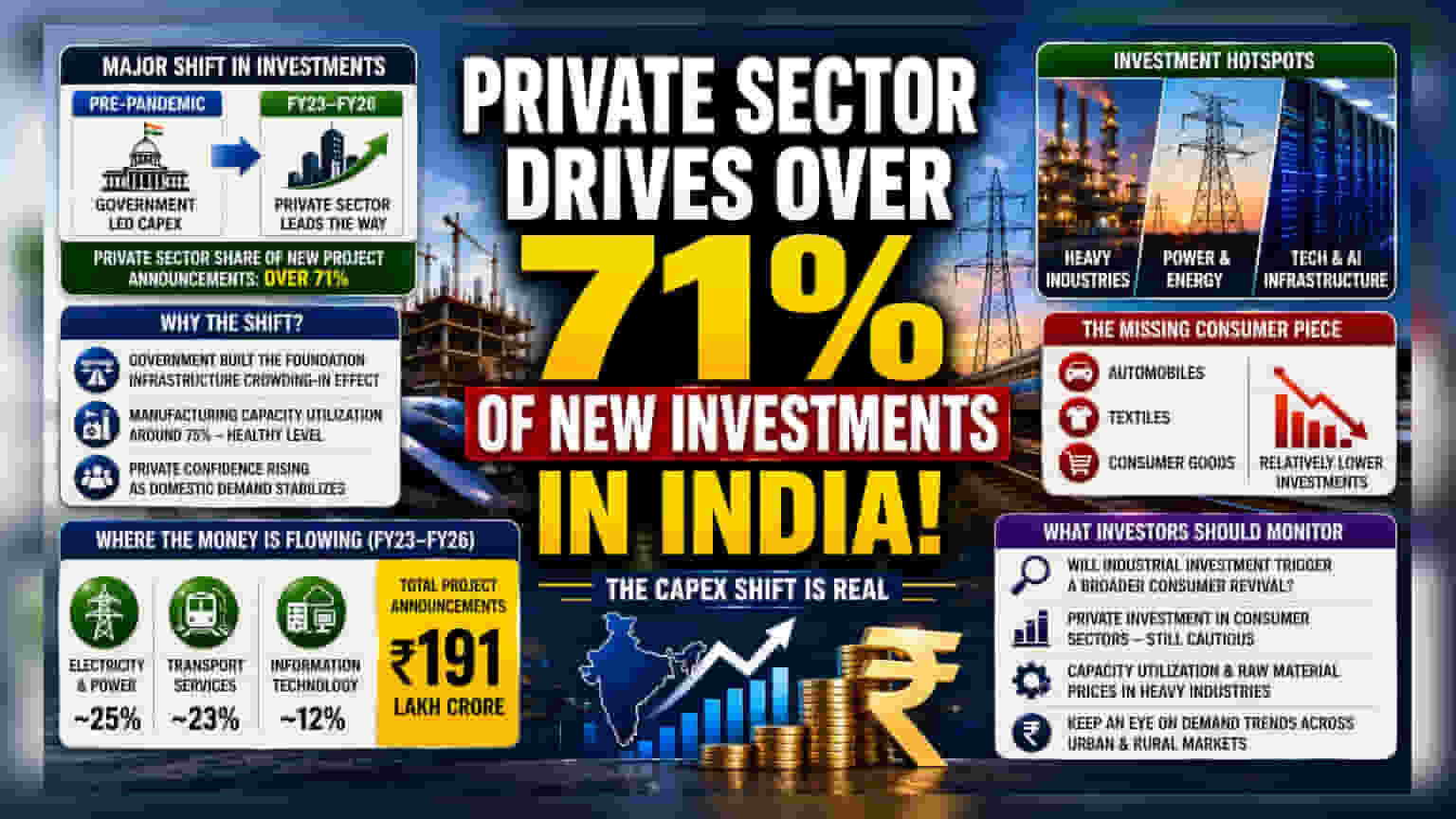
Private firms now account for over 70% of fresh project announcements in India, signaling a significant shift from government-led spending. While infrastructure, power, and IT sectors are attracting massive capital, consumer-focused industries remain slower to expand. This indicates an uneven investment cycle that investors should track closely.
What Happened
India’s investment picture has undergone a major change. Data from a recent Bank of Baroda report highlights that private sector companies now drive over 71% of new project announcements in India for the FY23-FY26 period. This is a sharp reversal from the years immediately preceding the pandemic, when government initiatives were the primary source of capital expenditure. This surge suggests that private businesses are increasingly confident about expanding their capacity as domestic demand stabilizes.
The Shift from Public to Private Capex
For several years following the pandemic, the Indian government acted as the primary spender, focusing heavily on infrastructure like highways, railways, and ports to keep the economy moving. This public spending, often called the “crowding-in” effect, was designed to lower policy risks and build foundational assets. With that infrastructure now largely in place, private companies are stepping in to build upon it. Capacity utilization in the manufacturing sector is hovering around 75%, a healthy level that often encourages businesses to initiate new expansion plans to meet future demand.
Where Money Is Flowing
The current wave of investment is not spread evenly across all sectors. Capital is heavily concentrated in heavy industries and technology. Electricity and transport services alone account for nearly half of the ₹191 lakh crore worth of project announcements from FY23 to FY26. This reflects a massive push to modernize the power grid and enhance logistics. Additionally, the information technology sector has secured a notable share, largely driven by investments in data centers and artificial intelligence infrastructure to support India’s digital economy.
The Missing Consumer Piece
While infrastructure and heavy industries are seeing robust growth, consumer-oriented sectors—such as automobiles, textiles, and household goods—have seen relatively smaller allocations. This divergence suggests that while industrial capacity is growing, demand in the consumer market remains more cautious. Companies in consumer-facing segments are often more sensitive to immediate changes in household spending power. The current trend highlights that the economy’s investment cycle is currently skewed toward industrial and long-gestation projects rather than quick-turnover consumer goods.
What Investors Should Monitor
Investors should look beyond the total investment numbers to understand where companies are placing their bets. The key monitorable is whether this high level of industrial investment successfully triggers a broader revival in consumer demand. If private investment in consumer-linked sectors stays low, it may signal that companies are still waiting for clear signs of stronger buyer sentiment. Furthermore, for companies in heavy industries and steel, keeping an eye on capacity utilization rates and raw material prices will be essential, as these sectors are now the primary drivers of India's capital expenditure cycle.