

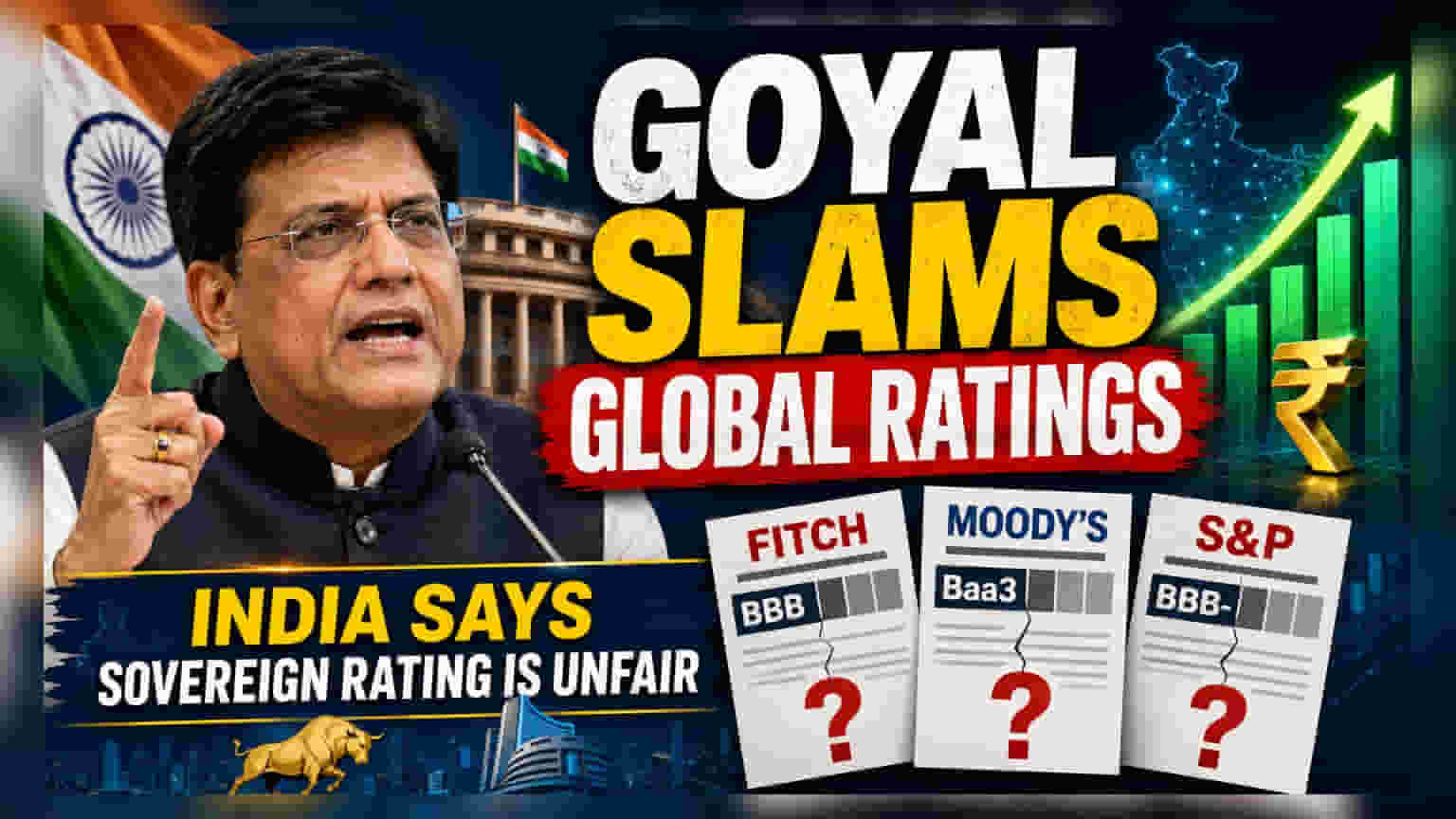
Commerce Minister Piyush Goyal has expressed concerns regarding the sovereign credit ratings assigned to India by global agencies like Fitch, Moody's, and S&P. He argued these assessments fail to accurately reflect India's economic fundamentals. For investors, sovereign ratings are significant as they influence the cost of external borrowing and can impact foreign capital flows into the country.
What Happened
Commerce and Industry Minister Piyush Goyal has openly criticized major international credit rating agencies, including Fitch, Moody's, and Standard & Poor's, for their sovereign ratings of India. During a business session in London, the Minister described these assessments as "unfair," arguing that global agencies have not fully recognized India's strong economic fundamentals and long-term growth potential.
In contrast, Minister Goyal praised the Indian rating agency CareEdge for providing a more objective evaluation of the country's economic standing. He urged international financial institutions to engage in a transparent, public debate regarding the methodologies used by these global agencies to determine sovereign ratings, noting that some economies with weaker fundamentals have received higher ratings than India.
Why Sovereign Ratings Matter For Investors
Sovereign credit ratings act as a benchmark for the overall economic health of a country. They are essentially a measure of a country's ability to pay back its debt. For Indian investors, this matters because these ratings directly influence the "cost of capital" for the entire country.
When a country has a higher credit rating, it is generally seen as lower risk. This allows the government and Indian corporations to borrow money from international markets at lower interest rates. Conversely, a lower rating can increase borrowing costs for Indian companies looking to raise funds in foreign currencies. Additionally, some global institutional investors have internal mandates that require them to invest only in countries above a certain credit rating, meaning improvements in these ratings can sometimes lead to increased foreign investment inflows.
The Gap In Perception
There is often a gap between how global agencies and local policymakers view an economy. Global agencies typically focus on specific financial ratios, such as the debt-to-GDP ratio, the fiscal deficit, and currency volatility. These metrics are applied using a standardized global framework to ensure consistency.
On the other hand, policymakers often emphasize domestic growth rates, infrastructure development, reform implementation, and sovereign capability. Minister Goyal’s comments reflect a push to have these growth-oriented factors given more weight in the final rating calculation. The core of his argument is that India’s growth story and structural strengths should be reflected more accurately in the final grade assigned by these global bodies.
What Investors Should Monitor
Investors should keep track of how global rating agencies respond to calls for greater transparency and methodology debates. While sovereign ratings rarely change overnight, any shift in the rating outlook or a change in a credit rating itself can trigger market volatility, particularly in currency markets and government bond yields.
Moving forward, the key monitorables include any updates to India's sovereign rating outlooks by major agencies, the country's fiscal deficit performance, and macro-economic data like GDP growth. These factors remain the primary drivers that influence how global agencies view the Indian economy, regardless of current policy debates.