

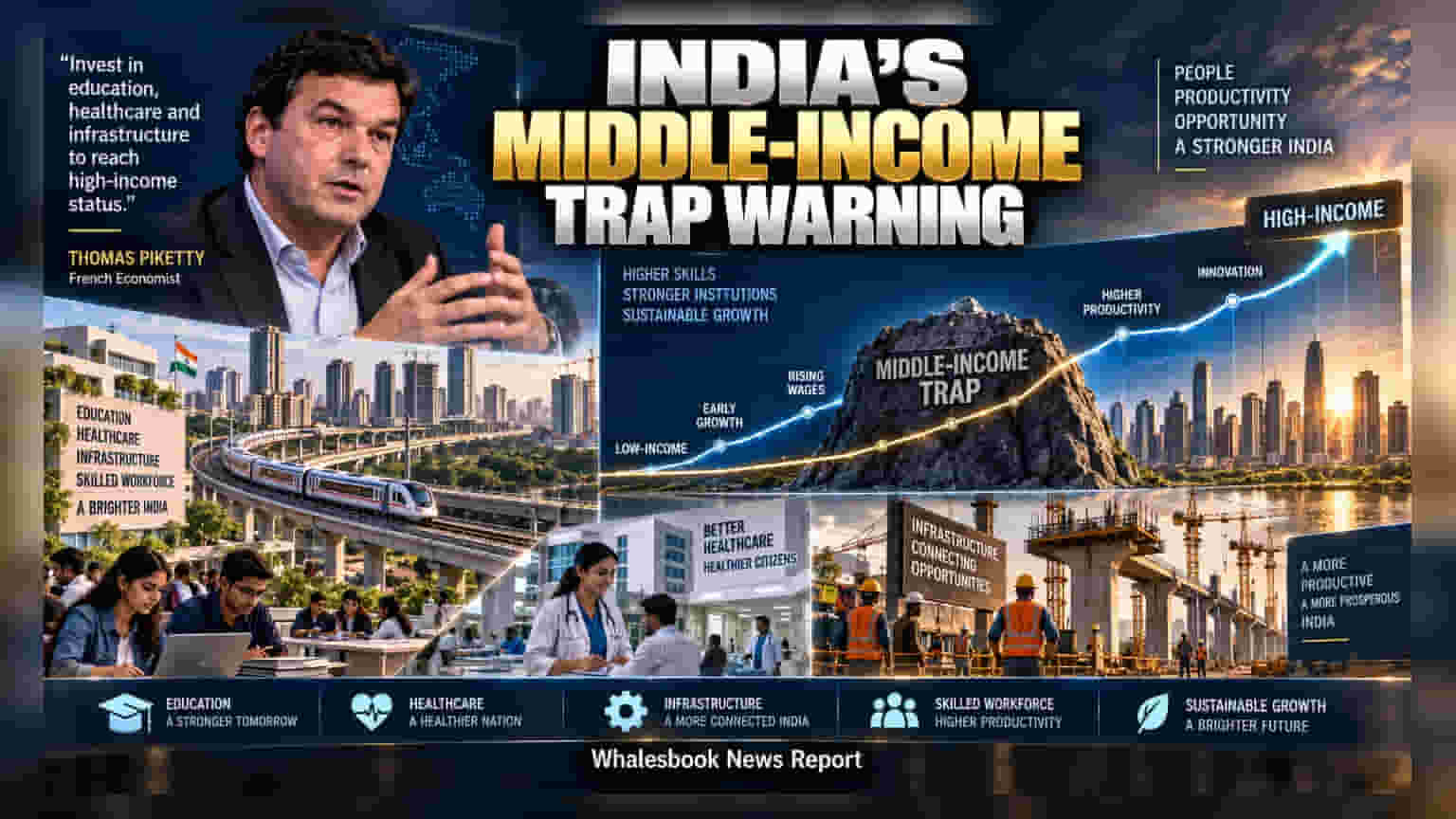
Economist Thomas Piketty warns that India must significantly increase spending on education, healthcare, and infrastructure to avoid the middle-income trap. The shift from capital accumulation to productivity-driven growth is essential for reaching high-income status. For investors, this long-term strategy impacts structural sectors, though balancing this growth with fiscal health remains a challenge.
French economist Thomas Piketty has flagged that India’s path to high-income status requires a shift in economic focus. He argues that India can avoid the 'middle-income trap'—a stage where a developing economy finds it difficult to sustain growth as wages rise—by making massive, targeted investments in education, healthcare, and infrastructure.
The concept of a middle-income trap refers to a situation where an economy can no longer compete in low-cost manufacturing due to rising wages, yet it has not yet developed the high-level productivity and innovation needed to compete with wealthier, more advanced nations. According to global data, many countries struggle to transition out of this phase once traditional growth drivers, such as simple infrastructure construction and a large workforce, start to lose their impact.
The Shift to Productivity
For investors, the argument highlights the difference between initial growth and long-term sustainability. Early growth often comes from building roads, factories, and power plants. However, Piketty suggests that as an economy matures, true value comes from productivity, technology, and a highly skilled workforce.
Recent data from UNESCO's 2026 scoreboard highlights a complex picture for India. Education spending has remained steady at 4.1% of GDP since 2015, but the share of total public expenditure allocated to this sector has declined by 1.5 percentage points to 14.2%. This creates a challenge: without a significant rise in human capital, maintaining rapid growth becomes difficult as the economy becomes more complex.
Sector Implications
While this argument is long-term, it points to sectors that are structurally important for India’s economy. Investments in healthcare, education, and infrastructure are essential foundations. Companies operating in these areas—such as private hospital chains, professional training institutes, construction firms, and logistics providers—are often tied to this broader economic development.
However, there are risks. Increased public spending can lead to higher debt if not balanced by efficient growth. The challenge for policymakers, and consequently for investors, is to fund these social and physical infrastructure needs without creating unsustainable fiscal pressure. This balance determines how much room the government has to keep spending on growth-oriented projects over the coming decade.
Climate and Global Context
Piketty also noted that while the world focuses on artificial intelligence, climate change poses a much larger and more direct economic risk for countries like India. The transition to a low-carbon economy will require massive adjustments, potentially changing the costs for industries that rely on traditional energy.
Ultimately, investors should track whether public and private spending shifts toward these high-impact areas. Rapid growth in the short term is one thing, but sustaining it as income levels rise requires a deliberate move toward a more skilled, efficient, and climate-resilient economy. The ability to execute these investments effectively, while managing fiscal health, will be the key test for India’s long-term economic trajectory.