

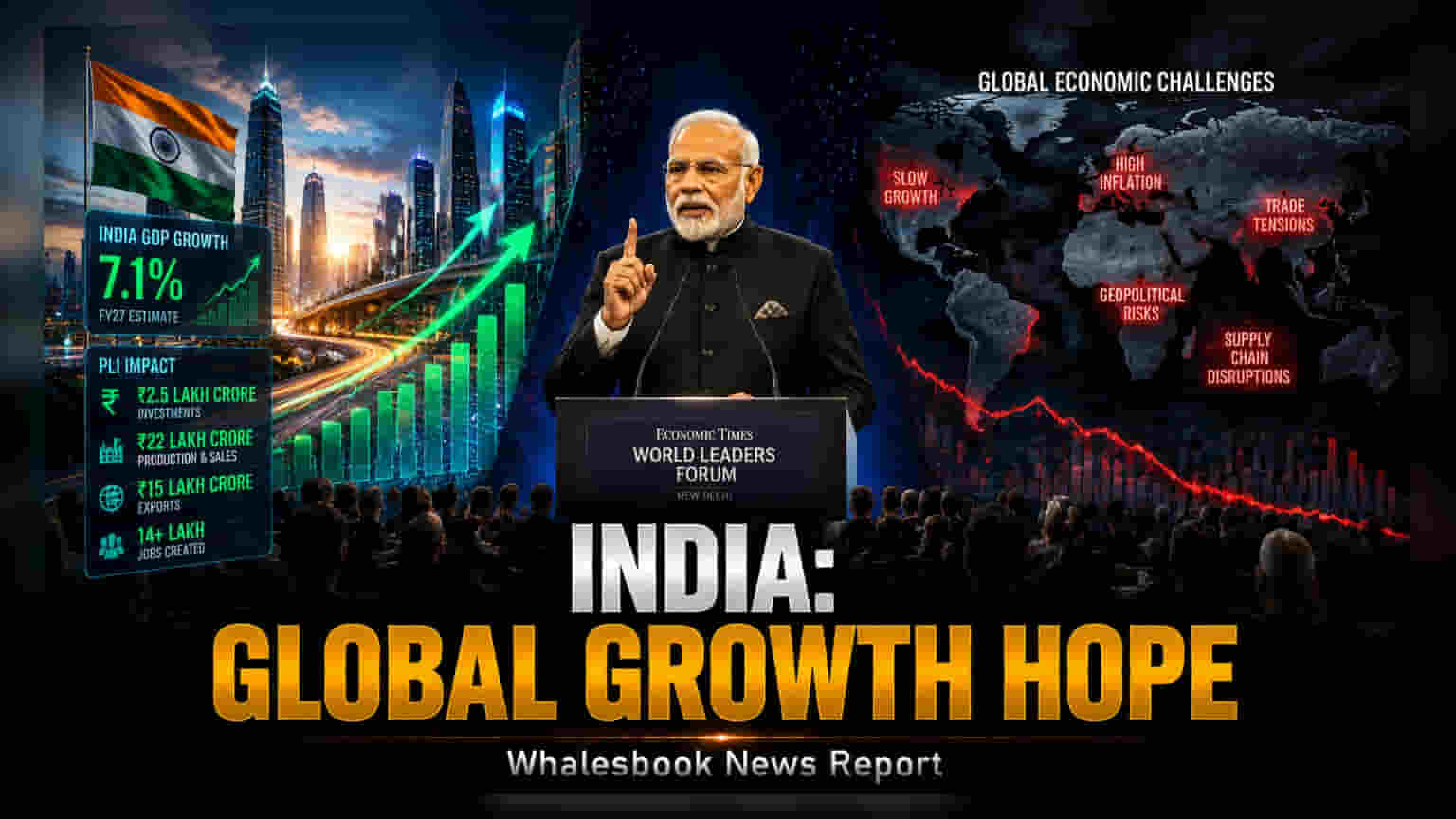
Prime Minister Narendra Modi addressed the Economic Times World Leaders Forum, positioning India as a global growth beacon driven by policy stability and reforms. He highlighted the success of the PLI scheme, which has attracted ₹2.5 lakh crore in investments and created over 14 lakh jobs. For investors, the government’s focus remains on maintaining a predictable, 'permitted-unless-prohibited' regulatory environment to sustain long-term economic momentum.
Prime Minister Narendra Modi addressed the Economic Times World Leaders Forum in New Delhi on Friday, characterizing India as a "bright spot of growth and hope" amidst a challenging global economic climate. The Prime Minister emphasized that his government’s approach to governance is rooted in political stability and policy continuity, which he argued provides a predictable environment for businesses and investors.
Shifting the Regulatory Paradigm
A central theme of the Prime Minister's address was the government’s transition toward a more enabling regulatory framework. He described a shift from a historical "prohibited-unless-permitted" model to a modern "permitted-unless-prohibited" approach. This change is intended to reduce bureaucratic friction and promote ease of doing business across sectors. By moving away from restrictive administrative processes, the government aims to encourage private sector participation and innovation, which are critical components of long-term economic expansion.
Impact of Production Linked Incentives
The Prime Minister specifically highlighted the success of the Production Linked Incentive (PLI) scheme, which he contrasted against the restrictive industrial policies of the past. Data shared by the government indicates that the scheme has been a significant catalyst for industrial activity, facilitating ₹2.5 lakh crore in investments. Furthermore, the initiative has supported ₹22 lakh crore in total production and sales, with exports under the scheme reaching ₹15 lakh crore. Beyond capital expenditure, the scheme has reportedly led to the creation of over 14 lakh jobs, illustrating the government's focus on linking industrial growth with domestic employment.
Investor Perspective on Economic Stability
For investors and market participants, the emphasis on policy consistency is a critical monitorable. Political and policy stability are often viewed as foundational for long-term capital allocation, especially when global markets face volatility and geopolitical risks. However, while the government remains focused on domestic manufacturing and reforms, investors often look at broader macroeconomic indicators to gauge the health of the economy. These include corporate earnings growth, sector-specific valuations, and the impact of global trade conditions on domestic industry.
Macroeconomic Context and Risks
While the government promotes India as a resilient growth hub, market analysts note that the domestic economy remains interconnected with global trends. High valuations in certain equity sectors, combined with the volatility of foreign portfolio investment (FPI) flows, continue to be areas of interest for institutional observers. Additionally, the challenge for the domestic industry lies in executing large-scale projects efficiently while navigating potential global headwinds such as supply chain disruptions and fluctuations in commodity prices. The government's ability to maintain its reform trajectory while managing these macro-financial pressures will likely remain the key factor for sustained economic and market performance in the coming quarters.