

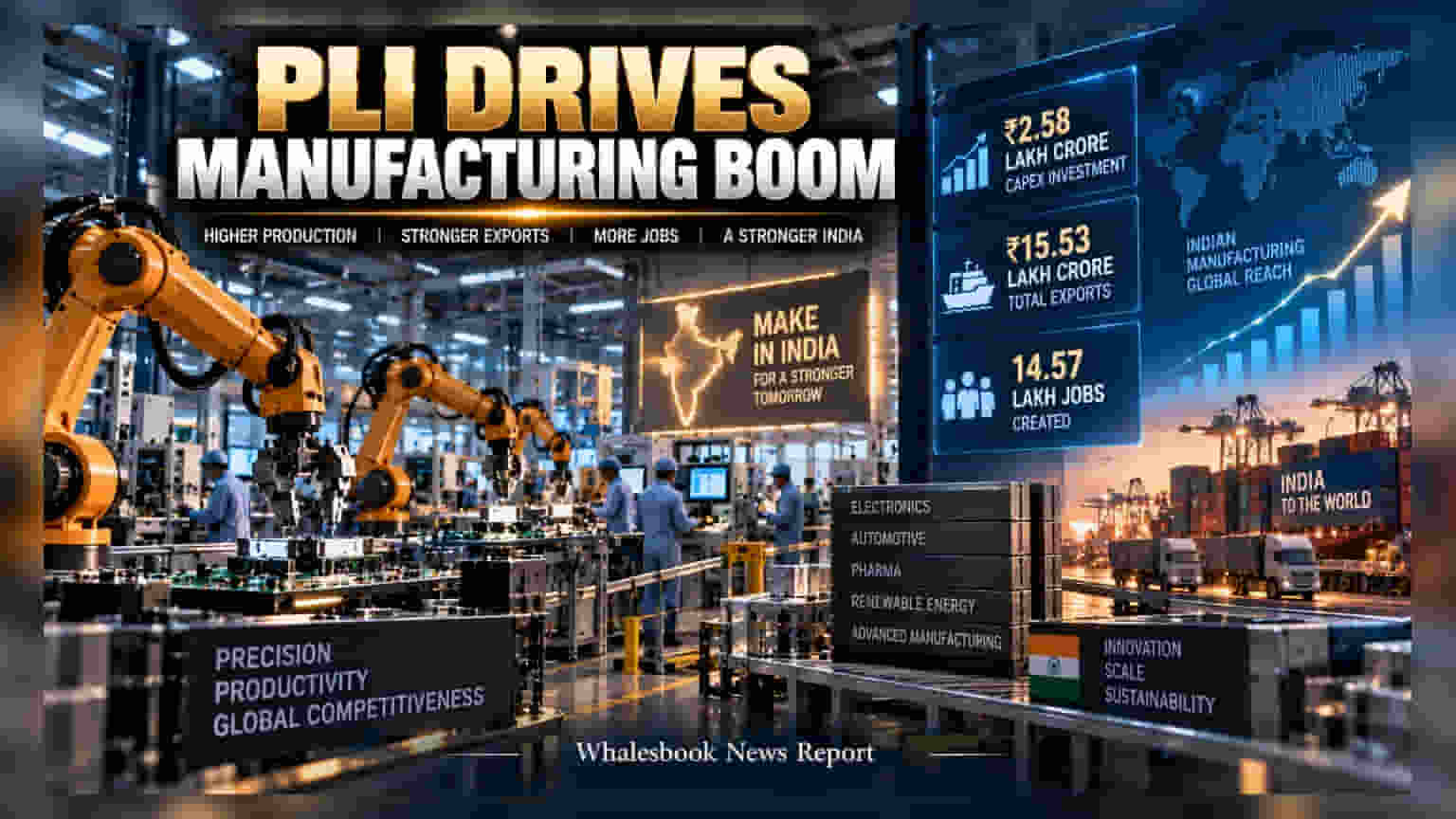
India’s manufacturing sector has reached a milestone with ₹2.58 lakh crore invested via Production Linked Incentive (PLI) schemes. This has helped generate ₹15.53 lakh crore in exports and created over 14 lakh jobs. For investors, this shift toward high-value, tech-integrated production offers growth opportunities, though challenges in supply chain and regulatory compliance remain.
The Make in India initiative has reached a notable phase in its evolution, with the manufacturing sector now moving from basic capacity building to more advanced, high-value production. According to recent data, the Production Linked Incentive (PLI) schemes have played a central role, driving ₹2.58 lakh crore in capital spending. This effort has led to ₹15.53 lakh crore in total exports and the creation of approximately 14.57 lakh jobs across various industrial sectors.
At its core, the PLI model provides financial incentives to companies based on their incremental production and sales targets. This structure encourages firms to not only expand their output but also to improve efficiency and integrate into global value chains. For investors, the significance lies in the changing nature of Indian manufacturing. The objective is no longer just to replace imports with domestic goods, but to build deep technical capabilities and create advanced production clusters that can compete globally. Programs like PM GatiShakti and the National Industrial Corridor Development Programme are currently providing the infrastructure backbone intended to lower logistics costs and improve the speed of moving goods.
However, the path toward becoming a global manufacturing hub involves specific operational realities. The Confederation of Indian Industry has noted that future growth will depend on how effectively companies can integrate advanced technologies and strengthen localized supply chains. While the capital inflow is strong, the ability of medium-sized enterprises to navigate regulatory compliance remains a significant hurdle. These companies often face difficulty entering complex global networks due to the high cost of meeting global quality and safety standards.
Investors may also observe that the sustainability of this growth relies on deeper factors beyond just government incentives. The expansion of trade agreements, which now cover 38 countries, is expected to be a primary driver for export volumes. The long-term success for manufacturing companies will likely be measured by their ability to transition from simple assembly of imported components to building indigenous, technology-intensive products.
The next steps for market participants will involve monitoring how efficiently these projects move from the planning phase to full production. Companies that can maintain consistent profit margins while managing the challenges of global supply chain integration and domestic regulatory requirements will likely be better positioned. Future updates on project commissioning, actual export figures, and any further updates to compliance frameworks will provide clearer signals on the sector's long-term health.