 Whalesbook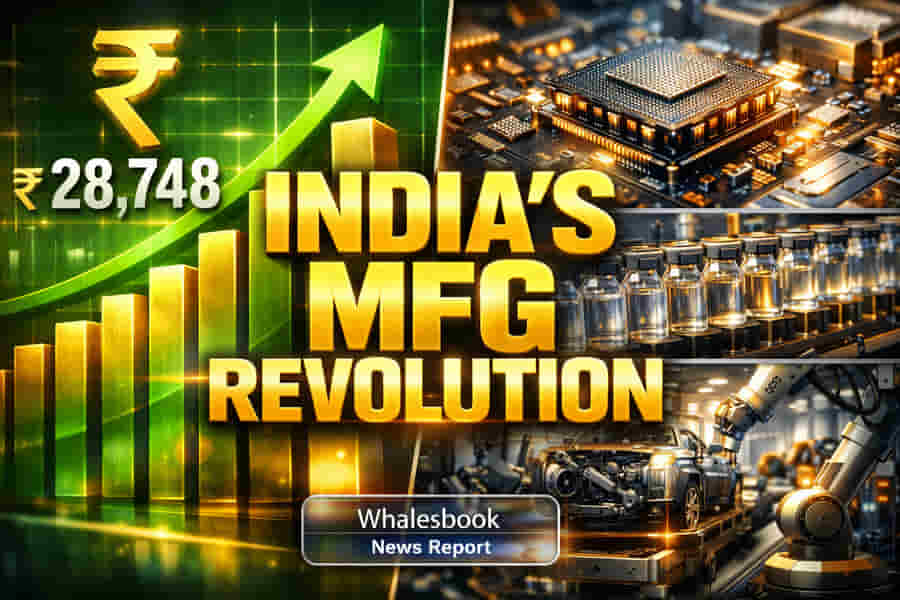
THE SEAMLESS LINK
The robust disbursement of ₹28,748 crore under India's Production Linked Incentive (PLI) schemes by December 2025 signifies a transformative phase in the nation's manufacturing journey. These incentives have catalyzed cumulative investments exceeding ₹2.16 lakh crore, translating into substantial production and export growth. Beyond mere output figures, the program's success is increasingly measured by its capacity to foster deeper integration into global value chains and achieve strategic import substitution across critical sectors, reshaping India's industrial competitiveness.
The Core Catalyst
The substantial financial backing from the PLI scheme is directly fueling sector-specific advancements. In electronics manufacturing, a near 77 percent reduction in mobile phone imports since FY 2020-21 has been achieved, with domestic production now meeting over 99 percent of demand. This progress extends beyond simple assembly to critical sub-assemblies like printed circuit boards and display modules, enhancing integration into global supply networks. The pharmaceutical sector has seen remarkable import substitution, with the PLI enabling the first-time domestic manufacture of 191 bulk drugs, achieving import savings of approximately ₹1,785 crore and boosting domestic value addition to 83.7 percent. The automotive sector reported sales of ₹32,879 crore in FY 2025-26, indicating momentum in electric mobility and advanced component manufacturing. Telecom and networking products have surged more than six-fold over their base year, with exports reaching ₹21,033 crore. Food processing has attracted over ₹9,200 crore in catalysed investments, targeting higher domestic value addition, while the solar module PLI aims for 48 GW of integrated manufacturing capacity with commitments of nearly ₹52,942 crore.
The Analytical Deep Dive
India's PLI strategy, while unique in its broad sectoral approach, aligns with global trends where nations offer incentives to bolster domestic manufacturing and attract investment, akin to initiatives like the US CHIPS Act. However, India's program spans a wider range of industries, aiming for scale across multiple value chains. Historically, sectors like electronics faced significant trade deficits; for instance, mobile phone imports exceeded exports by $3.3 billion in FY 2017-18. The PLI has demonstrably reversed this, fostering a substantial export surplus. Similarly, the pharmaceutical sector's heavy reliance on imported bulk drugs, particularly from China, is being systematically addressed, with domestic value addition targets set high. This national drive aligns with global supply chain reconfigurations and the "China Plus One" strategy, creating a favorable macro environment for Indian manufacturing. Yet, global volatility in raw material prices, such as polysilicon for solar production, can still introduce risks.
⚠️ THE FORENSIC BEAR CASE
Despite the positive aggregate figures, a deeper examination reveals potential headwinds. Implementation challenges, including delays in facility commissioning and upstream supply constraints, have been reported in sectors like solar modules, posing financial risks for awardees. The scheme's uniform incentive structure may not suit the diverse needs of all sectors; for example, smaller textile exporters are often excluded due to high investment thresholds, while capital-intensive industries face hurdles meeting targets. Job creation, while significant with over 1.4 million jobs reported, has faced scrutiny, with some analyses suggesting that technology-driven sectors inherently create fewer direct jobs. Concerns persist about long-term sustainability if companies become overly dependent on subsidies rather than achieving organic cost competitiveness. While substantial funds have been disbursed, earlier reports highlighted potential delays in subsidy payments and the need for clearer disbursement processes. Furthermore, WTO regulations can limit the direct linkage of subsidies to domestic value addition, potentially leading to continued reliance on imported components.
The Future Outlook
The future trajectory of India's manufacturing ambitions hinges on continuous policy refinement and strong industry-government collaboration. Strategies are evolving to enhance backward integration and component manufacturing, critical for deeper value chain embedding. The government is actively exploring alternative support mechanisms, including tax benefits and infrastructure enhancements, alongside the existing PLI framework. The ongoing focus on deepening localization and strengthening India's manufacturing base is expected to persist, aiming to establish the nation as a formidable global production hub.