

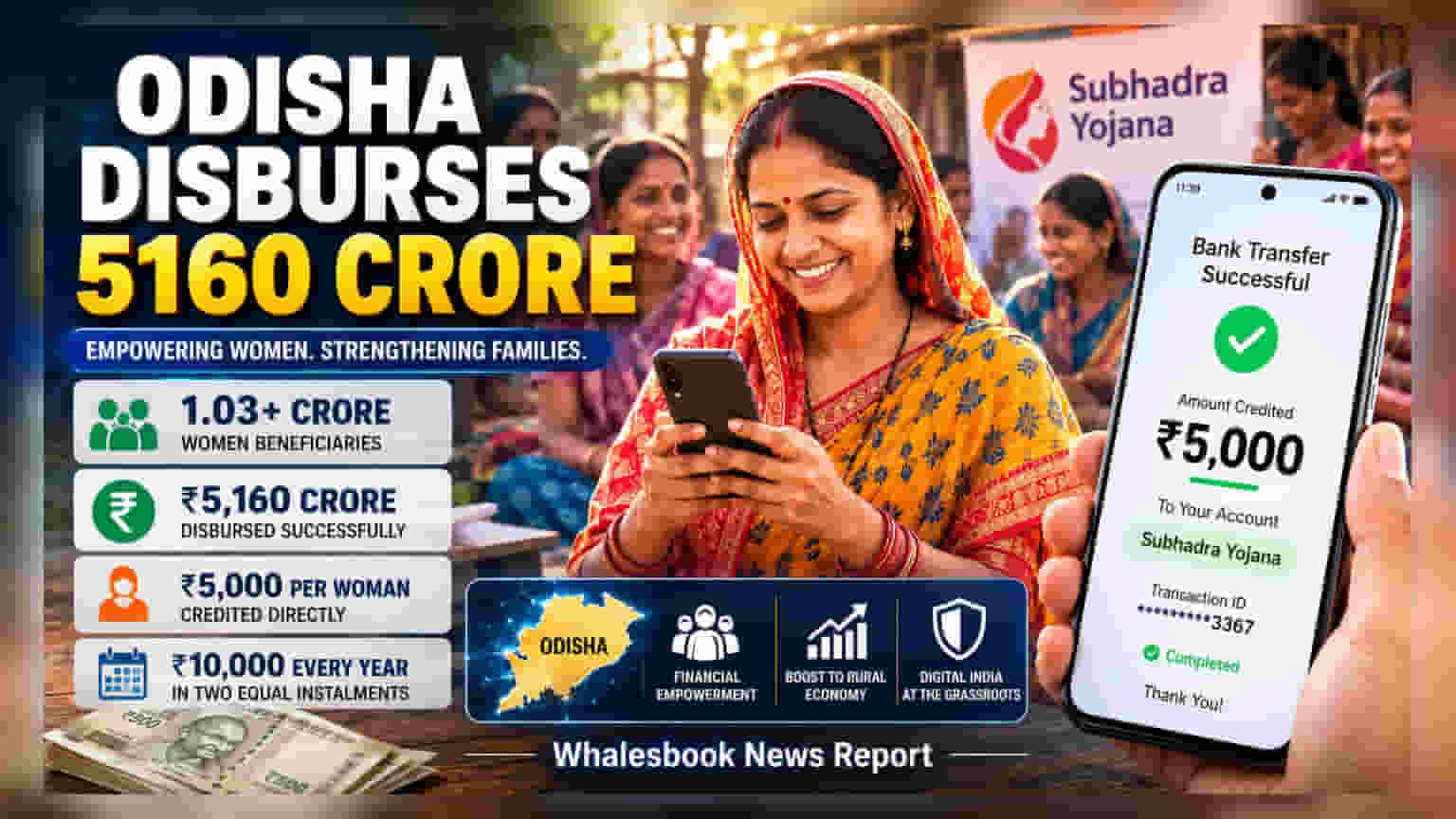
The Odisha government has disbursed ₹5,160 crore to over 1.03 crore women as the latest installment of the Subhadra Yojana. Each eligible beneficiary received ₹5,000 via direct bank transfer. For the broader economy, such large-scale welfare spending impacts rural household cash flow, which can influence consumption patterns and state fiscal management.
The government of Odisha has successfully completed a large-scale disbursement under the Subhadra Yojana, transferring a total of ₹5,160 crore to more than 1.03 crore women. Each eligible beneficiary received a credit of ₹5,000 directly into their registered bank accounts via the Direct Benefit Transfer system. This latest phase included 2.21 lakh new recipients, reflecting the ongoing expansion of the state's social welfare framework.
Launched in September 2024, the Subhadra Yojana is structured to provide ₹10,000 of financial support to eligible women every year. This annual amount is distributed in two equal tranches of ₹5,000 each, typically scheduled around significant occasions like Raksha Bandhan and International Women’s Day. Over a five-year window, the total support per beneficiary is planned at ₹50,000.
While this initiative is a public welfare program rather than a corporate event, it holds economic relevance for market observers. Large-scale government cash transfers are designed to bolster household liquidity. For the broader economy, sustained rural cash flows can influence consumption patterns, which is a factor that companies with a significant footprint in rural consumer goods or services often track to gauge local market sentiment.
From a fiscal viewpoint, the sustainability of large-scale welfare schemes remains a key area for observers of state-level economic policy. The state government is also focused on structural reforms to support rural productivity alongside these transfers. Recently, the administration formalized partnerships, including one with the Department of Posts, to integrate digital services at the local level. This includes streamlining registrations for programs like CM-Kisan, AgriStack, and Aadhaar seeding for agricultural participants. These efforts are aimed at digitizing rural services to reduce barriers for local communities. The long-term economic impact will depend on how effectively these cash transfers and digital infrastructure upgrades work together to support rural demand and household financial stability.