 Whalesbook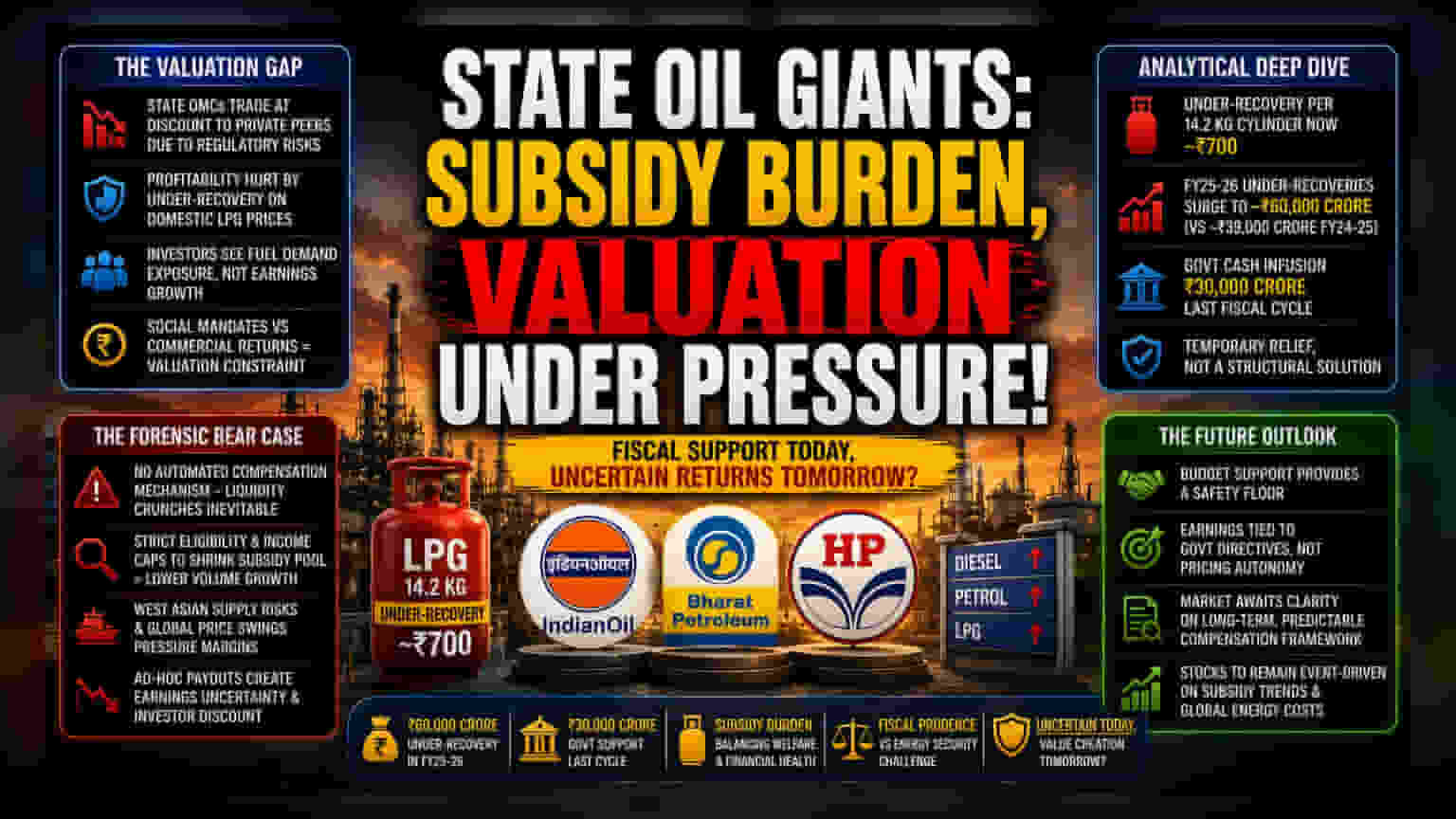


The Valuation Gap
Market sentiment regarding India's state-run oil marketing companies—specifically Indian Oil Corporation (IOC), Bharat Petroleum (BPCL), and Hindustan Petroleum (HPCL)—is increasingly tied to the delicate balance of government fiscal policy versus global energy costs. While these entities provide essential energy infrastructure, their profitability is structurally compromised by the requirement to sell domestic cooking gas at rates significantly below international parity. The current under-recovery per 14.2 kg cylinder, now reaching approximately ₹700, underscores the friction between maintaining social welfare mandates and preserving corporate earnings. Investors have historically viewed these companies as proxies for domestic fuel demand; however, the persistent need for government-led compensation cycles introduces a layer of regulatory and fiscal risk that often suppresses valuation multiples.
Analytical Deep Dive: The Subsidy Mechanism
The operational reality for OMCs involves a persistent exposure to international benchmarks, particularly the Saudi CP. When global LPG prices trend upward, the price differential is not fully captured at the retail pump. For fiscal year 2025-26, under-recoveries ballooned to roughly ₹60,000 crore, a stark increase from the previous fiscal year's figures. While the government has previously intervened with multi-tranche cash infusions—most notably the ₹30,000 crore package approved in the previous cycle—this support acts as a temporary stabilizer rather than a structural fix for margin volatility. Unlike private players who have more flexibility in commercial pricing, these OMCs face a unique burden: they are expected to function as commercial entities while bearing the primary fiscal cost of domestic energy inflation.
The Forensic Bear Case
From a risk-averse perspective, the reliance on ad-hoc government compensation is a structural weakness. There is no automated, recurring mechanism that perfectly offsets these losses in real-time, leading to periodic liquidity crunches. Furthermore, the push for aggressive digital authentication and strict eligibility verifications—including income-based subsidy caps—reveals a government intent to contain costs by shrinking the total subsidy pool. This strategy, while fiscally prudent for the state, may lead to lower aggregate volume growth for OMCs. Additionally, the unpredictability of West Asian energy supply chains and their direct influence on import costs poses a constant threat of margin compression that is difficult to hedge against.
The Future Outlook
Analysts remain divided on the long-term impact of these subsidy trends. While institutional support through budget allocations provides a safety floor for these stocks, the lack of pricing autonomy ensures that their earnings will continue to be heavily influenced by Ministry of Petroleum & Natural Gas directives. Forward-looking guidance remains tethered to the assumption that global volatility will necessitate sustained government assistance, though market participants continue to look for clearer signals on whether the current compensation model will evolve into a more predictable, transparent payout framework.