

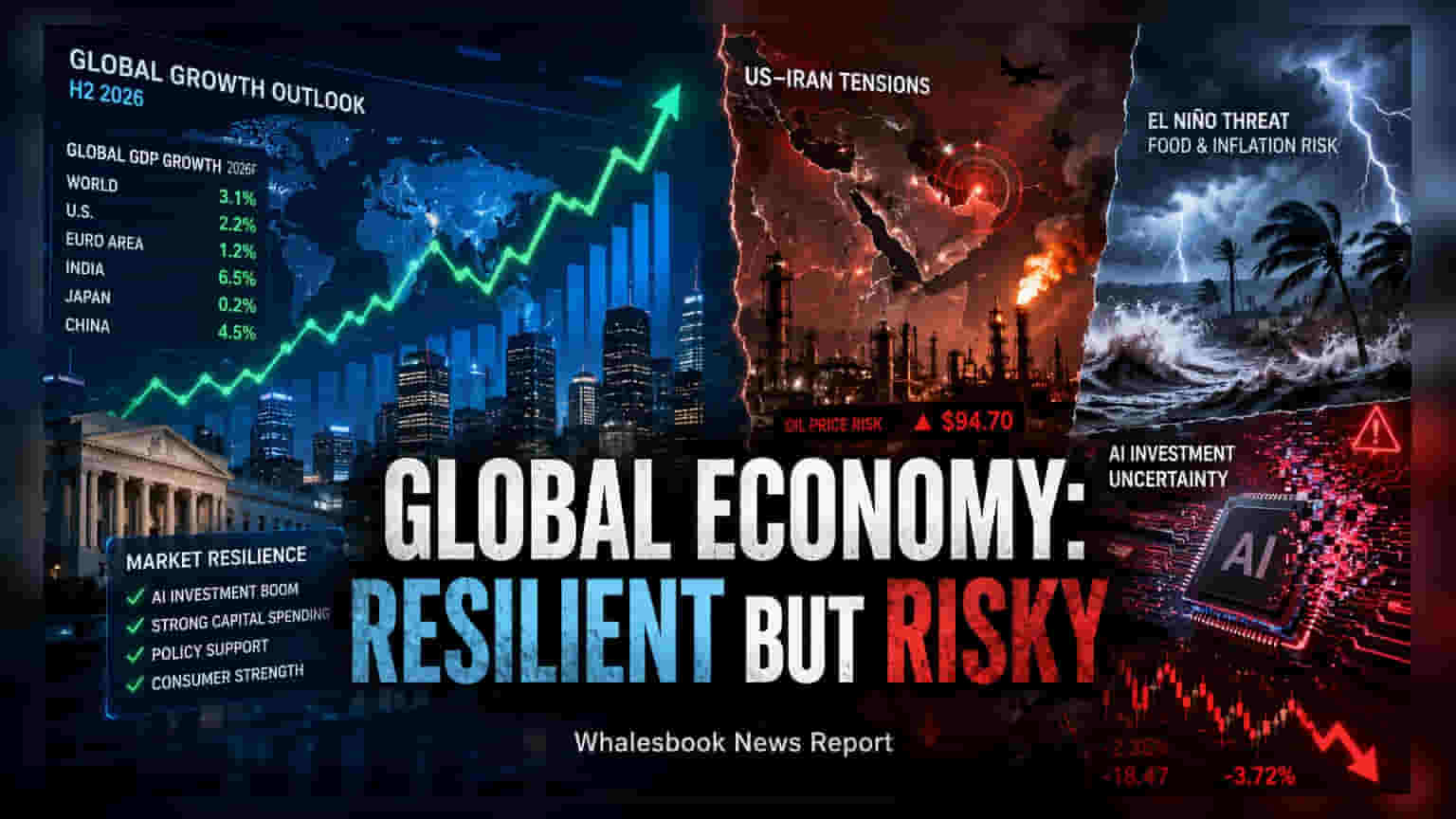
Nomura expects the global economy to show resilience in the second half of 2026, driven by AI investment and government stimulus. However, investors face risks from US-Iran tensions, the El Niño weather phenomenon, and persistent global inflation.
Financial services firm Nomura released its global economic outlook for the second half of 2026, predicting that the world economy will maintain its resilience despite a challenging environment. The report notes that global markets weathered energy price shocks and rising bond yields in the first six months of the year, aided by strong capital spending on Artificial Intelligence (AI) and government policy support.
In the United States, economic growth remains solid, supported by the 'One Big Beautiful Bill Act' (OBBBA) and persistent investment in AI. While business spending is broadening beyond the tech sector and consumer income remains stable, core inflation continues to challenge the Federal Reserve's 2% target. Nomura forecasts core inflation to hover around 3.2% in the fourth quarter of 2026, suggesting that the US central bank may maintain current interest rates for the time being.
Despite the generally positive growth outlook, Nomura identified several risks that could dampen global momentum. Tensions between the US and Iran remain a concern, as any escalation could disrupt energy supply and cause market volatility. Additionally, the El Niño weather phenomenon poses a threat to global food supplies and inflation, while potential setbacks in the ongoing AI investment cycle could weigh on productivity gains. Central banks globally are also navigating a difficult path as they adjust their future policy guidance.
Different regions show varying economic paths. In the Euro Area, persistent inflation continues to be a hurdle, with Nomura expecting one more interest rate hike from the European Central Bank in September. Japan is facing a projected economic contraction for the third quarter of 2026 due to weaker export demand, though the Bank of Japan is expected to continue with interest rate hikes to manage monetary policy.
For investors tracking the Asian region, Nomura holds a positive view on India, describing its economic outlook as 'brightening.' While other Asian economies like Indonesia, Malaysia, and South Korea face potential policy tightening to manage inflation, India and Thailand are expected to keep interest rates steady. The semiconductor industry continues to support growth in countries like Taiwan and South Korea, which are benefiting from the current chip supercycle.
Investors looking ahead may monitor how geopolitical developments in the Middle East and weather-related disruptions influence global energy and food prices, as these factors often have a direct impact on inflation trends and central bank decisions worldwide.