

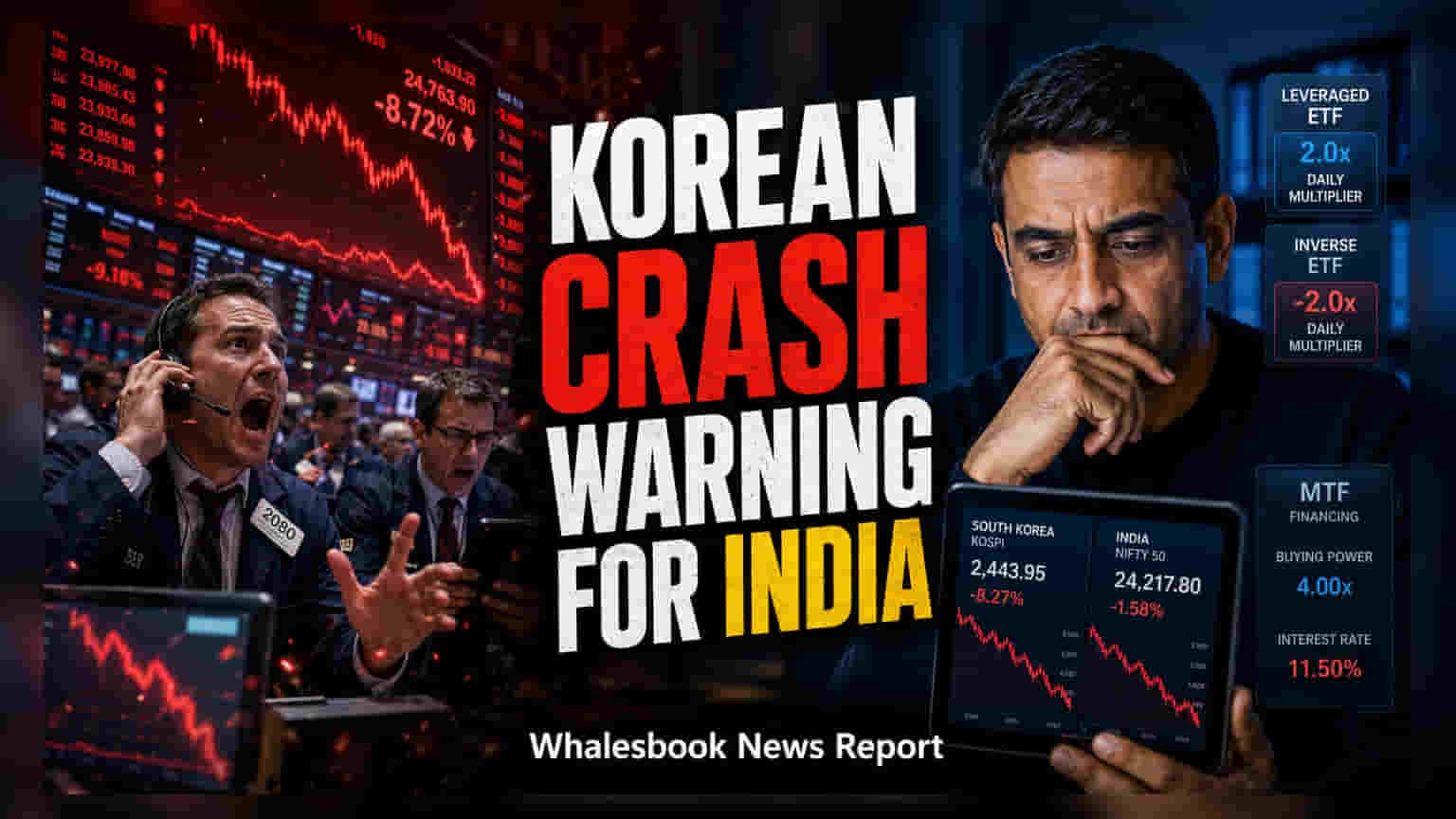
Zerodha founder Nithin Kamath has cautioned against rising debt levels in India's Margin Trading Facility (MTF) book, now estimated at approximately $15 billion. The warning follows market volatility in South Korea linked to leveraged products. Kamath highlighted that significant borrowing is being directed into illiquid stocks, which could face severe liquidity issues during a market downturn.
The recent volatility in the South Korean stock market, driven by leveraged investment products, has prompted a cautionary note regarding similar trends within the Indian financial ecosystem. Nithin Kamath, founder of the brokerage firm Zerodha, recently highlighted structural risks associated with the rapid growth of the Margin Trading Facility (MTF) in India.
The Mechanics of Market Risk
In South Korea, the market faced instability due to single-stock leveraged ETFs. These instruments allowed investors to amplify their exposure to large companies. Because these ETFs require daily rebalancing to maintain their leverage ratios, they often create a feedback loop where managers are forced to buy into rising markets and sell into falling ones, often worsening price fluctuations.
MTF Growth and Liquidity Concerns in India
India’s MTF market has grown significantly, reaching an estimated value of $15 billion, or approximately ₹1.25 lakh crore. While this represents a fraction of the overall cash market turnover, the primary concern lies in the quality of the collateral and the nature of the stocks being traded on margin. According to insights shared by the Zerodha founder, a notable portion of this MTF book is deployed in illiquid stocks that do not trade in the Futures and Options (F&O) segment.
When retail investors use borrowed money to buy stocks that lack high trading volumes, they face a unique danger. In the event of a market correction, these stocks can quickly hit lower circuits. This limits the ability of investors to sell their holdings, potentially leading to forced liquidations where the broker must sell collateral to recover the loan, further depressing stock prices.
Regulatory Impact and Investor Behavior
Recent changes by the Securities and Exchange Board of India (SEBI) regarding equity derivatives have increased the cost of trading single-stock futures and options. Consequently, some traders have shifted their activity toward MTF products. These facilities are attractive because they do not involve rollover costs and allow for smaller position sizes compared to the standardized contracts found in the derivatives segment.
However, the underlying risk of leverage remains unchanged regardless of the product used. Many retail participants continue to use borrowed capital to increase positions in underperforming or highly volatile shares. This behavior, often seen as an attempt to recover losses by doubling down on falling assets, can turn standard market corrections into much sharper declines. For investors, the key monitorable remains the composition of their portfolio and the extent of reliance on borrowed capital, as liquidity often vanishes precisely when it is needed most during periods of market stress.