

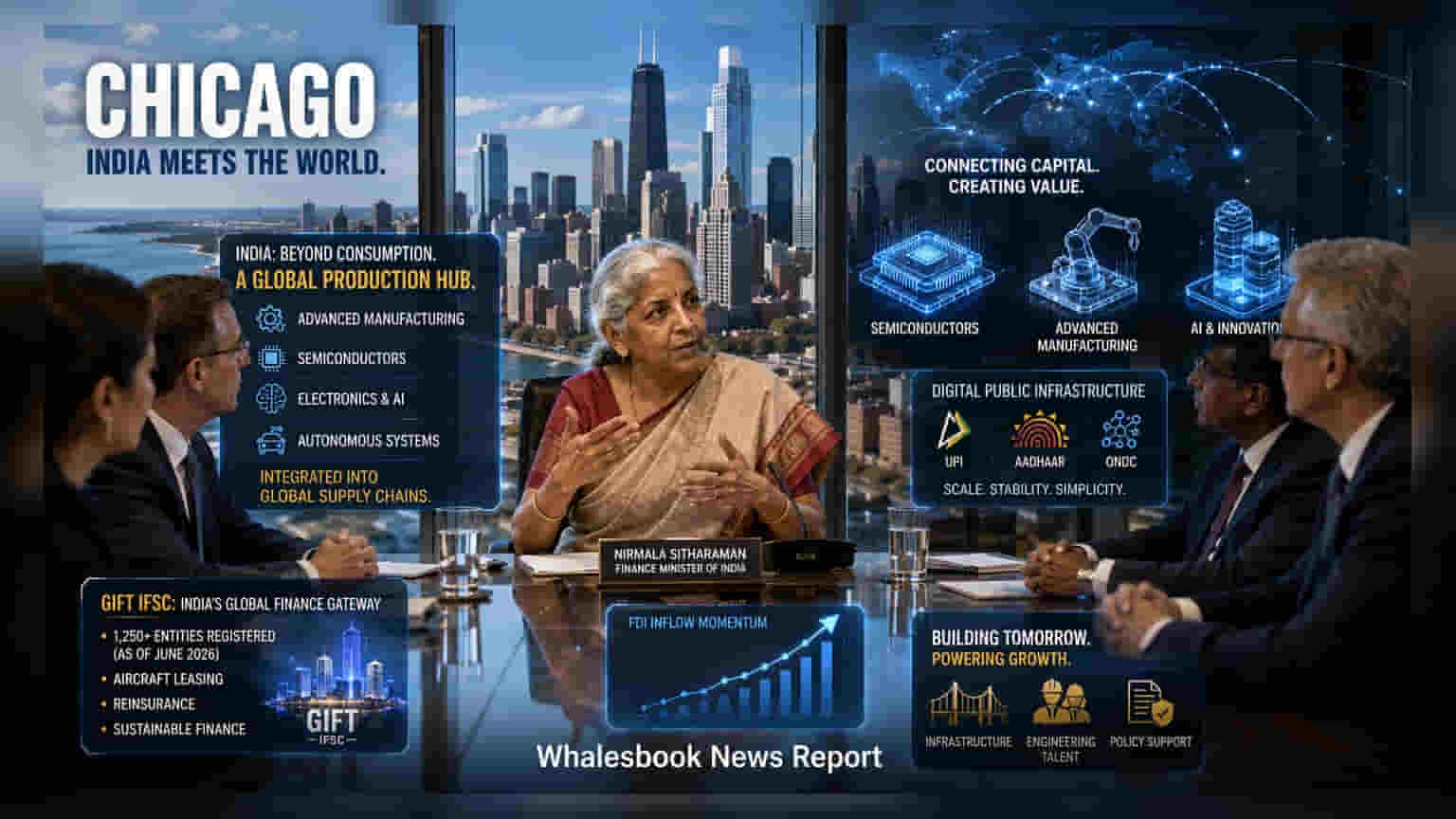
Finance Minister Nirmala Sitharaman is urging investors in Chicago to view India as a strategic manufacturing and innovation base, shifting focus beyond its role as a consumer market. This push aims to attract capital into high-tech sectors like semiconductors and AI, supported by India’s expanding digital infrastructure.
Finance Minister Nirmala Sitharaman has been meeting with business leaders in Chicago to reframe India’s economic profile for international investors. During her visit, she emphasized that India should no longer be viewed primarily as a large consumer market. Instead, the government is actively positioning the nation as a strategic platform for global manufacturing, high-value engineering, and technological innovation.
Targeting Advanced Manufacturing and Tech
The central message of this diplomatic and economic tour is to integrate India deeper into global supply chains. The government is specifically targeting capital for advanced sectors, including semiconductor manufacturing, electronics, artificial intelligence, and autonomous systems. This strategy relies on existing policies like the Production-Linked Incentive (PLI) schemes, which are designed to encourage large-scale component manufacturing rather than simple product assembly. By promoting this shift, officials aim to convince global firms to utilize India’s growing engineering talent pool and infrastructure for their long-term production needs.
Leveraging Digital and Financial Infrastructure
A key pillar of this pitch is the strength of India’s digital public infrastructure. The minister highlighted the scale and stability of systems like UPI, Aadhaar, and ONDC, arguing that they reduce operational friction for new businesses entering the market.
Parallel to this, GIFT City is being marketed as a vital link for international financial services. As of June 2026, the GIFT International Financial Services Centre (IFSC) has registered over 1,250 entities. The facility is increasingly focusing on specialized financial activities such as aircraft leasing, reinsurance, and sustainable finance. For institutional investors, this represents an effort to provide a more flexible environment for cross-border capital management.
Strategic Risks and Outlook
While the government aims to capture a larger share of foreign direct investment through this strategy, investors often track the execution of these complex policy frameworks. The success of manufacturing expansion depends on the sustained implementation of incentives and infrastructure spending. Additionally, operating in international financial hubs requires navigating evolving regulatory compliance standards, including recent updates to financial crime prevention rules in GIFT IFSC.
This engagement in Chicago follows a recent trade-focused visit to Canada and serves as a lead-up to the upcoming G20 Finance Ministers' meetings. The minister is scheduled to head the Indian delegation at the G20 FMCBG meetings, which will take place in Asheville, North Carolina, on August 31 and September 1, 2026. Investors may look to these upcoming sessions for further updates on global economic cooperation and policy developments.