 Whalesbook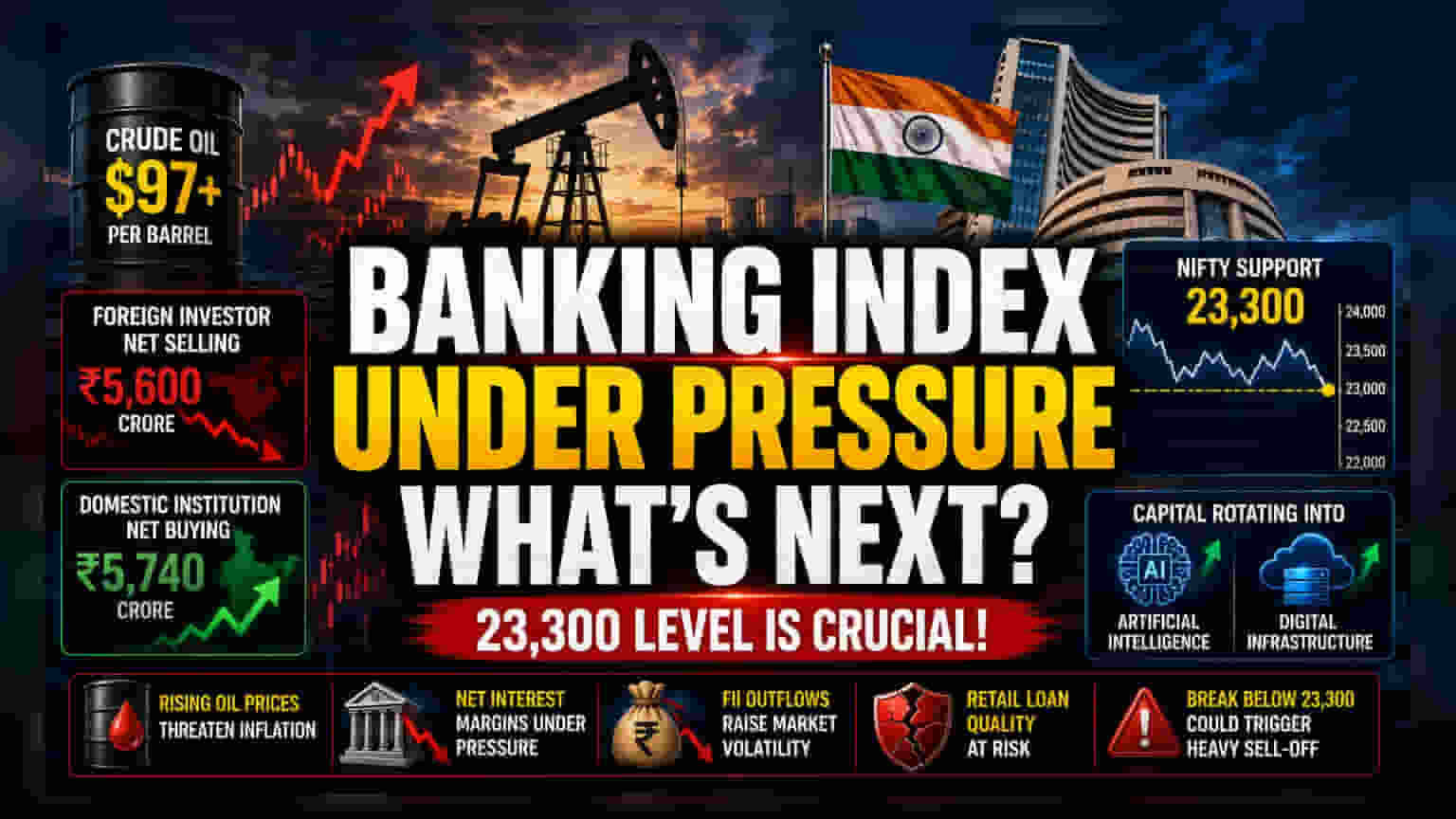


The Geopolitical Margin Squeeze
The recent rally in crude oil prices to the $97 per barrel threshold acts as a direct tax on the Indian economy, complicating the central bank’s inflation management efforts. Markets are increasingly sensitive to these energy price fluctuations because they threaten to compress net interest margins (NIMs) within the banking sector. As input costs rise and borrowing capacity potentially tightens, the banking index has become the primary site for institutional liquidation. This sensitivity is heightened by the current fiscal backdrop, where persistent geopolitical friction has forced a re-evaluation of valuation multiples across interest-rate-sensitive industries.
Institutional Divergence and Market Stability
Data from the National Stock Exchange highlights a distinct shift in capital allocation strategies. Foreign institutional investors withdrew over ₹5,600 crore on the most recent trading session, marking a departure from the bullish sentiment observed earlier in the quarter. This aggressive offloading is typically indicative of a flight to safety in response to global macro instability. However, the domestic institutional base continues to act as a shock absorber, absorbing these outflows with nearly ₹5,740 crore in net purchases. This tug-of-war is currently preventing a technical breakdown below the 23,300 level on the Nifty, though the diminishing velocity of domestic inflows remains a point of concern for market bulls.
The Forensic Bear Case: Structural Vulnerabilities
Despite the resilience shown by the index, several structural weaknesses remain hidden beneath the surface. The heavy reliance on domestic institutional liquidity to neutralize foreign exits creates an artificial floor that may collapse if domestic retail and mutual fund sentiment shifts. Furthermore, the banking sector faces a dual threat: while rising oil prices pressure macro-economic stability, high-interest-rate environments are also beginning to show cracks in retail loan quality. The sector’s reliance on credit growth at a time when industrial input costs are inflating suggests that future earnings revisions may be downward, particularly for large-cap private lenders that lack the balance sheet flexibility of their smaller, niche competitors.
Future Outlook and Sectoral Rotation
The current rotation into Artificial Intelligence and digital infrastructure signals that capital is seeking growth areas less correlated with traditional commodity-based inflation. As traditional sectors face headwinds, the shift toward tech-driven thematic investing appears to be the primary strategy for institutional capital. Market participants should monitor the 23,300 support level closely; a failure to hold this psychological threshold would likely trigger a secondary wave of selling driven by automated risk-management systems.