

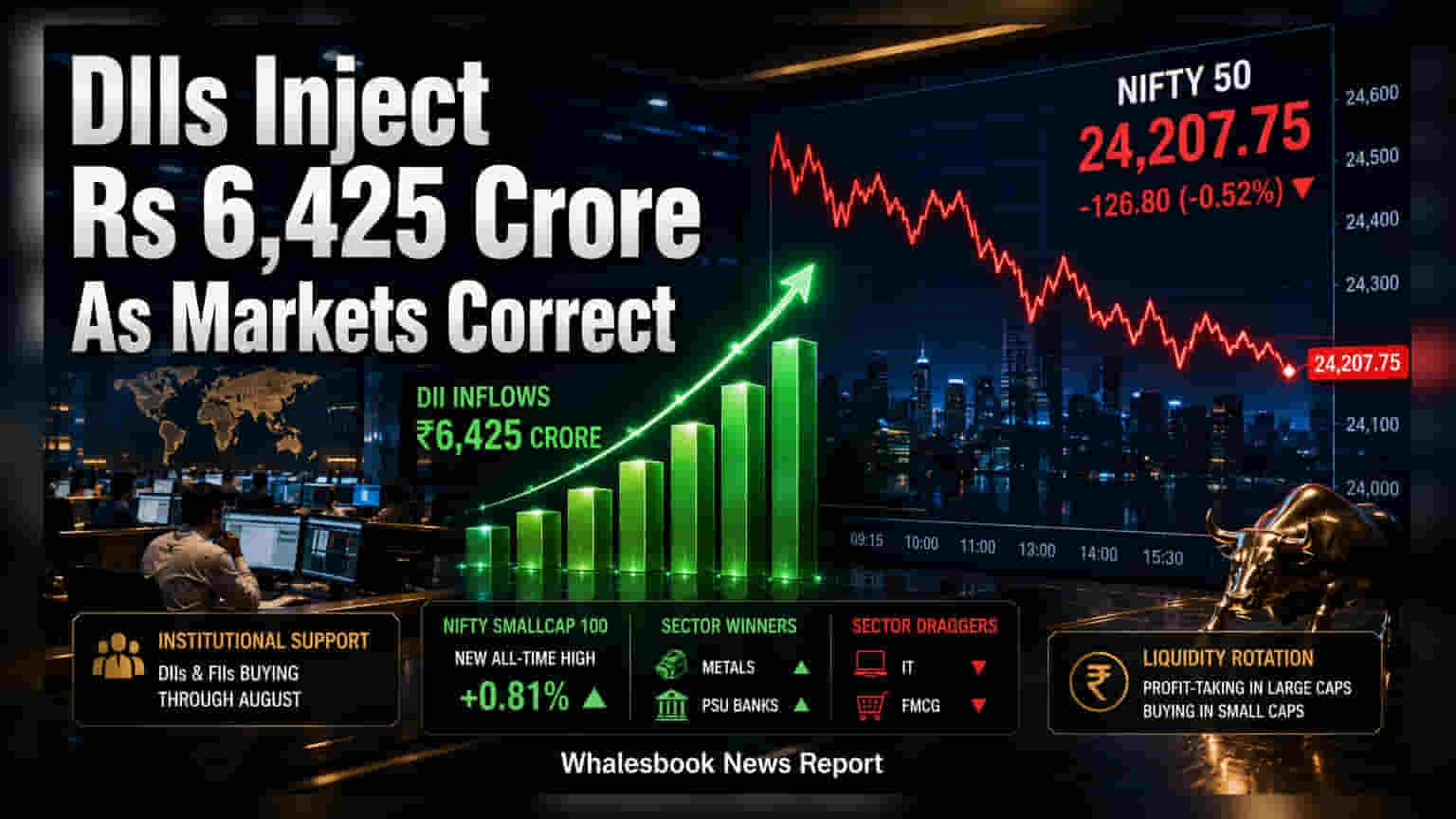
On August 26, 2026, the Nifty 50 fell 0.52% to 24,207, driven by selling in IT and FMCG stocks. Despite the benchmark decline, domestic and foreign investors continued their buying streak throughout August, providing support to the market. In a sign of shifting focus, the Nifty Smallcap 100 index climbed to a new all-time high, even as major large-cap benchmarks struggled under profit-taking.
The Indian stock market saw a day of contrasting trends on August 26, 2026. While the main benchmark indices ended the session in the red, there was clear evidence of continued support from big investors. The Nifty 50 index dropped 126.80 points, or 0.52%, to close at 24,207.75. Similarly, the BSE Sensex fell 183.15 points, ending at 77,472.94.
Despite the decline in the headline indices, the broader market remained active. Institutional investors—both domestic and foreign—have maintained a consistent buying streak throughout August. This sustained participation is helping to provide a floor for the market, even when large-cap stocks face selling pressure. Investors are currently weighing this liquidity support against global uncertainties that continue to create volatility.
Sector performance on Wednesday highlights why the main indices struggled. Heavyweight sectors such as IT and FMCG saw significant selling, which pulled down the Nifty 50 and Sensex. In contrast, sectors like metals and PSU banks managed to attract buying interest. The cooling of Brent crude oil prices, linked to easing tensions in the Strait of Hormuz, offered some relief to energy-dependent sectors, though this was not enough to boost the overall benchmark indices.
While large-cap stocks experienced profit-taking, the sentiment in the broader market was notably different. The Nifty Smallcap 100 index reached a new all-time high, closing with a gain of 0.81%. This divergence suggests that investors are actively rotating their money, moving away from large-cap shares that may be facing valuation concerns and into smaller companies with different growth expectations.
Looking ahead, market participants will likely monitor the sustainability of this sectoral rotation. The resilience of the smallcap segment indicates that liquidity is not exiting the market, but rather shifting focus. However, investors should also watch for further developments regarding global geopolitical risks, as these remain a primary factor influencing sentiment and currency trends. The balance between continuous institutional buying and the pressure on large-cap valuations will remain a key factor for the market in the coming sessions.