

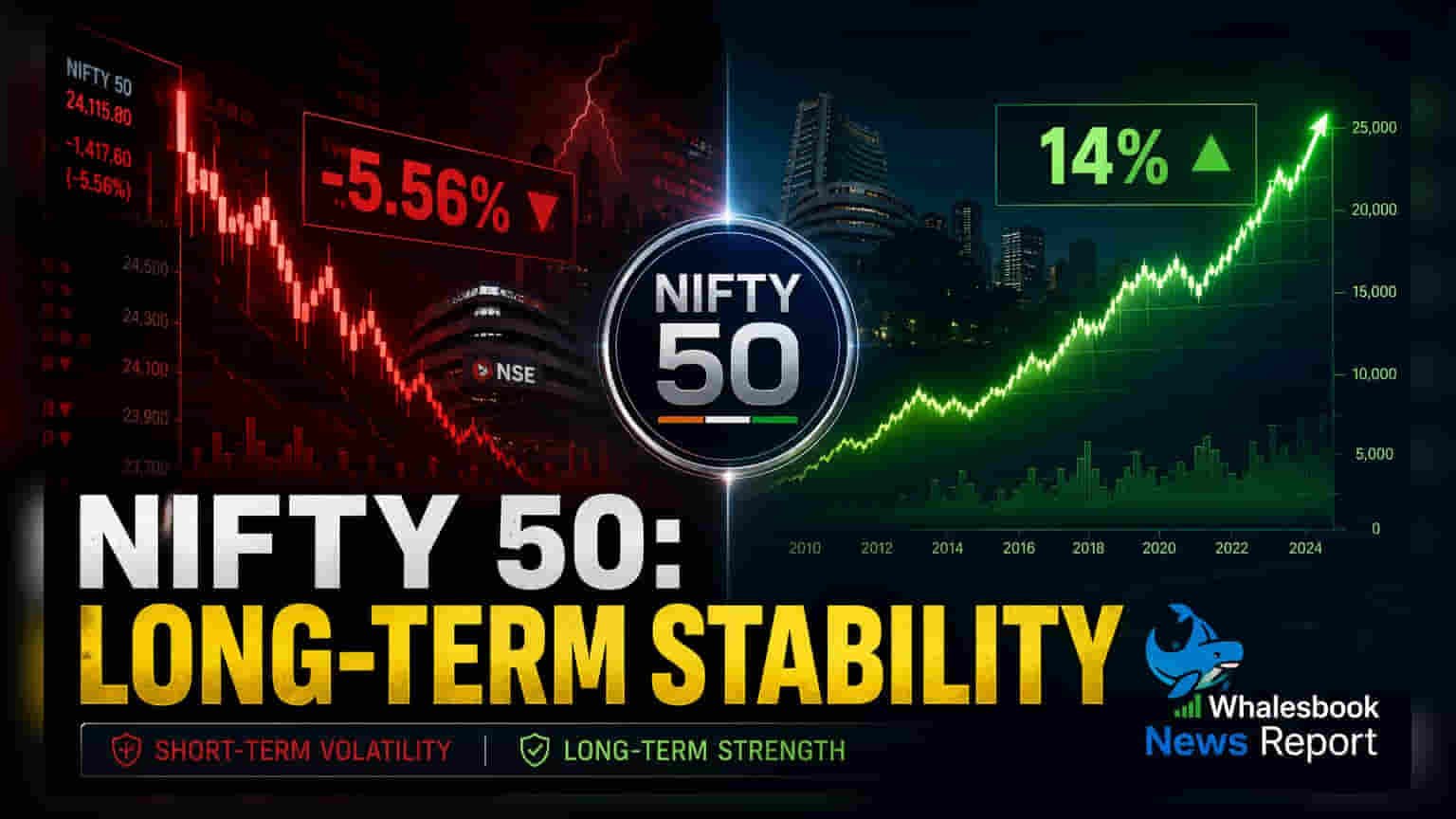
Analysis of the Nifty 50 Total Return Index (TRI) over two decades shows an average annual return of 14%. Despite current short-term volatility, where the index shows a one-year return of -5.56%, historical data suggests that longer holding periods significantly reduce the risk of loss. This highlights the value of patient, long-term investing over attempting to time the market.
What The 20-Year Data Shows
Recent analysis of the Nifty 50 Total Return Index (TRI) indicates that keeping investments for 20 years has historically delivered an average annual return of 14%. While the index is currently experiencing short-term volatility with a one-year performance of -5.56%, the long-term perspective shows a much more stable outcome for investors who stayed invested through different market cycles.
Looking back at market data from 2000 to 2025, researchers found that the range of returns narrows significantly over two decades. Regardless of whether an investor started during a market peak or a recession, the historical outcomes stayed within a consistent range of 11% to 16% per year over a 20-year horizon.
Why Short-Term Volatility Matters Less
The difference between short-term and long-term results is significant. An investment held for only one year can fluctuate wildly, with past data showing results ranging from a 65% loss to a 141% gain, depending heavily on the specific entry date. This high level of uncertainty makes market timing—the attempt to predict the exact right time to buy or sell—a difficult strategy.
Experts note that as the holding period increases, this variability decreases. The smoothing effect of time helps cancel out short-term market noise, global economic shocks, and localized volatility, allowing the underlying growth of the companies within the Nifty 50 to drive returns.
Understanding Total Return
The analysis focuses on the Total Return Index (TRI), which is different from the standard Nifty 50 price index. The TRI includes price appreciation and dividends paid by the companies in the index. For long-term investors, the reinvestment of dividends is a powerful engine for wealth creation, as it allows for compounding returns over many years. Relying on price-only data often underestimates the actual gains achieved by shareholders.
Strategies For Long-Term Investing
Market professionals emphasize that viewing performance through a narrow lens can lead to poor decision-making. Relying on Systematic Investment Plans (SIPs) is often cited as a practical way to manage volatility. Through a process known as rupee-cost averaging, investors purchase more units of an index when prices are low and fewer when prices are high. This systematic approach reduces the need to time the market and lowers the average purchase cost over time.
Chintan Kamdar, Founder of Digi-Finmart Private Limited, suggests that investors should look at rolling returns—a method that calculates average returns over specific overlapping periods—rather than point-to-point figures, which can be misleading depending on the start date. Subhendu Harichandan, Executive Director at Anand Rathi Wealth, adds that the primary focus for any investor should be achieving specific financial goals rather than reacting to short-term market movements. He suggests that periods of market correction can be seen as opportunities to accumulate assets for the long term.